I suppose it's a commonplace in a lot of cities that people who live there tend not to take full advantage of everything that's going on: daily routine takes over so easily, especially in London with its long commuting times.
I don't have that much of an excuse for never having been - in ten years - to a performance at our local performance space - a converted Presbyterian chapel - (since I've been to the café upstairs often enough). It's only about five minutes' walk away, but somehow nothing ever quite caught my eye there: until this weekend, when I saw (another advantage of going past on a bike rather than a bus) that there would be someone singing tango songs by Carlos Gardel and Astor Piazzolla.
Years ago, I got the chance of a business trip to Buenos Aires. I'm not sure I'd want to go back again (the diet seemed almost entirely meat-based - a pasty for starters, a huge slice of roast beef for a main dish: by the end of the week I'd have killed for a lettuce leaf), but it was an adventure, and I was especially taken by the "proper" tango music. They even had a TV channel devoted solely to tango lessons and performances, and not the kind of ballroom tango that's been so easily sent up in TV comedies.
Of course, I'm far too English to imagine ever being able to dance it (it's quite enough to hang on to the idea of playing the spoons as my fantasy someday talent), but that doesn't take away from the enjoyment of listening to it. Unfortunately something about the performance (maybe the space and the acoustic, but probably trying to present them as art songs with just a voice/piano combination) didn't quite get the tension and emotion across last night. Maybe it all depends on the contrast between the bandoneon and sweet and swooping strings:
Monday, 29 September 2008


Friday, 26 September 2008
Tutu much....
My spendy mood the other week also led to my booking a theatre trip - to see the Trocks. I've seen them a few times over the last 20+ years, so I booked for the programme that seemed to have unfamiliar things. I couldn't resist something described as "The underwater scene from The Little Humpbacked Horse", but (shows how much I know) it turns out to be genuinely part of the ballet repertoire, a sort of pre-Nutcracker Christmas treat in Imperial Russia, with dancing jellyfish, no less.
You will gather that this is not for the entirely serious balletomane: a company of - sometimes quite hefty - male dancers performing en travesti to pastiche the conventions and formalities of (mostly) classical ballet. The tone is set by the opening announcements in a heavy cod-Rrrraahsian accent ("Pl-yease to turn aff your mobile ph-yones, or ve vill do it for you."): all the clichés and absurdities of the style are guyed, fixed smiles remaining firmly in place, even as a six-footer is paired with a minuscule support, dancers miss the follow-spot, tread on someone else's toes, steal each other's thunder and so on. But the point is, they do actually do the dance: they really do waft across the stage on point, or do umpteen fouettés (twice in the course of the evening, on this occasion).
The audience was not that different from what you expect at most high-culture events in London. Perhaps slightly more student-y (Sadlers Wells rather than Covent Garden) and a fair smattering of gentlemen who "dance at the other end of the ballroom", and some people who probably know exactly how some of the classics should be danced, to judge from some (to me) inexplicable laughter at some points.
Alternative programme or no, a (traditional) change of programme saw Madame Ida Nevaseyneva giving us her dying swan (again), but I've posted that Youtube clip before - so here's another example of what they can do:
You will gather that this is not for the entirely serious balletomane: a company of - sometimes quite hefty - male dancers performing en travesti to pastiche the conventions and formalities of (mostly) classical ballet. The tone is set by the opening announcements in a heavy cod-Rrrraahsian accent ("Pl-yease to turn aff your mobile ph-yones, or ve vill do it for you."): all the clichés and absurdities of the style are guyed, fixed smiles remaining firmly in place, even as a six-footer is paired with a minuscule support, dancers miss the follow-spot, tread on someone else's toes, steal each other's thunder and so on. But the point is, they do actually do the dance: they really do waft across the stage on point, or do umpteen fouettés (twice in the course of the evening, on this occasion).
The audience was not that different from what you expect at most high-culture events in London. Perhaps slightly more student-y (Sadlers Wells rather than Covent Garden) and a fair smattering of gentlemen who "dance at the other end of the ballroom", and some people who probably know exactly how some of the classics should be danced, to judge from some (to me) inexplicable laughter at some points.
Alternative programme or no, a (traditional) change of programme saw Madame Ida Nevaseyneva giving us her dying swan (again), but I've posted that Youtube clip before - so here's another example of what they can do:
Monday, 22 September 2008
Cycles, churches, courts and crime
You expect to have to work for your bread, but this weekend required some effort to take advantage of the circuses - the Open House weekend and London Freewheel.
 Somehow, although I'm totally irreligious, the Open House weekend seems to find me visiting mostly religious buildings. Maybe they're just more visible, but this year I started out at Christ Church Spitalfields, now beautifully restored (and incidentally, where one of my great-great-grandfathers was christened - but I suspect that might have been insurance rather than zeal, since the "parish" was the only source of social security in hard times), and over the weekend also dropped in - since I was in the area - at St Clement Danes (the "RAF church", the old memorials to the likes of John Donne's wife being joined by those to many different units and groups of aircrew - and the people in occupied Europe who ran escape lines to get Allied airmen home), St Giles in the Fields and the Bevis Marks Synagogue (designed by a Quaker architect around the same time as the great Wren churches, it has a similar openness, lightness and sense of peace).
 There's almost as religious a feeling about the Royal Courts of Justice (that was apparently the intention), the pre-Disney Gothic-turreted fantasy in the Strand. I worked nearby for over twenty years and never realised just how open to visitors they are. They'd laid on mock trials, visits to the cells and a prison van (this required a degree of queuing I didn't fancy), an amusing talk by a judge's clerk about mostly the ceremonial robes but also about the daily work of a judge, as well as other talks and displays. It's a warren of corridors and courtrooms doors off mysterious half-landings up and down winding staircases. The courtrooms are surprisingly intimate, but this is hardly surprising, given that much of the business here is to do with private civil disputes and criminal appeals on points of law, rather than the grand public dramas of TV and movie trials.
From one end of the justice system to the other: the Thames Police Museum is a volunteer-run collection of all sorts of memorabilia crammed into the former carpenters' workshop at the headquarters of the river police in Wapping. Models of boats, old equipment, photographs of great events, uniforms, flags, paintings and documents all jostle for attention as you squeeze your way between the cabinets. There are some fascinating stories here, but they're a bit buried: and the reality of the work, as shown in a recent TV series, can be grim (the river is so murky that divers mostly have to locate what they're looking for by feel alone, whether it's a body or an abandoned weapon).
 As for the Freewheel event - last year I wondered if I should get a bike, and this year I was able to join in (no need to register - I don't want a free bib advertising Rupert Murdoch, thank you very much, and certainly not to go on one of his mailing lists). And a great day was had by all, notwithstanding some shocking bad manners by some cyclists (what else is new):
Somehow, although I'm totally irreligious, the Open House weekend seems to find me visiting mostly religious buildings. Maybe they're just more visible, but this year I started out at Christ Church Spitalfields, now beautifully restored (and incidentally, where one of my great-great-grandfathers was christened - but I suspect that might have been insurance rather than zeal, since the "parish" was the only source of social security in hard times), and over the weekend also dropped in - since I was in the area - at St Clement Danes (the "RAF church", the old memorials to the likes of John Donne's wife being joined by those to many different units and groups of aircrew - and the people in occupied Europe who ran escape lines to get Allied airmen home), St Giles in the Fields and the Bevis Marks Synagogue (designed by a Quaker architect around the same time as the great Wren churches, it has a similar openness, lightness and sense of peace).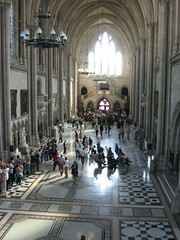 There's almost as religious a feeling about the Royal Courts of Justice (that was apparently the intention), the pre-Disney Gothic-turreted fantasy in the Strand. I worked nearby for over twenty years and never realised just how open to visitors they are. They'd laid on mock trials, visits to the cells and a prison van (this required a degree of queuing I didn't fancy), an amusing talk by a judge's clerk about mostly the ceremonial robes but also about the daily work of a judge, as well as other talks and displays. It's a warren of corridors and courtrooms doors off mysterious half-landings up and down winding staircases. The courtrooms are surprisingly intimate, but this is hardly surprising, given that much of the business here is to do with private civil disputes and criminal appeals on points of law, rather than the grand public dramas of TV and movie trials.
From one end of the justice system to the other: the Thames Police Museum is a volunteer-run collection of all sorts of memorabilia crammed into the former carpenters' workshop at the headquarters of the river police in Wapping. Models of boats, old equipment, photographs of great events, uniforms, flags, paintings and documents all jostle for attention as you squeeze your way between the cabinets. There are some fascinating stories here, but they're a bit buried: and the reality of the work, as shown in a recent TV series, can be grim (the river is so murky that divers mostly have to locate what they're looking for by feel alone, whether it's a body or an abandoned weapon).
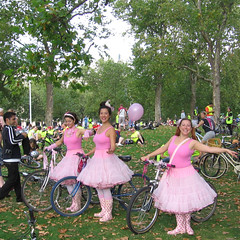 As for the Freewheel event - last year I wondered if I should get a bike, and this year I was able to join in (no need to register - I don't want a free bib advertising Rupert Murdoch, thank you very much, and certainly not to go on one of his mailing lists). And a great day was had by all, notwithstanding some shocking bad manners by some cyclists (what else is new):
 Thursday, 18 September 2008
Gently remove the postilion from under the horse...
This is one of the handy phrases offered by Mme de Genlis, tutor to French royalty, in her 18th century guide and phrasebook for travellers in rural France, as quoted in Graham Robb's Discovery of France, a book I'm loving.
The book is the story of how "France" developed from a society in which people had little experience of anywhere, let alone of any authority, outside their own immediate pays, where excise duties were required as goods moved from one part of the country to another, where families could - for no obvious reason - be defined as a caste almost of "untouchable" status as in India. It tells how the country was mapped, how transport was developed, how people migrated - a fascinating mix of global trends and piquant local detail. As for example, what Mme de Genlis's choice of phrases tells you about the state of the roads at the time. And did you know that bands of dogs were trained to smuggle goods past the excise officers - without being led by humans? Or that the "Tour de France" was a term for apprentices' travels to learn their trades around the country?.
The book closes with the development of both national identity through national education (and national military service) in the nineteenth century, and at the same time of regional/local identities to encourage tourism. Paris, by the way, hardly features.
The book is the story of how "France" developed from a society in which people had little experience of anywhere, let alone of any authority, outside their own immediate pays, where excise duties were required as goods moved from one part of the country to another, where families could - for no obvious reason - be defined as a caste almost of "untouchable" status as in India. It tells how the country was mapped, how transport was developed, how people migrated - a fascinating mix of global trends and piquant local detail. As for example, what Mme de Genlis's choice of phrases tells you about the state of the roads at the time. And did you know that bands of dogs were trained to smuggle goods past the excise officers - without being led by humans? Or that the "Tour de France" was a term for apprentices' travels to learn their trades around the country?.
The book closes with the development of both national identity through national education (and national military service) in the nineteenth century, and at the same time of regional/local identities to encourage tourism. Paris, by the way, hardly features.
Well bless my soul
Thanks to Cécile Quoi de 9, I discover there's a variety of fig in France known as "couille du Pape" - as demonstrated by a display of jam on the occasion of the Pope's visit to France.
That is to say, in France you can buy a kilo or a jar of - that of which the Pope, of all people, has no functional need. Well, it makes a variation on "Cobblers* to the Queen", I suppose.
*[For readers not familiar with British English - this is the punchline of an old joke relying on London rhyming slang. Cobblers stands for "cobblers' awls", which rhymes with...?
That is to say, in France you can buy a kilo or a jar of - that of which the Pope, of all people, has no functional need. Well, it makes a variation on "Cobblers* to the Queen", I suppose.
*[For readers not familiar with British English - this is the punchline of an old joke relying on London rhyming slang. Cobblers stands for "cobblers' awls", which rhymes with...?
Sunday, 14 September 2008
Legends
 Sunday turned out to be a late attempt at summer, so it was out with the bike again. An hour or so's ride got me to the British Library for the last day of the Ramayana exhibition - beautiful miniatures, from mostly 17th century editions of the great Indian myth, with material exhibiting its influence elsewhere in south and south-east Asia - different forms of text and image, dance, wall hangings, shadow puppets.
 It's a long - very long - legend of good and evil, how a king in exile pursues and destroys the abductor of his wife (with the aid of Hanuman the monkey god, Garuda the eagle and an army of monkeys and bears), she restores his (and public) faith in her virtue and loyalty by agreeing to sacrifice herself (but is saved), and they return to resume the throne and inaugurate a golden age. There are shape-shifting gods and demons, miraculous cures, battles, moving mountains, wicked stepmothers, brothers and wives both loyal and disloyal, and a great many other things familiar from folk myths and legends throughout the world.
Many beautiful details in the paintings: here's the online version on the BL's website.
On the way home, I realised I was near Bunhill Fields, the old cemetery for nonconformists, which I've never visited. So by way of light relief, I stopped in to pay my respects at the graves of Bunyan, Blake and Daniel Defoe - and the imposing tomb of Dame Mary Page (died 1728), with the inscription:
In 67 months she was tap'd 66 times, had taken away 240 gallons of water, without ever repining for her case, or fearing the operation.
Clearly an example to us all.
Saturday, 13 September 2008
Feast on the Bridge
This was the weekend of (among many other things) the Thames Festival. I've been less aware of it in the past than of the Great River Race, which passes where I live - but I don't think I could find anything different to say about the race this year. Instead, on Saturday I took the bike and rode into town to have a look at the Feast on the Bridge.
 Part farmer's market, part harvest festival and community fete, this takes over Southwark Bridge. There were stalls selling Sussex beer, Essex oysters, "street food from the Silk Route", burgers, sweets and cakes (including cakes and jam from our own local city farm), a stall for children to make their own gingerbread men, a giant pumpkin for them to be photographed with, folk rock and morris dancers, and two tables running the full length of the bridge for people to enjoy their food with a view. On the north side, there were free chocolate samples, and a cosy arrangement of sofas on the pavement for that homely touch.
I managed a good ride around central London and home again, but I still haven't quite got things organised. I need to find some way to carry my weekly shop home on the back, the best place to fix the lights, and I'm sure the brakes are binding a bit.
Hang on, it's all coming back to me: that's why we have bikes: let the tinkering begin!
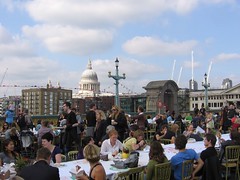 Part farmer's market, part harvest festival and community fete, this takes over Southwark Bridge. There were stalls selling Sussex beer, Essex oysters, "street food from the Silk Route", burgers, sweets and cakes (including cakes and jam from our own local city farm), a stall for children to make their own gingerbread men, a giant pumpkin for them to be photographed with, folk rock and morris dancers, and two tables running the full length of the bridge for people to enjoy their food with a view. On the north side, there were free chocolate samples, and a cosy arrangement of sofas on the pavement for that homely touch.
I managed a good ride around central London and home again, but I still haven't quite got things organised. I need to find some way to carry my weekly shop home on the back, the best place to fix the lights, and I'm sure the brakes are binding a bit.
Hang on, it's all coming back to me: that's why we have bikes: let the tinkering begin!
A grand night out
I do seem to have been in a spendy mood this week. I broke the habit of a lifetime and booked (shock!) to go out of an evening (horror!).
Suddenly realising that this was the last week of the Proms and that I hadn't been in person for decades, I had a look to see what was still available, and surprisingly, there were seats. Of course, if you've the time and stamina to queue, you can get into the standing places in the arena and topmost gallery quite cheaply, but for me it's enough of an adventure to get myself there at all. Best of all, there were still reasonably-priced seats for the Beethoven Choral Symphony, one of the traditional regulars of the Proms: and my seat was beside the organ, facing the conductor across the choir and orchestra.
 The Albert Hall is a grand amphitheatre in red and gold; it can hold 5500 people, but my first thought was how intimate it can feel, with the arena audience and many of those seated being very close to the performers. Hence, no doubt, the proprietorial nature of the traditional prommer, those people who regularly queue for the standing places and maintain the rituals of decades, chanting messages from arena to gallery, shouting "heave" when the piano lid goes up, and all the nonsense of the Last Night: but of course, rapt and knowledgeable silence while the music is playing, and usually a generous response - if they liked the performance, they let you know.
The size of the audience has to be taken into account if you visit, by the way: 5500 people, with the lights and all the exertions on the stage, generate a lot of heat, and it rises. The Proms take place over the summer, and even in one as dull as this has been, it can become quite clammy down on the ground, and more and more unpleasant in the higher tiers and the gallery. It's a Victorian building without air-conditioning. A practical top tip is to go to the loo at the start of the interval: there might not be time if you wait till after your ice-cream.
Being at a live performance allows you to hear a lot more detail in the range of both pitch and volume than you get from hearing (considerately-played) broadcasts or recordings at home. My seat gave me a slightly unbalanced sounds, being right behind the brass and percussion (it felt almost like an open-air acoustic), but there was so much more to hear than I'd ever really been aware of before.
It also gave me a performer's view - the screens at the front of the stage to let the soloists see the conductor (who would be behind them), just how many hammers the tympanist had to choose from, and some sort of electronic device on his music stand (a decibel meter?) and the extraordinary self-devised notation for the equally extraordinary Penderecki piece (exactly what people think of as modern classical music, strange slidings, swoopings, tapping, slapping and plucking in no conventional time pattern: the sort of thing that sets the mood for in a sci-fi horror film, but it seemed to fit in the context of this programme).
I could also, of course, see what the choir and orchestra see of the conductor.
By chance, the scheduled programmes and the recordings I've been catching up on have been Beethoven-heavy, and it had struck me just how playful Beethoven is with rhythm, and how much all the different conductors were letting the music dance. Tonight, we certainly got dancing, on the podium as much as in the music.
Noseda had a gesture and a move for every mood and detail he was trying to evoke: stern, dreamy, nonchalant, decisive, precise, straining, imploring, a hand outstretched at thigh-level as though supporting the sound, a chop or a double-handed backhand or a thumb-to-index circle indicating the degree of emphasis he wanted from a section, sometimes the fingertips crumbling pastry or spinning threads in the air, sometimes seeming to shoo invisible pigeons away, his shoulders raised and his feet moving as though through treacle, or arms raised and hands floating, his feet almost on tiptoe as he swayed the rhythm. And all at a take-no-prisoners tempo. No wonder he looked exhausted at the end.
That's not to everyone's taste (though the audience can't see most of it); there's as much to admire in the way, for example, Colin Davis just stood back at moments, stopped even beating time and let the Gustav Mahler Youth Orchestra play Sibelius); but this was a fabulous performance with the customary response, and special cheers (three separate calls) for the choir. "Roar of applause" wasn't just a cliché in this case.
As I came out, Prince Albert was glittering in his floodlit memorial. He might have been surprised to see just how much good has been done from the profits of his Great Exhibition, perhaps that the Hall is not only still standing but thriving - Sunday jazz brunches and all, and perhaps shocked by some of the music; but, musically capable as he was said to be, I think he would have approved.
Suddenly realising that this was the last week of the Proms and that I hadn't been in person for decades, I had a look to see what was still available, and surprisingly, there were seats. Of course, if you've the time and stamina to queue, you can get into the standing places in the arena and topmost gallery quite cheaply, but for me it's enough of an adventure to get myself there at all. Best of all, there were still reasonably-priced seats for the Beethoven Choral Symphony, one of the traditional regulars of the Proms: and my seat was beside the organ, facing the conductor across the choir and orchestra.
 The Albert Hall is a grand amphitheatre in red and gold; it can hold 5500 people, but my first thought was how intimate it can feel, with the arena audience and many of those seated being very close to the performers. Hence, no doubt, the proprietorial nature of the traditional prommer, those people who regularly queue for the standing places and maintain the rituals of decades, chanting messages from arena to gallery, shouting "heave" when the piano lid goes up, and all the nonsense of the Last Night: but of course, rapt and knowledgeable silence while the music is playing, and usually a generous response - if they liked the performance, they let you know.
The size of the audience has to be taken into account if you visit, by the way: 5500 people, with the lights and all the exertions on the stage, generate a lot of heat, and it rises. The Proms take place over the summer, and even in one as dull as this has been, it can become quite clammy down on the ground, and more and more unpleasant in the higher tiers and the gallery. It's a Victorian building without air-conditioning. A practical top tip is to go to the loo at the start of the interval: there might not be time if you wait till after your ice-cream.
Being at a live performance allows you to hear a lot more detail in the range of both pitch and volume than you get from hearing (considerately-played) broadcasts or recordings at home. My seat gave me a slightly unbalanced sounds, being right behind the brass and percussion (it felt almost like an open-air acoustic), but there was so much more to hear than I'd ever really been aware of before.
It also gave me a performer's view - the screens at the front of the stage to let the soloists see the conductor (who would be behind them), just how many hammers the tympanist had to choose from, and some sort of electronic device on his music stand (a decibel meter?) and the extraordinary self-devised notation for the equally extraordinary Penderecki piece (exactly what people think of as modern classical music, strange slidings, swoopings, tapping, slapping and plucking in no conventional time pattern: the sort of thing that sets the mood for in a sci-fi horror film, but it seemed to fit in the context of this programme).
I could also, of course, see what the choir and orchestra see of the conductor.
By chance, the scheduled programmes and the recordings I've been catching up on have been Beethoven-heavy, and it had struck me just how playful Beethoven is with rhythm, and how much all the different conductors were letting the music dance. Tonight, we certainly got dancing, on the podium as much as in the music.
Noseda had a gesture and a move for every mood and detail he was trying to evoke: stern, dreamy, nonchalant, decisive, precise, straining, imploring, a hand outstretched at thigh-level as though supporting the sound, a chop or a double-handed backhand or a thumb-to-index circle indicating the degree of emphasis he wanted from a section, sometimes the fingertips crumbling pastry or spinning threads in the air, sometimes seeming to shoo invisible pigeons away, his shoulders raised and his feet moving as though through treacle, or arms raised and hands floating, his feet almost on tiptoe as he swayed the rhythm. And all at a take-no-prisoners tempo. No wonder he looked exhausted at the end.
That's not to everyone's taste (though the audience can't see most of it); there's as much to admire in the way, for example, Colin Davis just stood back at moments, stopped even beating time and let the Gustav Mahler Youth Orchestra play Sibelius); but this was a fabulous performance with the customary response, and special cheers (three separate calls) for the choir. "Roar of applause" wasn't just a cliché in this case.
As I came out, Prince Albert was glittering in his floodlit memorial. He might have been surprised to see just how much good has been done from the profits of his Great Exhibition, perhaps that the Hall is not only still standing but thriving - Sunday jazz brunches and all, and perhaps shocked by some of the music; but, musically capable as he was said to be, I think he would have approved.
Thursday, 11 September 2008
Well, I've been and gorn and done it
 I've bought a bike. Having ridden it all the way home from the shop, I reckon I could get to and from work in about the same time as I spend on public transport. So we shall see.....
Wednesday, 10 September 2008
Still here
I'd be surprised if anyone ever really thought the LHC experiment at CERN might lead to the end of the world. Maybe I'm just naively trusting of people in white coats.
It all looks very James Bond meets Dr. Who, and frankly that's about my level of understanding: so it's even less of a surprise that this morning I was most struck by the Guardian magazine's take on the whole thing (if they're going to have more giveaway posters, this is a much better candidate than some of their other offerings - click on the image to see it full-size):

It all looks very James Bond meets Dr. Who, and frankly that's about my level of understanding: so it's even less of a surprise that this morning I was most struck by the Guardian magazine's take on the whole thing (if they're going to have more giveaway posters, this is a much better candidate than some of their other offerings - click on the image to see it full-size):

Saturday, 6 September 2008
Brava!
Hooray for a poet!
A schools examining board - acting on just three complaints - withdrew this poem from its syllabus:
Today I am going to kill something. Anything.
I have had enough of being ignored and today
I am going to play God. It is an ordinary day,
a sort of grey with boredom stirring in the streets
I squash a fly against the window with my thumb.
We did that at school. Shakespeare. It was in
another language and now the fly is in another language.
I breathe out talent on the glass to write my name.
I am a genius. I could be anything at all, with half
the chance. But today I am going to change the world.
Something's world. The cat avoids me. The cat
knows I am a genius, and has hidden itself.
I pour the goldfish down the bog. I pull the chain.
I see that it is good. The budgie is panicking.
Once a fortnight, I walk the two miles into town
For signing on. They don't appreciate my autograph.
There is nothing left to kill. I dial the radio
and tell the man he's talking to a superstar.
He cuts me off. I get our bread-knife and go out.
The pavements glitter suddenly. I touch your arm.
Today, the poet, Carol Ann Duffy, published her comment:
You must prepare your bosom for his knife,
said Portia to Antonio in which
of Shakespeare's Comedies? Who killed his wife,
insane with jealousy? And which Scots witch
knew Something wicked this way comes? Who said
Is this a dagger which I see? Which Tragedy?
Whose blade was drawn which led to Tybalt's death?
To whom did dying Caesar say Et tu? And why?
Something is rotten in the state of Denmark - do you
know what this means? Explain how poetry
pursues the human like the smitten moon
above the weeping, laughing earth; how we
make prayers of it. Nothing will come of nothing:
speak again. Said by which King? You may begin.
Wit is the best response to idiocy.
By the way, is anyone asking about the recruitment policy that appointed the original complainant an examiner?
A schools examining board - acting on just three complaints - withdrew this poem from its syllabus:
Today I am going to kill something. Anything.
I have had enough of being ignored and today
I am going to play God. It is an ordinary day,
a sort of grey with boredom stirring in the streets
I squash a fly against the window with my thumb.
We did that at school. Shakespeare. It was in
another language and now the fly is in another language.
I breathe out talent on the glass to write my name.
I am a genius. I could be anything at all, with half
the chance. But today I am going to change the world.
Something's world. The cat avoids me. The cat
knows I am a genius, and has hidden itself.
I pour the goldfish down the bog. I pull the chain.
I see that it is good. The budgie is panicking.
Once a fortnight, I walk the two miles into town
For signing on. They don't appreciate my autograph.
There is nothing left to kill. I dial the radio
and tell the man he's talking to a superstar.
He cuts me off. I get our bread-knife and go out.
The pavements glitter suddenly. I touch your arm.
Today, the poet, Carol Ann Duffy, published her comment:
You must prepare your bosom for his knife,
said Portia to Antonio in which
of Shakespeare's Comedies? Who killed his wife,
insane with jealousy? And which Scots witch
knew Something wicked this way comes? Who said
Is this a dagger which I see? Which Tragedy?
Whose blade was drawn which led to Tybalt's death?
To whom did dying Caesar say Et tu? And why?
Something is rotten in the state of Denmark - do you
know what this means? Explain how poetry
pursues the human like the smitten moon
above the weeping, laughing earth; how we
make prayers of it. Nothing will come of nothing:
speak again. Said by which King? You may begin.
Wit is the best response to idiocy.
By the way, is anyone asking about the recruitment policy that appointed the original complainant an examiner?
Friday, 5 September 2008
Is there anything more exhausting...
..than doing nothing - or rather, having nothing to do (or, at least, nothing that really demands immediate attention)? Apparently the office was busy while I was away - and, heaven knows, people seemed to be clearing a lot of stuff to dump on us just before my break - but this afternoon has really dragged.
At home, on the other hand, there's been a lot of catching up to do. Did I mention I got a hard-drive recorder to go with my shiny new TV? It has that "series record" facility - so I came home to find it full of all sorts of things I'd idly clicked on, chiefly a whole batch of Proms concerts. I've still to work through them all, but the range so far has stretched from classical-jazz crossover music, to Vaughan Williams (it's an anniversary year this year: and we didn't just get the floaty-mimsy-Edwardian early music but his stark and angular 9th symphony, from just before he died) to the Bach St John Passion, to a wonderful evening of the Beethoven Violin Concerto (elegant and fun - it adds so much to be able to see the players smiling at each other and obviously making a conversation out of the music) and the Sibelius 2nd symphony (one of the first major classical pieces to engage me as a teenager, and this performance was all flood and fire).
And to bring the tone down, there's an agreeably daft new series Lost in Austen, where a modern young woman who adores Pride and Prejudice and longs for the imagined elegance of the time suddenly finds Elizabeth Bennet in her bathroom, having found a door from the attic at Longbourn, and they end up swapping places. I can just hear the pitch to the schedulers at ITV: "It's Bridget Jones meets Life on Mars - with bonnets!"
At home, on the other hand, there's been a lot of catching up to do. Did I mention I got a hard-drive recorder to go with my shiny new TV? It has that "series record" facility - so I came home to find it full of all sorts of things I'd idly clicked on, chiefly a whole batch of Proms concerts. I've still to work through them all, but the range so far has stretched from classical-jazz crossover music, to Vaughan Williams (it's an anniversary year this year: and we didn't just get the floaty-mimsy-Edwardian early music but his stark and angular 9th symphony, from just before he died) to the Bach St John Passion, to a wonderful evening of the Beethoven Violin Concerto (elegant and fun - it adds so much to be able to see the players smiling at each other and obviously making a conversation out of the music) and the Sibelius 2nd symphony (one of the first major classical pieces to engage me as a teenager, and this performance was all flood and fire).
And to bring the tone down, there's an agreeably daft new series Lost in Austen, where a modern young woman who adores Pride and Prejudice and longs for the imagined elegance of the time suddenly finds Elizabeth Bennet in her bathroom, having found a door from the attic at Longbourn, and they end up swapping places. I can just hear the pitch to the schedulers at ITV: "It's Bridget Jones meets Life on Mars - with bonnets!"
Friday, 29 August 2008
Call me childish (if you dare), but I like sitting in front on the top deck of the bus. That way I get the best view: today, a competitive-looking cyclist stopped by a red light. Roadworks were enforcing single-lane working, so he couldn't jump the light; instead, he was twisting his body and his front wheel this way and that - anything rather than put his foot on the ground.
I know the frustration: for a London pedestrian, there's a drive to keep moving. It's not so much speed as continuity of pace; something to do with a sense of control, perhaps. I felt it too with Vélib in Paris: going along a long straight street, I'd find myself getting into a slow bicycle race with the red lights in the hope they would change before I got there (too many had an irritating habit of changing just after I'd stopped).
 And it's the sense of control that sells a scheme like Vélib: you can pick a bike up and put it away without having to worry about storing or maintaining it.
The bikes are sturdy, and basic (three speeds, brakes, adjustable seat post, permanent dynamo lights, a basket, a kickstand and that's about it), but a lot of effort must go into maintenance: several times I saw inspectors going round (on Vélib bikes) with their clipboards, presumably noting any bikes that needed work (I was surprised at how few needed air in the tyres - or are they solid?).
 There seems to be a signalling etiquette: although you can, in office hours, call up the office from a button on the control post at a station, I rather suspect users indicate a faulty bike by lowering the seat and swivelling it round backwards - and I've seen some bikes with the tyres partially removed, which I also suspect might be a signal from the inspectors to the people who go round with the collector vans.
I've no idea about the economics of it: the pricing is designed to encourage short hops, but I regularly managed to get from the Hotel de Ville up to the Bassin de la Villette within the "free" half hour (my record was 19 minutes) - all in all, I took 46 rides in two weeks, for at most €16. I know there's some sort of commercial sponsorship, but there must be a substantial subsidy from city finances: and who knows what sort of return can be calculated in terms of car journeys or metro overcrowding foregone?
I forgot, until almost the end of my time in Paris, that one reason for trying the bikes out was to see whether it would make sense to buy a bike. Well, I'm certainly not past riding in city traffic (if I can go round the place de la Concorde on a bike, London traffic doesn't worry me), and I certainly don't need anything too fancy (maybe an extra gear or two), but it's that ability to 'park and forget' that really appealed - it's a self-powered taxi. And that's exactly what you don't get with your own bike. We've got secure storage both at home and at work: but I can't take a bike on the tube if I don't want to ride all the way, and could I be bothered with the faff of a folding bike? I have a faint echo in my mind of my mother when presented with a new ornament. She would smile sweetly as she thanked the donor for the present, but as soon as they were out of earshot, you could hear her mutter 'One more bloody thing to dust'.
I know the frustration: for a London pedestrian, there's a drive to keep moving. It's not so much speed as continuity of pace; something to do with a sense of control, perhaps. I felt it too with Vélib in Paris: going along a long straight street, I'd find myself getting into a slow bicycle race with the red lights in the hope they would change before I got there (too many had an irritating habit of changing just after I'd stopped).
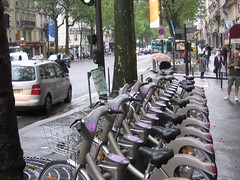 And it's the sense of control that sells a scheme like Vélib: you can pick a bike up and put it away without having to worry about storing or maintaining it.
 The bikes are sturdy, and basic (three speeds, brakes, adjustable seat post, permanent dynamo lights, a basket, a kickstand and that's about it), but a lot of effort must go into maintenance: several times I saw inspectors going round (on Vélib bikes) with their clipboards, presumably noting any bikes that needed work (I was surprised at how few needed air in the tyres - or are they solid?).
 There seems to be a signalling etiquette: although you can, in office hours, call up the office from a button on the control post at a station, I rather suspect users indicate a faulty bike by lowering the seat and swivelling it round backwards - and I've seen some bikes with the tyres partially removed, which I also suspect might be a signal from the inspectors to the people who go round with the collector vans.
 I've no idea about the economics of it: the pricing is designed to encourage short hops, but I regularly managed to get from the Hotel de Ville up to the Bassin de la Villette within the "free" half hour (my record was 19 minutes) - all in all, I took 46 rides in two weeks, for at most €16. I know there's some sort of commercial sponsorship, but there must be a substantial subsidy from city finances: and who knows what sort of return can be calculated in terms of car journeys or metro overcrowding foregone?
I forgot, until almost the end of my time in Paris, that one reason for trying the bikes out was to see whether it would make sense to buy a bike. Well, I'm certainly not past riding in city traffic (if I can go round the place de la Concorde on a bike, London traffic doesn't worry me), and I certainly don't need anything too fancy (maybe an extra gear or two), but it's that ability to 'park and forget' that really appealed - it's a self-powered taxi. And that's exactly what you don't get with your own bike. We've got secure storage both at home and at work: but I can't take a bike on the tube if I don't want to ride all the way, and could I be bothered with the faff of a folding bike? I have a faint echo in my mind of my mother when presented with a new ornament. She would smile sweetly as she thanked the donor for the present, but as soon as they were out of earshot, you could hear her mutter 'One more bloody thing to dust'.
Sunday, 24 August 2008
Home again
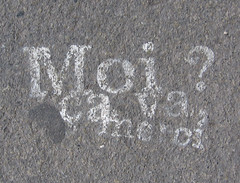 The last day wasn't entirely about tidying up the flat (the secret is - as one never does at home - to clean as you go, and better still, don't make things dirty in the first place).
 Ignoring a strange sort of irritated uncertainty (don't want to go, can't wait to go), I went to a favourite place I hadn't so far visited this trip, the place des Vosges: one of the most beautiful squares I know, and full of interest on the weekend - this piece of pavement graffiti for one, but also the buskers taking advantage of the perfect soundbox of its arcades (despite one of the creakiest see-saws in existence):
In the evening, one last try at my Arc de Triomphe project. A couple of times before, the queues to go up have been off-puttingly long; but at dinner-time on a Saturday night, they were virtually non-existent, so there was plenty of time and space to put this together:
Friday, 22 August 2008
Içi on spontane
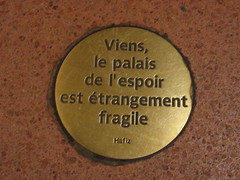 It's been pouring with rain all day, but with only two days left, staying in wasn't really an option. Instead, another chance discovery beckoned - an exhibition (free!) at the Mitterrand library of documents and images from May 1968. It was basically a series of wall displays and a handful of fliers and photos in cabinets; I noticed a number of my contemporaries there, looking shyly excited and nostalgic, like my parents' generation looking at old gas-masks and ration books.
I don't know what's stranger: revisiting the near-hysteria of that time, or doing so in the context of this over-slickly technological new library, named for the sly survivor of the old politics (who appeared to make a complete ass of himself at the time, but still outlived and out-smarted his rivals to the left, the right and in the centre - and I'm not sure we yet know who he really was).
They say if you can remember the 60s, you weren't there; but we bystanders get the best of the view, you know, and keep our memories into the bargain. I was in Paris in June 1968 with a friend - the Right had just won the general election and the strikes and disturbances were collapsing. Somewhere in a cupboard there's one of the last posters still then available at the Sorbonne (but a hole was rubbed through it by a bit of the tandem we were travelling on - don't ask).
Even then, there was some scepticism about it all: at the time Private Eye referred to a lot of mad Frogs charging about as usual, and heaven knows, if you were looking for examples of "infantile Leftism", my contemporaries could give you a few. There was one particularly bad incident of vandalism in my college; but what took the biscuit was the time a student occupation of the central administration at Cambridge took the decision that various ancient railings should be cut down as a symbolic liberation. "We need hacksaws!" was the cry (hacksaws - to cut through several inches of wrought iron!), so a collection was taken up with great enthusiasm, and a delegation sent to buy hacksaws: only to return with the news that it was early closing day - end of revolution. As the Prime Minister of the day remarked, this was the kind of Left that was more gauche than sinister.
Of course, it's hard to imagine now that democracy itself couldn't be taken for granted. France had faced more than one serious prospect of a Greek-style military coup d'état more than once in recent memory, and Franco still ruled on its southern borders. Perhaps, too, there was some prescient sense that the surge in prosperity over the 1950s and 60s wasn't sustainable, as events were to show in the next few years.
But even then, I found the dogmatism hard to take: even more so now that, in the UK and US, there are people who have retained the fundamentalist approach but use it to pursue the neocon agenda.
Thursday, 21 August 2008
Gilding and gods
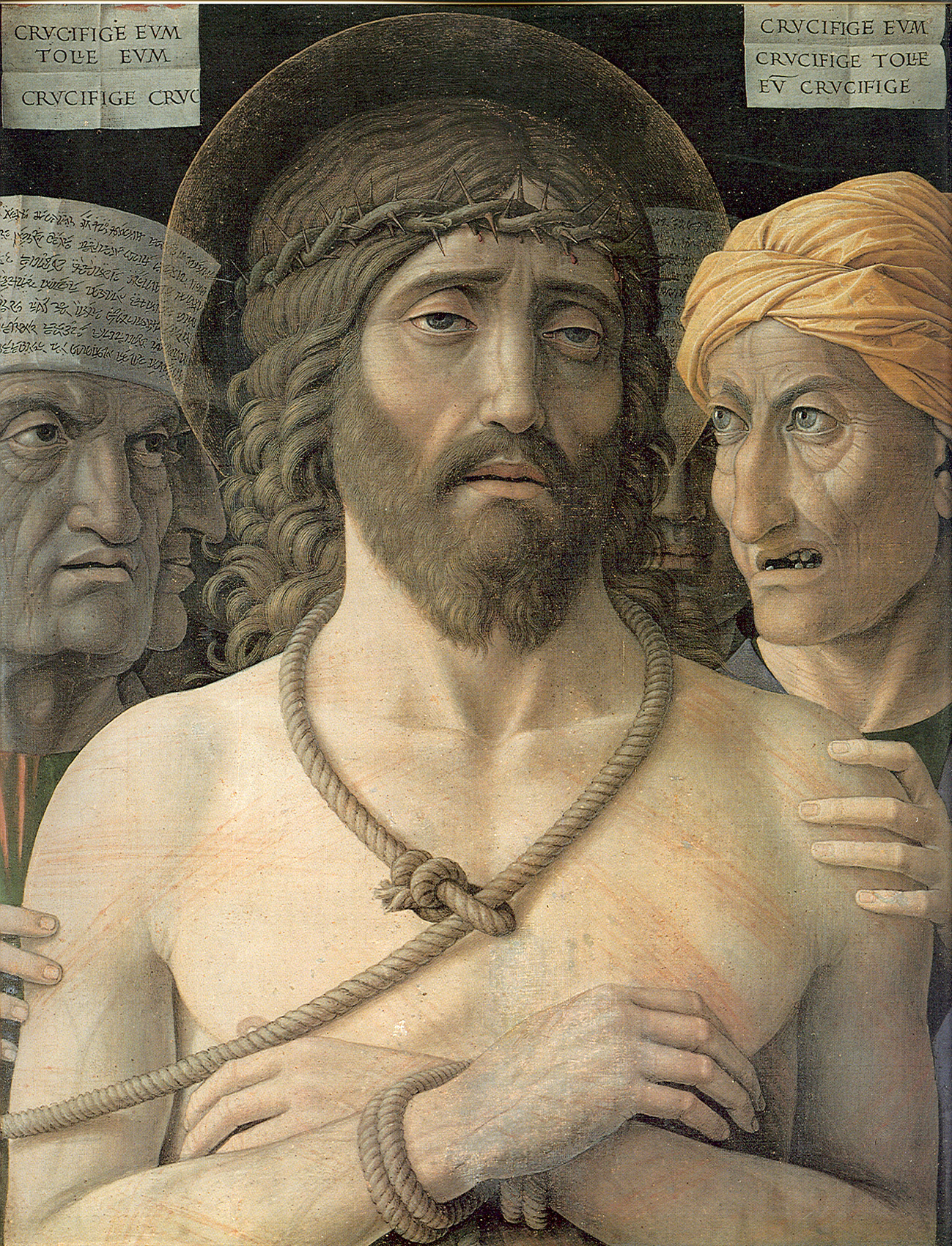 A heavy museum day today. First the Musée Jacquemart-André, a once private collection kept as it was, in the same way as the Wallace Collection was. An imposing and ostentatious house of the post-Haussmann redevelopment of Paris, with all the gilding you can imagine, the entrance guarded by a rather droopy-looking lion, it was the home of a couple of indefatigable collectors, of 17th and 18th century paintings (including a couple of Rembrandt portraits), and of Italian art from all periods. Perhaps too many madonnas for my taste, but I was very impressed by this Mantegna Ecce Homo, and intrigued by an 18th century Viennese clock where a pointer moves along a horizontal line.
They also had a visiting exhibition of a private collection of art from Africa and Oceania, which was a bit of an eye-opener, and served as a sort of taster for the afternoon's visit to the Musée du Quai Branly. This is the latest in tradition by which each President of France has the opportunity (duty?) to launch a "grand projet": and this museum was Jacques Chirac's. I'm not sure if this rather Napoleonic idea of the "grand project" isn't something relatively recent (5th Republic only?), nor how it works: is the President allowed to have whatever he dreams up, or is he given a shortlist of various big ideas in the broadly cultural domain that have been kicking around for a while but never had government funding?
The Quai Branly fits into a rather long and narrow site (complete with a modish vertical garden), and the architects have used it to ensure you have a long and winding journey, not only into the museum, but also up to the collections, and then around them, from Oceania to Australia to South-East Asia to Asia to Africa to the Americas. An equally sinuous internal partition provides built-in screens for films (and seats for visitors to enjoy them one-on-one) showing rituals, dances, and people from the different cultures talking about what the different objects mean to them. There's lots of fascinating objects and some beautiful textiles. If there's a common theme at all, it is broadly an anthropological focus on traditions outside the major religious cultures (Christian, Islamic, Buddhist, Hindu). The total effect is a bit overwhelming - it would be easy to spend all day there, and it's perhaps best not visited after another museum.
Wednesday, 20 August 2008
Marabouts and castanets
Another day where chance changed any vague plans I had. Definitely museum weather, so this was the day for the Muséé Jacquemart-André, I thought; but first, as the metro passed through Barbès-Rochechouart, I thought I'd stop off and take a look at the cheap clothing shops and the market under the railway line along Bvd de la Chapelle. Interesting that the patter's very similar to London markets: "Everything's got to go! Last chance!"
The first time I came here, there were several hawkers pushing out fliers for marabouts - this time only one, but one that was advertising here three years ago. Mamadou is still claiming to be a seer, healer and medium with an excellent reputation, offering precise and detailed visions, capable of finding solutions to all your difficulties: love, infidelity, loneliness, impotence, work, business, studies and driving tests. And all on the basis of a photo - consultation by correspondence only. The only thing is, if he or she is so good at this sort of thing, why isn't he or she living the life of Riley in some jetset hideaway? Or maybe he (or she) is.....
 Back on the metro, the map shows only one stop beyond the Jacquemart-André to the Grand Palais, only recently reopened since a refit - so why not take a quick look?
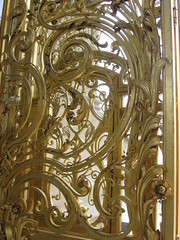
This part of Paris is deliberately imposing, remodelled around 1900 with a great deal of self-assertion, as in the gilt and curlicues on the Pont Alexandre III; and it's here that statues of heroes abound - Bolivar and La Fayette eternally waving swords at each other, Churchill, de Gaulle and Clémenceau all striding determinedly in different directions. The great nave of the Grand Palais is currently refitting for the next big event, so there wasn't anything to see except the newly-cleaned outside. You have to wonder exactly what was meant by some of the detailing.
 Opposite is the Petit Palais. Not only did it have a café (well, it was lunchtime), but its permanent collections as the city museum of fine arts are free - and rather impressive. This Gallé piece was commissioned by a society lady who features as a minor character in a detective story set in the period that I just happen to be reading at the moment. The focus isn't just on art directly relevant to Paris: there are some impressive examples of art from all periods, though not all rooms were open. Some beautiful religious art, both Western and Orthodox, and some impressive Roman sculptures as well, in a building surprisingly light and elegant for its period and size.
They also had a special exhibition on Flamenco and how it was viewed, both as part of a touristic "Spanishness" but also as it was taken up by the artistic avant-garde of the early 20th century. Lots of interesting pictures, a rather pointless film by Man Ray, but a couple of fascinating early films (from 1894, and from the 1900 exhibition for which the Palais was built) and enthralling examples of dancing from the 1930s. And I only saw it because of a whim.
The first time I came here, there were several hawkers pushing out fliers for marabouts - this time only one, but one that was advertising here three years ago. Mamadou is still claiming to be a seer, healer and medium with an excellent reputation, offering precise and detailed visions, capable of finding solutions to all your difficulties: love, infidelity, loneliness, impotence, work, business, studies and driving tests. And all on the basis of a photo - consultation by correspondence only. The only thing is, if he or she is so good at this sort of thing, why isn't he or she living the life of Riley in some jetset hideaway? Or maybe he (or she) is.....
 Back on the metro, the map shows only one stop beyond the Jacquemart-André to the Grand Palais, only recently reopened since a refit - so why not take a quick look?
This part of Paris is deliberately imposing, remodelled around 1900 with a great deal of self-assertion, as in the gilt and curlicues on the Pont Alexandre III; and it's here that statues of heroes abound - Bolivar and La Fayette eternally waving swords at each other, Churchill, de Gaulle and Clémenceau all striding determinedly in different directions. The great nave of the Grand Palais is currently refitting for the next big event, so there wasn't anything to see except the newly-cleaned outside. You have to wonder exactly what was meant by some of the detailing.
 Opposite is the Petit Palais. Not only did it have a café (well, it was lunchtime), but its permanent collections as the city museum of fine arts are free - and rather impressive. This Gallé piece was commissioned by a society lady who features as a minor character in a detective story set in the period that I just happen to be reading at the moment. The focus isn't just on art directly relevant to Paris: there are some impressive examples of art from all periods, though not all rooms were open. Some beautiful religious art, both Western and Orthodox, and some impressive Roman sculptures as well, in a building surprisingly light and elegant for its period and size.
 They also had a special exhibition on Flamenco and how it was viewed, both as part of a touristic "Spanishness" but also as it was taken up by the artistic avant-garde of the early 20th century. Lots of interesting pictures, a rather pointless film by Man Ray, but a couple of fascinating early films (from 1894, and from the 1900 exhibition for which the Palais was built) and enthralling examples of dancing from the 1930s. And I only saw it because of a whim.
Tuesday, 19 August 2008
A fairground surprise
The great thing about Vélib is that you can stop when something catches your eye, like this contre-jour effect on the Canal St Martin:

I was on my way to the area around Parc Bercy, passing the Palais Omnisports and finally spotting how they manage to mow the grass on a near-vertical slope. The park was developed on a wine-warehousing site near the railfreight station; some attractive stone-faced buildings have been retained as a rather too spick-and-span shopping village (chi-chi kitchen gadgets, Occitane en Provence and rather a lot of Club Med), surrounded by posh apartments and offices. Stopping for lunch there, I realised there might be an explanation for the decline in the population of sparrows in London. Maybe they've all come here, because there seem to be a lot, in rude health - I saw one fly off with a piece of bread almost as big as itself.
On the way around the park itself, I saw, of all things, a pair of chandeliers hanging over a gateway in a security fence. Passing round the building, I realised this was the Musée des Arts Forains, or fairground art. I'd heard of it, but discounted the idea of visiting because I had the impression they only accepted organised groups: but there was a sign saying the next visit would begin shortly, and the people waiting didn't appear to be a coach-party. Sure enough, though most of them had booked, there was no difficulty about admitting people who, like me, had just turned up on spec. The main point is that you can only take a guided tour, for which they obviously prefer people to book.
 The space is large (several "pavillons" which I assume were also warehouses), with objects hanging from the ceiling and theatrically spot-lit. Our guide started out by concentrating on the art involved, and parallels with what was going on in society at large at the time. With the children getting fractious, he rapidly moved on to the fairground organs and what not only the children had really come for - a chance to try the carousels and games, including a rare bicycle carousel and a café waiters' race, and finishing with a Venetian scene:
The tour took two hours, with other strange and interesting things to see outside as well: definitely a highlight of this trip, and all the more so for being so unexpected. Finally crossing the swooping Passerelle Simone de Beauvoir, what should I see on the (really rather excessive) steps of the Bibliothèque Mitterrand than a candidate for Claude's photographer hunt:

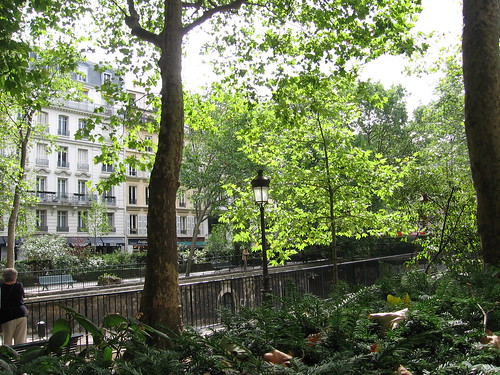
I was on my way to the area around Parc Bercy, passing the Palais Omnisports and finally spotting how they manage to mow the grass on a near-vertical slope. The park was developed on a wine-warehousing site near the railfreight station; some attractive stone-faced buildings have been retained as a rather too spick-and-span shopping village (chi-chi kitchen gadgets, Occitane en Provence and rather a lot of Club Med), surrounded by posh apartments and offices. Stopping for lunch there, I realised there might be an explanation for the decline in the population of sparrows in London. Maybe they've all come here, because there seem to be a lot, in rude health - I saw one fly off with a piece of bread almost as big as itself.
On the way around the park itself, I saw, of all things, a pair of chandeliers hanging over a gateway in a security fence. Passing round the building, I realised this was the Musée des Arts Forains, or fairground art. I'd heard of it, but discounted the idea of visiting because I had the impression they only accepted organised groups: but there was a sign saying the next visit would begin shortly, and the people waiting didn't appear to be a coach-party. Sure enough, though most of them had booked, there was no difficulty about admitting people who, like me, had just turned up on spec. The main point is that you can only take a guided tour, for which they obviously prefer people to book.
 The space is large (several "pavillons" which I assume were also warehouses), with objects hanging from the ceiling and theatrically spot-lit. Our guide started out by concentrating on the art involved, and parallels with what was going on in society at large at the time. With the children getting fractious, he rapidly moved on to the fairground organs and what not only the children had really come for - a chance to try the carousels and games, including a rare bicycle carousel and a café waiters' race, and finishing with a Venetian scene:
The tour took two hours, with other strange and interesting things to see outside as well: definitely a highlight of this trip, and all the more so for being so unexpected. Finally crossing the swooping Passerelle Simone de Beauvoir, what should I see on the (really rather excessive) steps of the Bibliothèque Mitterrand than a candidate for Claude's photographer hunt:

Monday, 18 August 2008
Lest we forget
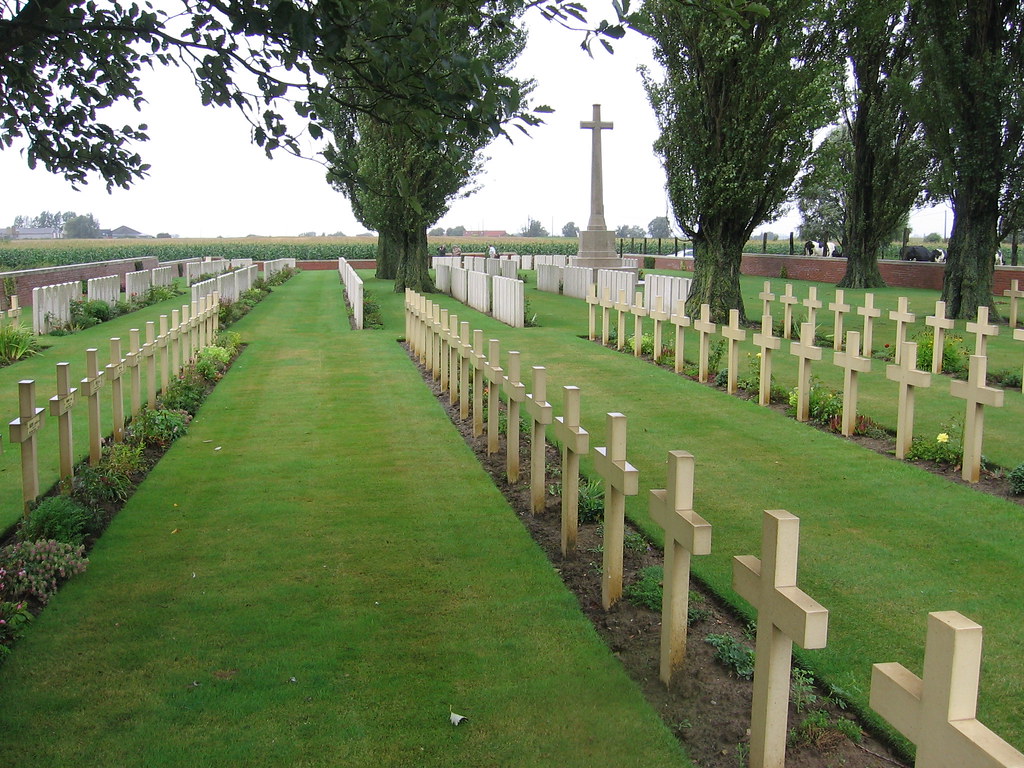
Rain seeping from the low-hanging clouds drifts in veils across the fields of maize and hay-bales; the road comes to the war cemetery a mile beyond the shuttered, single-storeyed Flanders village, turning right at the village recycling centre and past the cattle pond (life goes on). 90 years and all but a month ago, my father's cousin David died near here.
He wasn't the closest relative to die in that war. My father's older brother Harry, who'd joined the artillery in India when Dad was barely a toddler, was sent to the second, successful Mesopotamia campaign in 1917. In the confusion of a sudden sandstorm aiding a Turkish counter-attack, Harry was taken prisoner. Since Turkey did not accept the Geneva Convention on prisoners of war, there was no news of him for a year; by the time his mother heard that he was held at a place on what is now the Turkish/Syrian border (where, most likely, he was put to work building a railway) he had in fact died of disease three months earlier.
There will be little chance to visit his grave - it's in Baghdad. Perhaps in times to come, historians will see my lifetime, despite all the terrible things that have happened, as an interval of peace and prosperity for most of the western world between the long European civil war over the rights and limits of nationhood, and whatever wars are to come over resources, indeed survival itself, in the face of climate change. But for now, I have to mark the extraordinary good fortune that I've have never had to face the same dangers and sacrifices as millions of others, like David and Harry.
This cemetery is not a great silent rolling sward of gravestones, nor a mighty monument like the Menin Gate or Douaumont. David lies, with Privates McLaughlin, Greenway, and Keating, Fernand Berthou, Jean-Baptiste Guichon, Otto Blassmann, Willy Osterkamp (yes, some Germans are here too) and some 500 others in a space not much larger than a football pitch, a corner of a now not so foreign field, shaded by poplars and tucked in between the cowsheds and a crop of spinach. Freight trains thunder past between Lille and Dunkirk; cars, trucks, tractors and concrete mixers race along the main road. Life goes on.
I haven't found an exact record of how David died. It was between the collapse of the last great German offensive and the final Allied counter-attack: a routine patrol, an opportunist sniper, or accident or disease? Many of the individual service records of that time didn't survive the next war, and the unit war diaries only named officers. In the next war, someone who managed to escape from Crete to Cairo managed to list the names of every casualty in the unit and everyone, like my father, taken prisoner; but in World War One, "other ranks" like Harry and David were simply statistics: "Missing: O.R. 1".
Harry was 24, by the way. David wasn't yet 20.
Saturday, 16 August 2008
Strapontins and mixed bedding
One of the first French sentences I learnt in France, rather than from a book, was "Ne pas utiliser les strapontins aux heures d'affluence". Mundane to a French ear, no doubt, just as we Londoners find inexplicable the amusement so many visitors to London get from "Mind the gap". A strapontin is the jump seat by the doors in the Metro, which, if used, takes up useful standing and door space (I think the wording nowadays is "En cas d'affluence", or in other words, the Metro can be crowded at any time of day).
Mundane as the instruction is, there's something irresistible about the rise and fall, the rhythm of the words. The other language lesson my generation got on foreign trains came from the three-language warnings under each window about leaning out (as you could in those days). Each of them seemed to suggest a national stereotype. In German, it sounded like a peremptory bark, from the wax-moustached General Nicht Hinauslehnen; in Italian, the world-weary Professore E Pericoloso Sporgersi merely suggested it was dangerous to lean out; but the rhythm of the French version suggested a flirtatious finger-wag from the elegant and sophisticated Mme Ne Pas Se Pencher Au Dehors.
All of which is by way of introducing the fact that standing beside a strapontin is the best position for pointing a camera lens out of the open window on a Metro train. The occasion for doing so was a ride around on lines 2 (which passes through my local station) and 6; together they form a circle round the outer arrondissements, poorer, posher and middling. More significantly, they run on elevated tracks for parts of the trip in the north-east and south-west (and just at the moment there's a replacement bus for part of line 6, which irritatingly seemed to mean I couldn't do the trip on one ticket).
Here's what you can see:
Not all official announcements are rules, however elegantly phrased (another enjoyable piece of French boilerplate is the requirement to obtempérer aux injonctions of the powers that be). Keeping your eyes open for notices from the Mairie can have its advantages, like spotting the adverts for Classique au Vert: afternoon concerts at the Parc Floral at Vincennes.
They don't cost anything extra on top of the €5 to get into the park. The park itself is pleasant enough, with woodland walks, flamboyant flowerbeds and exhibition pavilions, some of which appear a bit jaded, with elements of botanic and ecological education, but I'm not sure it's worth going out of the way to see, expecially for people with limited time in Paris. There's also a castle with a long history of its own; but one glance at the castle walls induced a touch of castle fatigue. Not even the information that Henry V (of Agincourt fame) died there and that his body was boiled for the journey back to England could tempt me inside. We used to have a family joke about someone once saying "It was a lovely funeral - we buried him with boiled ham", but I never thought it might be as....
The music on the programme was some jolly and inconsequential work by Rossini and his contemporaries, slightly disturbed not only by chattering - rather than thieving - magpies but also chattering people in the row in front of me. There was a shared moment of amusement when a child shrieked with glee at one of the period instruments cracking on a note. Eventually some distant rumbles of thunder said it was time to make a move, but here's a flavour of the event (this music, by the way, is a quintet by Antonin Reicha):
Mundane as the instruction is, there's something irresistible about the rise and fall, the rhythm of the words. The other language lesson my generation got on foreign trains came from the three-language warnings under each window about leaning out (as you could in those days). Each of them seemed to suggest a national stereotype. In German, it sounded like a peremptory bark, from the wax-moustached General Nicht Hinauslehnen; in Italian, the world-weary Professore E Pericoloso Sporgersi merely suggested it was dangerous to lean out; but the rhythm of the French version suggested a flirtatious finger-wag from the elegant and sophisticated Mme Ne Pas Se Pencher Au Dehors.
All of which is by way of introducing the fact that standing beside a strapontin is the best position for pointing a camera lens out of the open window on a Metro train. The occasion for doing so was a ride around on lines 2 (which passes through my local station) and 6; together they form a circle round the outer arrondissements, poorer, posher and middling. More significantly, they run on elevated tracks for parts of the trip in the north-east and south-west (and just at the moment there's a replacement bus for part of line 6, which irritatingly seemed to mean I couldn't do the trip on one ticket).
Here's what you can see:
Not all official announcements are rules, however elegantly phrased (another enjoyable piece of French boilerplate is the requirement to obtempérer aux injonctions of the powers that be). Keeping your eyes open for notices from the Mairie can have its advantages, like spotting the adverts for Classique au Vert: afternoon concerts at the Parc Floral at Vincennes.
They don't cost anything extra on top of the €5 to get into the park. The park itself is pleasant enough, with woodland walks, flamboyant flowerbeds and exhibition pavilions, some of which appear a bit jaded, with elements of botanic and ecological education, but I'm not sure it's worth going out of the way to see, expecially for people with limited time in Paris. There's also a castle with a long history of its own; but one glance at the castle walls induced a touch of castle fatigue. Not even the information that Henry V (of Agincourt fame) died there and that his body was boiled for the journey back to England could tempt me inside. We used to have a family joke about someone once saying "It was a lovely funeral - we buried him with boiled ham", but I never thought it might be as....
The music on the programme was some jolly and inconsequential work by Rossini and his contemporaries, slightly disturbed not only by chattering - rather than thieving - magpies but also chattering people in the row in front of me. There was a shared moment of amusement when a child shrieked with glee at one of the period instruments cracking on a note. Eventually some distant rumbles of thunder said it was time to make a move, but here's a flavour of the event (this music, by the way, is a quintet by Antonin Reicha):
Subscribe to:
Posts (Atom)