Heron Island, Great Barrier Reef, Australia
Showing posts with label krakow. Show all posts

Saturday, 2 January 2010

One of my reasons for going to Krakow was that my father was, as a prisoner of war, working in a coal mine in the area in 1943/44. I'd been able to find in the National Archives a report from the Red Cross inspectors of the time that identified the place (Bory, near Jaworzno) from the camp number, and with a bit of digging on the internet I'd been able to link the German names of that time to the Polish ones.

A bit more digging with Google maps and satellite views, and the local bus company's own online information made it possible to work out how to get there and back by train and bus, reasonably simply.

Jaworzno made a change from tourist Krakow, at the very least. An agglomeration of small villages into modern town planning and development, mixing little streets of one-storey cottages reminiscent of parts of Scotland (a few of the cottages appearing, where the dilapidated render is crumbling, to be built like crude drystone walls) with Soviet-era housing estates and half-hearted shopping centres along modern by-pass roads, and an attempt at a modern town centre. It's actually quite reminiscent of similar attempts in British industrial centres.

Eventually, the bus route ends outside the most likely candidate for Dad's mine. What can I say? I don't quite know what I hoped to find, or what he would have made of it. Had he wanted and been able to visit for himself, he would probably have said - more or less politely - that he recognised bits of it, whether he did or not. It's a mine like many another; the winding gear is spruced up and brightly painted, and most of the buildings are anonymous and undateable. Some of the outbuildings look old and crumbling, but the remains of slagheaps look more like ski-slopes in the morning's fresh fall of snow. The cold at least gives a sense of the desolation I'd have expected to feel in Dad's situation.


There doesn't appear to be anywhere to eat nearby, and if I don't get the bus that's coming, I'll have to wait an hour, since it's Saturday. The only thing to do is to run for the bus, head back to the train for Krakow - and be grateful I've got the option.
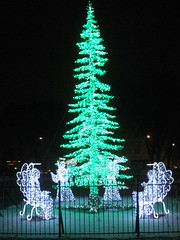
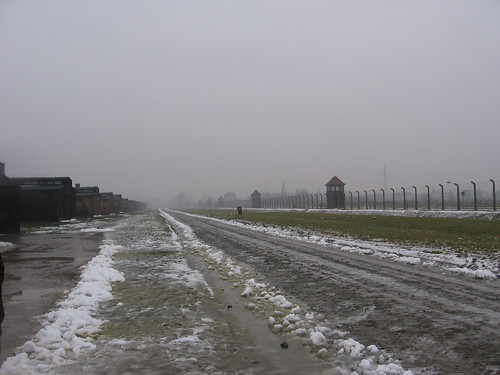
I've never been a great one for celebrating New Year's Eve, and even less on a cold and slushy evening after a day at one of the most miserable places in human history. There was a stage show on the main square, apparently, but a pop concert doesn't appeal at the best of times. So after catching some photos of the more striking Christmas lights and decorations, it was an early night in for me, and Sasha the cat (who comes with the flat). I watched some TV, but the English language world news channels don't hold the attention for long, and the main Polish TV channels have a strange habit of not just dubbing foreign programmes, but overlaying the dubbing on top of the original soundtrack, parts of which remain just audible in the background. Maybe it makes for subconscious language practice, but I found it damned annoying.

The obligatory fireworks took up quite a bit of the night - not much to see in view of the general murk, but plenty to hear, not just a half hour fusillade at midnight, but occasional resurgences throughout (and occasionally the next day, too). Sasha the cat (who comes with the flat) hid under the bed - no more to be said (I'd better stop before I start imagining that Sasha the cat has a big hat, etc., etc.).

Apart from the fireworks, it was also possible to hear that rain was clearing the snow a bit, which meant that New Year's Day was misty. It was also very, very quiet. Not much was open, so I waited to watch the Vienna New Year's Day concert on TV before a brisk walk around the Wawel hill and its cathedral (the decorative rain-spouts making their function very clear).

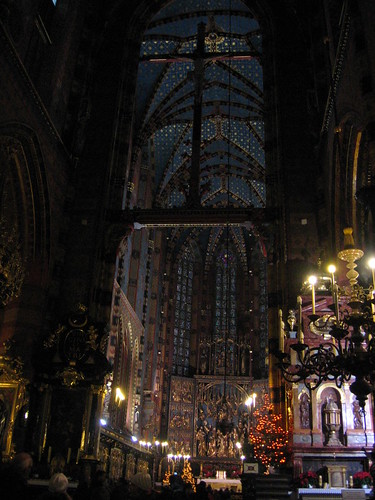
On my way back to the tram, I discovered that the Mariacka church was open to visitors, and stopped to - well, sorry, gawp at the profusion of gilding and the detail of the mediaeval altarpiece:

Thursday, 31 December 2009

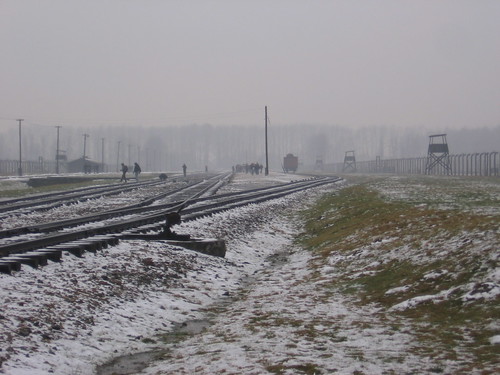
Oh, how promptly and obediently we stuck on the coloured patches our guide gave us to wear. And oh, how the irony of it completely passed her by.


Wednesday, 30 December 2009

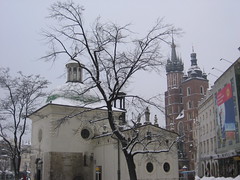
Krakow in the snow

After the first evening, as in every home exchange, of orienting myself to someone else's way of organising their home (so many keys! no teapot! have I, the invading stranger, put the cat off its food?*) and the neighbourhood (evidently the would-be trendy/arty bit of Krakow), it snowed overnight.

Even under skies that stayed leaden-grey all day, there was a certain extra charm to seeing real snow weighing down Christmas trees and street decorations alike.

As the morning wore on, though, the mixture of slush and occasional rain made this a day for indoor sightseeing. In the Czartorysky Museum, one is introduced to a dizzying succession of Polish monarchs and marshals of the 16th-18th centuries and their various portraits, acquisitions and knick-knacks (the glory days of richly-decorated armour and sumptuous carpets and tents acquired as booty from defeating the Ottomans soon give way to more domestic goods), and then a collection of paintings, which likewise rather tails off after the mediaeval, Renaissance and the Rembrandt.

I had lunch in a cellar which also offered a fortune-teller (no-one seemed to need her services, and she didn't seem bothered - no doubt it was no surprise to her).

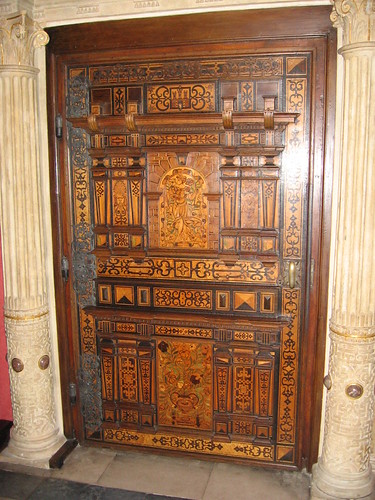
In the Collegium Maius, the mediaeval base and current museum and ceremonial heart of the Jagiellonian University, not everything is mediaeval: it's the closest I shall ever come to an Oscar, and Olympic gold medal or a Nobel prize (this must be one of the few places where you can see them all in one cabinet, as they have been presented to the university by former students). The main impression, however, is of the solemnity with which great institutions like this present their history (all the more understandable here, given what's happened to Poland over the centuries); much is familiar to anyone who's seen an Oxford or Cambridge college chapel or library, but there are some really impressive examples of decorative art and craft:


*This is a rhetorical question. There is a cat. There is food. What - by one letter - is the most economical response?