Heron Island, Great Barrier Reef, Australia
Showing posts with label ely. Show all posts

Monday, 15 February 2021

A tale of two cities: Ely (3)

Outside, you might wonder why there's a cannon defending the Cathedral

It might have something to do with the fact that it's pointing straight at the house that Oliver Cromwell lived in during the 1630s and 1640s, as a rising farmer, country gentleman, Presbyterian (and no fan of bishops, cathedrals or stained glass), and MP.


Part of the ground floor doubles as the Tourist Information Office, but the rest is devoted to presenting the domestic interiors of the day.


Upstairs, there's an outline history of the causes and conduct of the Civil Wars, exploring Cromwell's record as he emerged as a leader in Parliament, army general and ultimately, as "Lord Protector", more or less military dictator and monarch in all but name. Visitors are invited to rate him Hero or Villain - it seemed it had been running around 65-35 in favour of "Hero", reinforcing (for those who remember their 1066 And All That) the view that the Roundheads were Right but Repulsive and the Cavaliers Wrong but Wromantic.

A few streets away there's a small local history museum, with plenty for school parties to get to grips with, from prehistoric finds to the draining of the Fens around about (Cromwell's first big local issue as an MP, standing up for displaced local farmers), eel-fishing (hence the town's name), the history of the assorted criminals and unfortunates who ended up in the building when it was the Bishop's Gaol, and Ely's experience in WW2 as a centre for both evacuees from London and massive numbers of airmen on bases nearby. 


Those apart, it's a pleasant, busy and reasonably well-serviced small town, though my photos don't capture much of that (I can never get over the habit of not taking pictures of the humdrum and everyday, even though that might be of most interest to others). The bland chainstore frontages of the main shopping streets somewhat conceal interesting side alleyways.


And on the way back to the station, it's worth a diversion to a well-pubbed waterside:


Sunday, 14 February 2021

A tale of two cities: Ely (2)

Arriving at the Cathedral, there are some impressive doors:

and the view of the interior, and particularly its roof, is equally impressive:

So are its stone, metal and wooden fixtures and fittings:

Some of the decoration, particularly the painted ceiling, is Victorian, part of the revival of interest in mediaeval styles previously dismissed as too papistical. The really distinctive thing about the Cathedral is, however, original: well, almost. The Octagon Tower was built in 1322 to replace an earlier Norman tower that had collapsed.


Victorian, too, are the stained glass windows; but upstairs in a side gallery, heralded by the play of coloured light from the windows on the floor, is the Stained Glass Museum, all about how it developed, and is made to this day, with plenty of examples, not only mediaeval but also early twentieth-century domestic and contemporary aesthetic (with plenty of Victorian stuff in between):


Saturday, 13 February 2021

A Tale of Two Cities: Ely (1)

Real-life travel being off the agenda for the foreseeable (no point trying to predict anything these days, it seems), time to do some armchair travel with old photos (surprising how little one actually looks at them, once taken and filed away). Back in the mists of pre-Covid time (2018, to be precise), one adventure was a day trip to Ely. Tidying up some old souvenirs had turned up a programme for a concert in the cathedral that I must have been to in my student days, but I have no recollection of it at all, so it seemed worth checking out again.

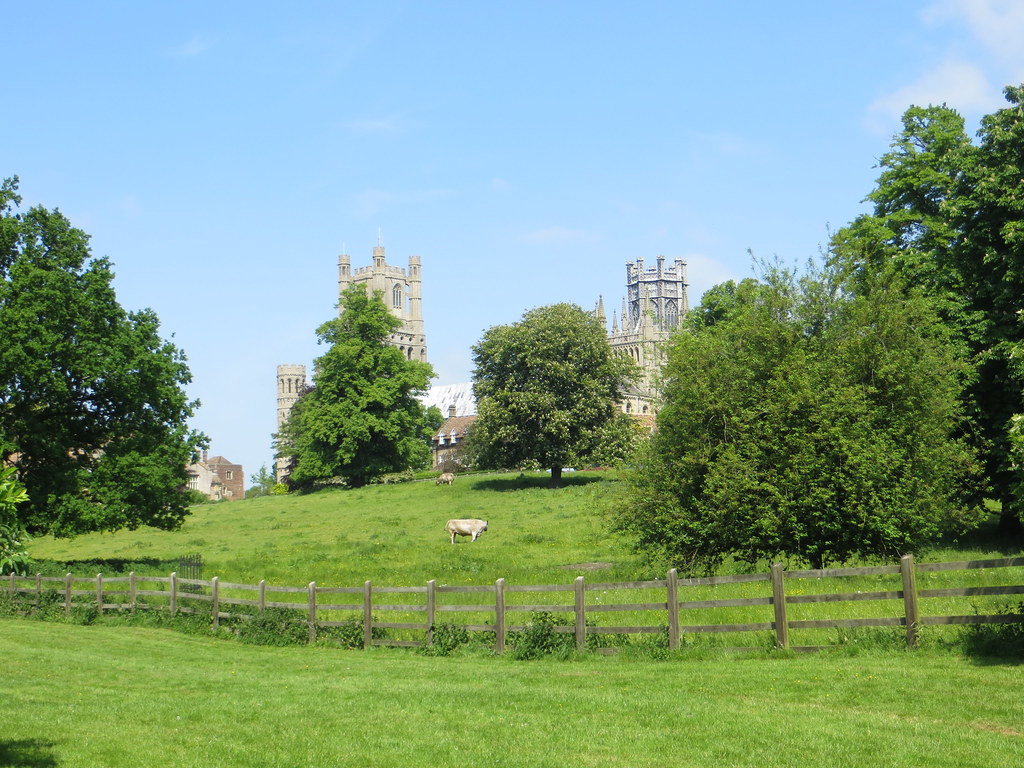
It's such a small place, on one of the few hills for miles around, that the Cathedral's domination of the town is visible from quite a way away. 

On leaving the station, there's a handy poster map of the centre to show the way to all the main attractions, but it's hardly necessary in the circumstances. Go round through the park, rather than the ordinary-looking streets, and the Cathedral (and with it the geography of the centre) is easily found.


It was originally the heart of a massive mediaeval monastery, whose purlieu took up most of where the modern town stands. On the Dissolution of the Monasteries, Henry VIII allowed the Cathedral to stand, and many of the surrounding buildings to become the King's School, which is there to this day, and mostly behind walls, off-limits to the passer-by. 


So even if you're welcome to use the park and pass through to the town centre, there's still a cloistered feel to it all.


But lest you think this place is entirely other-worldly, the old gate house to the Cathedral/School area contains a library which is keeping up with the times.

On to the Cathedral....