According to the statutory planning application notice attached to our riverboat pier, we are to have, not just a signpost or an information board, or a map, but..
an "interchange totem".
Watch out for war-dancing commuters.
Showing posts with label languages. Show all posts
Showing posts with label languages. Show all posts
Thursday, 10 September 2015


Tuesday, 9 July 2013

Saturday, 30 March 2013
Jargogled, at all?
A slight touch of apricity at last, after so much lumming and the not so distant memory of snowbroth, not to mention the enlivening prospect of a longer twitter-light, tempted me out on my bike again.
Not that the exercise is likely to turn me into a monsterfully callipygian snoutfair, but it might hold at bay for a little longer the chances of becoming a complete jollux. Alas, the wind deals such a curglaff that any bike discovers its inherent resistentialism, gorgonizing the rider into an elflocked quockerwodger, reduced to groaking outside the chippy like a lunting slubberdegullion, or tempted into the warmth of the pub, even at the risk of a fuzzled, crapulous curmuring.
In case you're thinking these must be the beef-witted twattlings, hugger-mugger cant or grumpish brabbling of a lethophobic cockalorum, relax: it's just a test of whether it pays, as the Reader's Digest used to say, to increase your word power - with the help of this little list.
Not that the exercise is likely to turn me into a monsterfully callipygian snoutfair, but it might hold at bay for a little longer the chances of becoming a complete jollux. Alas, the wind deals such a curglaff that any bike discovers its inherent resistentialism, gorgonizing the rider into an elflocked quockerwodger, reduced to groaking outside the chippy like a lunting slubberdegullion, or tempted into the warmth of the pub, even at the risk of a fuzzled, crapulous curmuring.
In case you're thinking these must be the beef-witted twattlings, hugger-mugger cant or grumpish brabbling of a lethophobic cockalorum, relax: it's just a test of whether it pays, as the Reader's Digest used to say, to increase your word power - with the help of this little list.
Monday, 23 July 2012
Startling discovery!
It may be a belated discovery, but that's what comes of being taught a language with a view to studying the high literary culture rather than everyday life: in French, paper clips are called "trombones".
That is all.
That is all.
Friday, 20 July 2012
Adventures in machine translation
Every morning, our hotel in the Stubaital would give us an overview of the day's weather and some suggestions for the day's activities. One day the English version on our breakfast table proposed a walk to look at the monastery bodice - an intriguing prospect, till the German teachers of English on the neighbouring table pointed out that the German for "bodice" was more or less the same as the name of a village further down the valley. We also had suggestions for "fastidious mountain routes", and one of the mountain lodges in the area (the Oberrisshütte, if you're interested) was translated (semantically if not semiologically correctly) as "the upper crack shack".
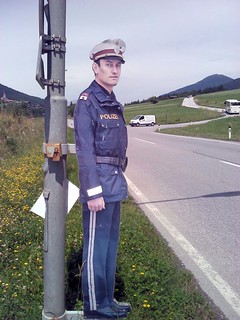
Machine translation still has a long way to go (as any fule kno). Likewise, perhaps, the idea that a suitable deterrent for drivers tempted to speed would be a simple life-size photograph of a policeman, safely padlocked to a lamp-post.

Machine translation still has a long way to go (as any fule kno). Likewise, perhaps, the idea that a suitable deterrent for drivers tempted to speed would be a simple life-size photograph of a policeman, safely padlocked to a lamp-post.
Monday, 11 June 2012
Rank sedition!
Something that caught my eye in today's paper: on the sample list of words that the government expects primary school children to spell properly, are "bruise", "destroy", "ridiculous" and "tyrant": is someone trying to drop a hint to the Secretary of State?
That said, it can only be a good thing if children routinely start learning foreign languages in primary schools (provided, that is, the resources will be there to make it happen properly - don't hold your breath).
That said, it can only be a good thing if children routinely start learning foreign languages in primary schools (provided, that is, the resources will be there to make it happen properly - don't hold your breath).
Saturday, 19 November 2011
Subtitles
There's a small flurry of excitement about the launch of the new series of the Danish crime series The Killing ("this time, she's got a new jumper!").
Apart from the whole question of why we enjoy watching so much misery played out, I'm struck by the commissioners' anxiety about the acceptability of subtitles. I'm wondering how many people have to use them even for English-language films and programmes, now that a naturalistic sound ambience and styles of acting and [in]articulation can make it difficult to make out what someone's saying. I had to use them all the time for The Wire, and even occasionally for homegrown drama. (And no, it's not my ears: try listening to any replays of old programmes made in dead studio sound, or to His Girl Friday, of 1939, and see how they still manage to get the dialogue across, the faster and more manic it gets towards the end).
If there's a problem with subtitles, it's when you do have some knowledge of the original language, but not quite enough to keep up, especially if it's full of slang delivered at speed - as for example in Spiral (Engrenages in the original French), which also filled the same "cult" slot on BBC4.
I'm forever trying to translate back from what I'm reading to what I've heard, which tends to distract from following the plot, even if it does add to my knowledge of French police procedure and criminal jargon (let's hope there's no need for that to come in handy next time I go). Even in other languages, there's a temptation to pick out odd bits and pieces: the way Sarah Lund referred to her CV left me wondering whether what we think of in English as "estuary" vowels might actually be a relic of the Angles and Vikings all those centuries ago.
Apart from the whole question of why we enjoy watching so much misery played out, I'm struck by the commissioners' anxiety about the acceptability of subtitles. I'm wondering how many people have to use them even for English-language films and programmes, now that a naturalistic sound ambience and styles of acting and [in]articulation can make it difficult to make out what someone's saying. I had to use them all the time for The Wire, and even occasionally for homegrown drama. (And no, it's not my ears: try listening to any replays of old programmes made in dead studio sound, or to His Girl Friday, of 1939, and see how they still manage to get the dialogue across, the faster and more manic it gets towards the end).
If there's a problem with subtitles, it's when you do have some knowledge of the original language, but not quite enough to keep up, especially if it's full of slang delivered at speed - as for example in Spiral (Engrenages in the original French), which also filled the same "cult" slot on BBC4.
I'm forever trying to translate back from what I'm reading to what I've heard, which tends to distract from following the plot, even if it does add to my knowledge of French police procedure and criminal jargon (let's hope there's no need for that to come in handy next time I go). Even in other languages, there's a temptation to pick out odd bits and pieces: the way Sarah Lund referred to her CV left me wondering whether what we think of in English as "estuary" vowels might actually be a relic of the Angles and Vikings all those centuries ago.
Tuesday, 25 January 2011
Words, words, words
I see Madame Defarge is feeling deprived of the opportunity to comment in her Blogger identity. Such is the world of dependence on "free" software, but that's one of my King Charles's heads when I'm at work, and I don't intend to harp on it now.
Instead, let us ponder the relative frustrations of, on the one hand, having things to say and not being able to say them, or - as in my case in recent weeks - having a space to say things, and not finding that much to say.
It might, perhaps, be an idea to try a different sort of concept: in which spirit, this website offers some ideas for blog titles - Crepuscular Degeneration, anyone? Withdrawn Lassitude?
 Alternatively, some new vocabulary might be in order. In which case, in honour of Burns Night, here is a test of some opportunities from north of the border. (29 out of 35, since you ask, mostly by inspired guesswork: and I'm still working out how to create the opportunity to call someone a kenspeckle bauchle cockapentie - now that would be a blog identity to have some fun with).
Instead, let us ponder the relative frustrations of, on the one hand, having things to say and not being able to say them, or - as in my case in recent weeks - having a space to say things, and not finding that much to say.
It might, perhaps, be an idea to try a different sort of concept: in which spirit, this website offers some ideas for blog titles - Crepuscular Degeneration, anyone? Withdrawn Lassitude?
 Alternatively, some new vocabulary might be in order. In which case, in honour of Burns Night, here is a test of some opportunities from north of the border. (29 out of 35, since you ask, mostly by inspired guesswork: and I'm still working out how to create the opportunity to call someone a kenspeckle bauchle cockapentie - now that would be a blog identity to have some fun with).
Tuesday, 19 October 2010
More solutions
On my way back from the Post Office (why is the person in front of me in the queue always the angry one with the complicated grievance?), I noticed yet another "solutions" merchant: a van on a building site, advertising "progressive fenestration solutions" (=they put in the windows).
Just the sort of thing to make me contemplate a progressive defenestration solution of my own.
Just the sort of thing to make me contemplate a progressive defenestration solution of my own.
Saturday, 17 July 2010
Faux amis
I've learnt a new French verb from Claude's blog: "je fessebouc" (think about it).
Does that mean that the French think of the world's largest online network as "Bumgoat"?
Does that mean that the French think of the world's largest online network as "Bumgoat"?
Thursday, 5 February 2009
Dilemma
Today I received an email at work which included a remark about the need to ensure that X would be "kept in the loop going forward".
This sounds to me like a nasty accident waiting to happen. Should I tell Health and Safety?
This sounds to me like a nasty accident waiting to happen. Should I tell Health and Safety?
Wednesday, 21 May 2008
Da dit
 Being the kind of person who hangs on to almost anything in case it comes in useful (I'm still giving houseroom to a massive turn-the-handle gramophone - one day I might get round to digitizing all my 78s), I was cheered (and I'm not the only one) to read that the author Alan Sillitoe still keeps his hand in at the Morse code he learned as a radio operator in 1944 - and there's a French poetry magazine that's broadcast in Morse, apparently.
I've never learnt more than a few dah-dits in Morse - enough to recognise the origins of the signature tune for the Inspector Morse series, and ro realise that text messaging on mobile was at least giving ...--... a new lease of life (SMS, if you hadn't worked it out, as the default ringtone for an incoming message). I couldn't see myself tapping away in the darkness, or waiting to see if the coded message would get through before the sinister knock on the door; but on the Joni Mitchell principle ("You don't know what you've got till it's gone"), I admire people who keep supposedly obsolete skills - and languages - alive.
Now, is there a celebrity that can do semaphore?
Thursday, 15 May 2008
Nothing to do with Samson or Philistines..
 For some time now, I've been intrigued by this sign on a local building site.
Apart from the familiar meaning of "slew", I know it as a noun. My old Oxford dictionary has the meaning of a swampy pond, which explains why it conveys unpleasant or disparaging associations to me: but it seems there's also an American usage whose meaning may come from an Irish word simply meaning "many" (evidence, no doubt, that I don't know my Erse from my elbow).
A verb whose present tense is "slew" is something new to me. On checking, I find it means to turn on the spot, or on the same axis, and by extension to swing round (and as a metaphor, to get someone drunk or to exhaust them with beating). So I suppose in this context it's - prosaically - simply a warning to the crane and machine drivers to be careful not to swing round and risk bashing the existing structure the sign's attached to.
But it also seems to me like a perfect substitute for that old political metaphor the "u-turn". Obviously, one has to be careful to avoid inadvertent libel, but, if the appropriate circumstances arose, even the Evening Standard might be tempted by a headline like BORIS: I SLEW ON BENDY-BUSES.
Saturday, 5 April 2008
;
I've just caught up with a piece in yesterday's Guardian (I just can't get through it all in the day, and usually catch up over tea in bed the next morning): apparently, there's a hooha in France about the decline of the point virgule (which sounds much more interesting, racier even, than the half-hearted English "semi-colon", don't you think?).
It sounds, as they say, a classically French piece of intellectual anguish, and letters to the Guardian about it today sound a classically English response of harrumphing pragmatism combined with a mild facetiousness.
What are described as the French rules for the use of the semi-colon are what I was taught for use in English. This is interesting, when you consider other differences in practice when it comes to notating punctuation. Each language has its own quirks: take, for example, the different ways of indicating speech (in French, with a long dash; in German, between >> and <<). The Spanish way of using upside-down question marks and exclamation marks at the beginning of the sentences that require them right way up at the end seems somehow to fit the way a flamenco dancer or a bullfighter takes a stance before getting on with the business at hand; and I think I'm right in saying German rarely has a need for semi-colons, if at all.
I wouldn't regard Guillemette Faure's suggestion that a semi-colon could become an emoticon as necessarily a sign of loss or failure. Not only in email but even more in real-time text chat (in which I once had a passing academic interest), what could more elegantly serve to indicate "Hang on a minute, that needs a bit more thought" or even "You do realise you've just said that out loud"?
As you might guess, I'm with the semi-colon's defenders, if only on the Joni Mitchell principle ("You don't know what you've got till it's gone"). I particularly like these two explanations:
and this from Will Self (not a writer I get on with, usually):
Of course, as with any lament for a symbol, it's an underlying reality that's causing concern. In this case, I think it's the tide of purely functional, crudely pragmatic rather than reflective prose - the kind that peddles certainties, and avoids complexity, qualification, contradictions. And that is not unique to any one language or culture.
It sounds, as they say, a classically French piece of intellectual anguish, and letters to the Guardian about it today sound a classically English response of harrumphing pragmatism combined with a mild facetiousness.
What are described as the French rules for the use of the semi-colon are what I was taught for use in English. This is interesting, when you consider other differences in practice when it comes to notating punctuation. Each language has its own quirks: take, for example, the different ways of indicating speech (in French, with a long dash; in German, between >> and <<). The Spanish way of using upside-down question marks and exclamation marks at the beginning of the sentences that require them right way up at the end seems somehow to fit the way a flamenco dancer or a bullfighter takes a stance before getting on with the business at hand; and I think I'm right in saying German rarely has a need for semi-colons, if at all.
I wouldn't regard Guillemette Faure's suggestion that a semi-colon could become an emoticon as necessarily a sign of loss or failure. Not only in email but even more in real-time text chat (in which I once had a passing academic interest), what could more elegantly serve to indicate "Hang on a minute, that needs a bit more thought" or even "You do realise you've just said that out loud"?
As you might guess, I'm with the semi-colon's defenders, if only on the Joni Mitchell principle ("You don't know what you've got till it's gone"). I particularly like these two explanations:
Michel Volkovitch, author, poet and translator, is another ardent defender. "The point-virgule is precious when the subject matter is complex," he says. "For constructing a piece properly, distinguishing themes, sections and sub-sections - in short, for dissipating any haziness or imprecision of thought. It puts things in order, it clarifies. But it's precious, too, for adding a little softness, a little lightness; it can stop a sentence from touching the ground, from grinding to a halt; keeps it suspended, awake. It is a most upmarket punctuation mark."
and this from Will Self (not a writer I get on with, usually):
I like them - they are a three-quarter beat to the half and full beats of commas and full stops. Prose has its own musicality, and the more notation the better. I like dashes, double-dashes, comashes and double comashes just as much. The colon is an umlaut waiting to jump; the colon dash is teasingly precipitous.
Of course, as with any lament for a symbol, it's an underlying reality that's causing concern. In this case, I think it's the tide of purely functional, crudely pragmatic rather than reflective prose - the kind that peddles certainties, and avoids complexity, qualification, contradictions. And that is not unique to any one language or culture.
Wednesday, 26 March 2008
Odi et amo
 A chance discussion about learning Latin brought back some memories recently.
In my time, schoolbooks didn't seem to go out of their way to be particularly interesting (though it seems there may have been aspects we and our teachers were unaware of). All I remember of the early days of school Latin was a bit of the Aeneid and Caesar and his weird fetish for throwing his armies across rivers. And "All Gaul was quartered into three halves" (pause for schoolmasterly snicker). Later, I felt distinctly cheated to discover that all along there'd been texts (which we studied for an exam that turned out not to require them) containing racy bits from bishops' visitation reports (a sort of Dark Ages Father Ted), St Columba meeting the Loch Ness monster, all that sort of thing.
I also remember my first exchange visit to a family in Paris as a shy, homesick teenager, my school French coping with official signs and instructions but hopelessly lost in the torrential volubility of family life (I now see Madame was perhaps as nervous as me or my own mother: probably wondering if I was expecting to eat roast beef with mint sauce and milky tea all the time). In all that, the one familiar point was my exchange partner's first choice of record to play. I didn't understand a word of the French, of course (I had to Google for the lyrics before I could try the translation below), but the opening chorus was clear as anything:
Rosa rosa rosam
Rosae rosae rosa
Rosae rosae rosas
Rosarum rosis rosis
It's the oldest tango in the world, that blond heads learning Latin heehaw like a nursery rhyme
It's the tango of school, that traps dreams - it would be sacrilege not to let it make you naughty
It's the tango of the good fathers who keep a warning eye on the Jules and Prospers who'll be tomorrow's France
It's the tango of the spotty swots, all wrapped up in cottonwool around hearts already cold
It's the tango of the must-try-harder, who conjugate disappointment and who'll end up behind a counter because Daddy didn't.
It's the past tense, where I came bottom, because this rosa rosae tango wasn't as much fun as my cousin Rosa
It's the tango of strolls alone together under corbelled, statued arcades protecting us from questions
It's the tango of rain on the yard, the mirror of an unloving pool that made me see, one fine day, I'd be no Vasco de Gama
But it's the tango of the blessed time where such a little kiss, one empty Thursday, made Cousin Rosa rosy.
It's the tango of the time of zeros - I had so many, written small and big, I could make tunnels for Charlie Chaplin, halos for St Francis
It's the tango of prizes for those who had the luck to learn in childhood everything that would be no use
But it's the tango you regret, once you've bought the time to see, dumbly, that Roses have thorns.
Friday, 25 January 2008
Ivy, privy, famous; clamour
Many thanks to Ché.l'écossais who, in a comment on Word du Jour, drew attention to this brilliant guide to English pronunciation. Try reading it out loud - I had to pause once or twice. And it was written by a foreigner, too.
Ivy, privy, famous; clamour: he couldn't have known how succinct a description that is about so much of the modern process of journalism....
Ivy, privy, famous; clamour: he couldn't have known how succinct a description that is about so much of the modern process of journalism....
Friday, 28 December 2007
Some Christmas logodaedaly
In the true spirit of a family Christmas, I think I shall treat you to the benefit of one of the books I was given.
I don't think I can quite sustain a complete consuetudinary to the tralatitious Christmas celebration, but you may take it from me that our gulosity deliciated in my sister-in-law's magirologistic skills - no omophagy here. We are hardly prone to polydipsia, but we can appreciate a certain nippitate nittiness at this time of year - thank goodness, not a trace of the jumentous! Of course, there was much galimatias, but on the whole we avoided the risk of becoming temulent or succumbing to the woofits.
The children there were delightful as ever: not at all mammothrept - not a sign of momurdotes. Of course, there were times when might wish for a sitooterie, particularly when a grandparental whigmaleery presented a three-year old with one of these. Oh the rimbombo!
How was your Christmas? Were all your gifts cromulent? An autogeneal curwhibble, perhaps, or something from the knackatory? Were the presents you gave crumenically laetificant?
I don't think I can quite sustain a complete consuetudinary to the tralatitious Christmas celebration, but you may take it from me that our gulosity deliciated in my sister-in-law's magirologistic skills - no omophagy here. We are hardly prone to polydipsia, but we can appreciate a certain nippitate nittiness at this time of year - thank goodness, not a trace of the jumentous! Of course, there was much galimatias, but on the whole we avoided the risk of becoming temulent or succumbing to the woofits.
The children there were delightful as ever: not at all mammothrept - not a sign of momurdotes. Of course, there were times when might wish for a sitooterie, particularly when a grandparental whigmaleery presented a three-year old with one of these. Oh the rimbombo!
How was your Christmas? Were all your gifts cromulent? An autogeneal curwhibble, perhaps, or something from the knackatory? Were the presents you gave crumenically laetificant?
Sunday, 2 December 2007
Amusia
Sitting indoors with the makings of a cold on a wet winter Sunday, catching up on yesterday's newspaper, my eye lights on the word "amusia".
For a moment, I thought of a mythical country where the national sport might be giggling, the national anthem Will You Stop Your Tickling, Jock, and the most solemn day of the year would feature the laying of a wreath of water-squirting flowers to commemorate those who died laughing. But like all utopias, it would have its dystopian side: can you imagine what Kafka would have made of The Laughing Policeman?
As it happens, the reality of amusia would be even worse for me: the inability to recognise music as music. It's discussed in Oliver Sacks's book Musicophilia (another one to add to the pile of fascinating things to find out about), but I remember now there was a flurry of interest about a year ago, about the Delosis online test. (I've just done it again, and from what I recall, my score's gone up since I did it a year ago - I seem to be more aware of rhythmic variations).
We might occasionally debate whether it would be worse to lose one's sight or one's hearing. Heaven knows, I hope never to find out. But if there's one thing worse than losing the hearing of music, it would be having hearing but experiencing music as a meaningless clatter indistinguishable from all the other extraneous noise of the world. Imagine, none of the inspiration or consolations of great music (or of the cheaply potent).
For a moment, I thought of a mythical country where the national sport might be giggling, the national anthem Will You Stop Your Tickling, Jock, and the most solemn day of the year would feature the laying of a wreath of water-squirting flowers to commemorate those who died laughing. But like all utopias, it would have its dystopian side: can you imagine what Kafka would have made of The Laughing Policeman?
As it happens, the reality of amusia would be even worse for me: the inability to recognise music as music. It's discussed in Oliver Sacks's book Musicophilia (another one to add to the pile of fascinating things to find out about), but I remember now there was a flurry of interest about a year ago, about the Delosis online test. (I've just done it again, and from what I recall, my score's gone up since I did it a year ago - I seem to be more aware of rhythmic variations).
We might occasionally debate whether it would be worse to lose one's sight or one's hearing. Heaven knows, I hope never to find out. But if there's one thing worse than losing the hearing of music, it would be having hearing but experiencing music as a meaningless clatter indistinguishable from all the other extraneous noise of the world. Imagine, none of the inspiration or consolations of great music (or of the cheaply potent).
Saturday, 1 December 2007
It's a commonplace that one of the best ways to learn a language is to fall in love with a native (I'm bowdlerising a bit, I think): one of the next best is to fall in love with a song.
I picked up on a phrase in one of Claude's posts that called to mind a song sung by Jean Sablon which I have on a 78. And in hunting for an online recording for someone else, I found on Youtube a whole treasure trove of chanson: Sablon, Trenet, Mistinguett, Lucienne Boyer, Damia. In amongst them was this one of Jean Sablon's that I didn't know:
I picked up on a phrase in one of Claude's posts that called to mind a song sung by Jean Sablon which I have on a 78. And in hunting for an online recording for someone else, I found on Youtube a whole treasure trove of chanson: Sablon, Trenet, Mistinguett, Lucienne Boyer, Damia. In amongst them was this one of Jean Sablon's that I didn't know:
Friday, 23 November 2007
Words, words, words...
Apparently, some words of mine sent Claude to her dictionary.
As it happens, I've been trying to read some Fred Vargas that I bought on a previous trip to France. No chance of reading it on the train*, I'm afraid, as I find almost every page contains something to send me off to my huge Robert - accastillage, baffe, mettre en boule, plastron, bousiller (she likes that word, does our Ms Vargas), crânement.......
Proof once more that when it comes to languages, there really is no substitute for just doing it, over and over again.
The book's just introduced the idea of a Breton village crier - Ar Bannour - whose voice can carry from the church to the wash-house. The first is an obvious title for a blog: but then the second might better reflect the reality of a lot....
*There was a man on the tube this morning reading a book by an author with a Turkish-looking name, and a title that looked like no language I could recognise; I guessed Albanian - but then he pulled out of his bag a Kurdish dictionary. That's London for you.
As it happens, I've been trying to read some Fred Vargas that I bought on a previous trip to France. No chance of reading it on the train*, I'm afraid, as I find almost every page contains something to send me off to my huge Robert - accastillage, baffe, mettre en boule, plastron, bousiller (she likes that word, does our Ms Vargas), crânement.......
Proof once more that when it comes to languages, there really is no substitute for just doing it, over and over again.
The book's just introduced the idea of a Breton village crier - Ar Bannour - whose voice can carry from the church to the wash-house. The first is an obvious title for a blog: but then the second might better reflect the reality of a lot....
*There was a man on the tube this morning reading a book by an author with a Turkish-looking name, and a title that looked like no language I could recognise; I guessed Albanian - but then he pulled out of his bag a Kurdish dictionary. That's London for you.
Subscribe to:
Posts (Atom)