Tuesday, 11 February 2025
Friday, 15 March 2024
Steam trains - up a mountain and along a valley
My trainspotting days are long gone, but they were in the age of steam, and something remains of the appeal of the steam engine which quiet, efficient electric trains just don't seem to have. Our group had a strong contingent of serious anoraks, who knew a great deal about all that sort of thing and enthusiastically took up the option to explore as much as possible of the Harz network, with the rest of us tagging along for a couple of rides with the better views. (It wasn't just the engines that were old - the carriages were, I suspect, old third-class stock from East German railways - wooden seats and not much in the way of suspension, while the toilet facilities were the old-style trap that simply opened on to the track beneath).
The high point (literally) of the trip was to go up the Brocken mountain. Old legend has it that on Walpurgisnacht, witches would gather on the mountain for a "witches' sabbath" (sort of a springtime Halloween, but no doubt used in its time for the periodic persecution of supposed witches, as elsewhere). More recently, being such a handy high point so close to the border between East and West Germany, it became a listening post for surveillance and spying on Western transmissions, but also housed (as it still does) a TV transmission tower.
The train winds its way up through forests (sadly depleted since a blight struck much of it a few years ago, as did some wildfires) to the - frankly rather bleak - plateau on top. Perhaps not surprisingly, the views from the top were almost entirely of enclosing clouds, so nobody wanted to linger.
Another day, we had more sunshine and a gentle ride through a river valley, to a quiet spa town and back.
And it looked and felt like this:
Thursday, 14 March 2024
More holiday snaps - Quedlinburg
Monday, 4 March 2024
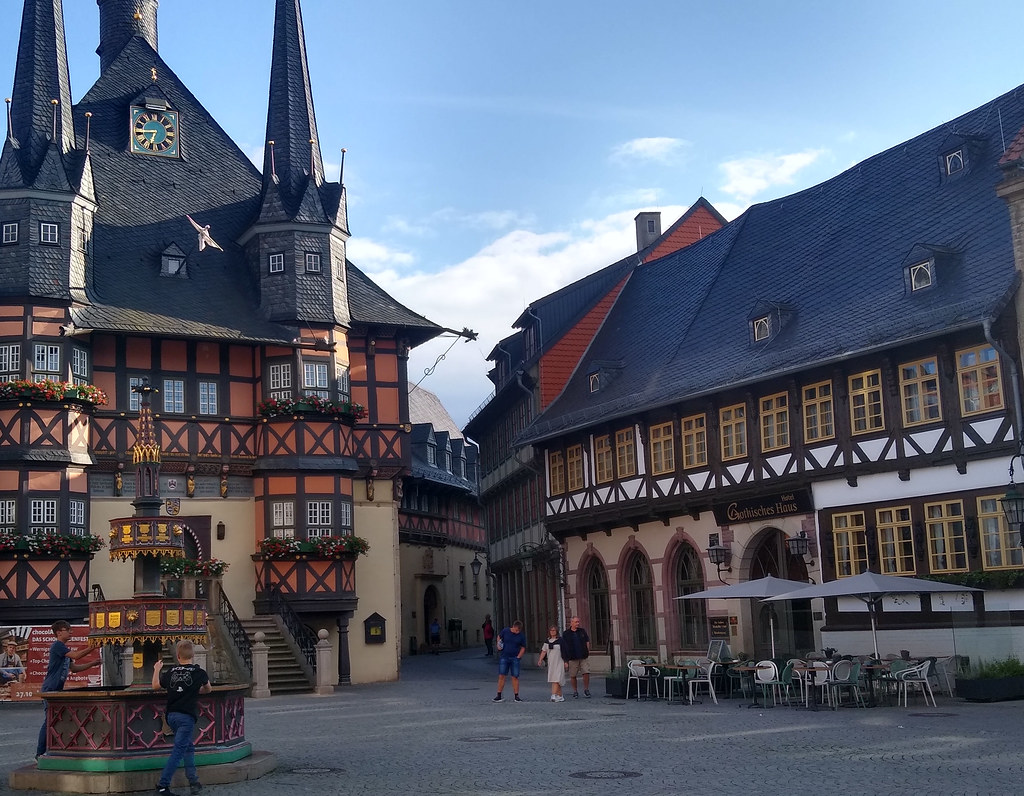
More holiday snaps - Wernigerode
After our brief stop to ride the Schwebebahn, the trains took us to our base for the week, in Wernigerod: in the heart of the Harz, so to speak.
It's picturesque and traditional-looking, with plenty of half-timbered houses and flowers (it even has a floral clock, just as one used to see in the posher British seaside holiday resorts).
![]() |
![]() |
| Is it a bird? Is it a plane? It's outside the library, at least |
And there's a castle (of course). The local aristocrats had a long history, but their castle reflects a rebuild in the ponderous taste of the late 19th century - all dark wood and stuffed hunting trophies outside, and touches of pseudo-mediaeval fairytale outside:
![]() |
| The castle courtyard |
One thing I couldn't help noticing was that in at least one place they had retained the old East German Ampelmann for the pedestrian crossing lights. Somehow he looks rather jollier than one would expect from a Communist dictatorship, which is no doubt why he was held in such affection:
But they also maintain a nod to the area's association with legends of witches and the like:
Thursday, 18 February 2021
A tale of two cities: WInchester (3)
Wednesday, 17 February 2021
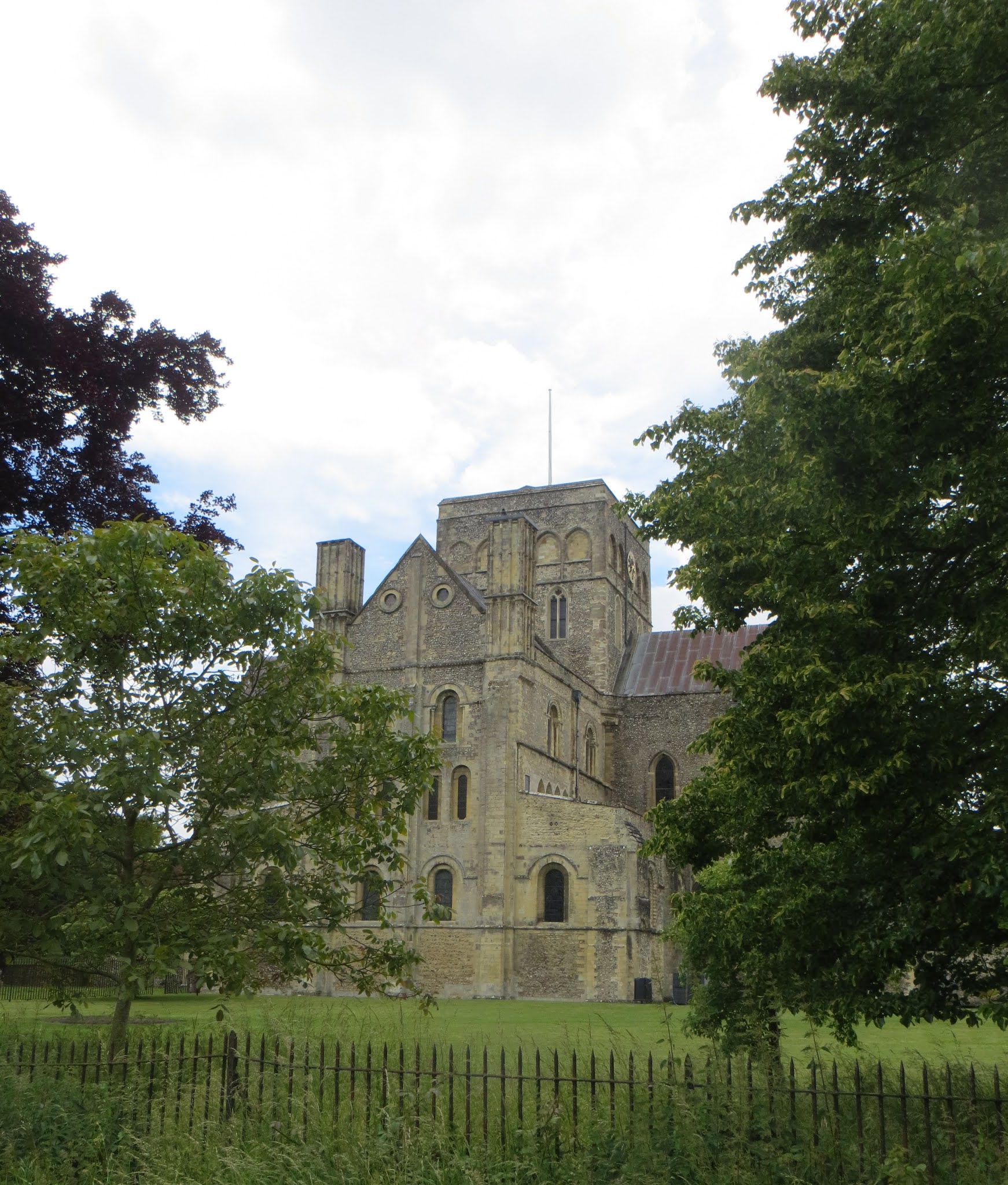
A tale of two cities: Winchester (2)
| On doing the outside (as you must to get to the café), the path passes this statue to the extraordinary William Walker, who toiled for years among the Cathedral's foundations to shore them up against encroaching ground water.
Small wonder that in the surrounding streets there's a pub named after him, complete with diver's helmet as its sign. |
Tuesday, 16 February 2021
A tale of two cities: Winchester (1)
Monday, 15 February 2021
A tale of two cities: Ely (3)
It might have something to do with the fact that it's pointing straight at the house that Oliver Cromwell lived in during the 1630s and 1640s, as a rising farmer, country gentleman, Presbyterian (and no fan of bishops, cathedrals or stained glass), and MP.
Part of the ground floor doubles as the Tourist Information Office, but the rest is devoted to presenting the domestic interiors of the day.
Upstairs, there's an outline history of the causes and conduct of the Civil Wars, exploring Cromwell's record as he emerged as a leader in Parliament, army general and ultimately, as "Lord Protector", more or less military dictator and monarch in all but name. Visitors are invited to rate him Hero or Villain - it seemed it had been running around 65-35 in favour of "Hero", reinforcing (for those who remember their 1066 And All That) the view that the Roundheads were Right but Repulsive and the Cavaliers Wrong but Wromantic.
A few streets away there's a small local history museum, with plenty for school parties to get to grips with, from prehistoric finds to the draining of the Fens around about (Cromwell's first big local issue as an MP, standing up for displaced local farmers), eel-fishing (hence the town's name), the history of the assorted criminals and unfortunates who ended up in the building when it was the Bishop's Gaol, and Ely's experience in WW2 as a centre for both evacuees from London and massive numbers of airmen on bases nearby.
Those apart, it's a pleasant, busy and reasonably well-serviced small town, though my photos don't capture much of that (I can never get over the habit of not taking pictures of the humdrum and everyday, even though that might be of most interest to others). The bland chainstore frontages of the main shopping streets somewhat conceal interesting side alleyways.
And on the way back to the station, it's worth a diversion to a well-pubbed waterside:
Sunday, 14 February 2021
A tale of two cities: Ely (2)
and the view of the interior, and particularly its roof, is equally impressive:
So are its stone, metal and wooden fixtures and fittings:
Some of the decoration, particularly the painted ceiling, is Victorian, part of the revival of interest in mediaeval styles previously dismissed as too papistical. The really distinctive thing about the Cathedral is, however, original: well, almost. The Octagon Tower was built in 1322 to replace an earlier Norman tower that had collapsed.
Victorian, too, are the stained glass windows; but upstairs in a side gallery, heralded by the play of coloured light from the windows on the floor, is the Stained Glass Museum, all about how it developed, and is made to this day, with plenty of examples, not only mediaeval but also early twentieth-century domestic and contemporary aesthetic (with plenty of Victorian stuff in between):