Heron Island, Great Barrier Reef, Australia
Showing posts with label museums. Show all posts

Friday, 17 May 2024

Another day, another museum

 
On my list of places to visit for some years - Strawberry Hill House, a Gothic fantasy of Horace Walpole, politician (his father was our first and longest-serving Prime Minister), writer (he wrote the first Gothic novel and invented the word "serendipity"), connoisseur and collector. 

Surrounded now by the affluent commuter suburb of Strawberry Hill and its comfortable villas from the later 19th and early 20th century, and a university, the house when built was a summer rural retreat from London, with open views down to the Thames. 

Its design and decoration draw on mediaeval inspiration, but it has a lighter feel than the later idea of hefty Victorian Gothic we're much more familiar with, such as St Pancras station: painted wood, plaster and papier maché rather than solid stone and brick.

Starting in the hallway and stair case:


with its skylight drawing the eye to Tudor-style chimneys:


and its stained glass - some re-created as part of more recent restorations, but this Dutch picture of the prodigal son looks convincingly old:


the stairs take one up to the library (plenty of papier maché finials here):


and on to the gallery - Walpole's original collections were largely dispersed over subsequent generations, but suitable copies and replacements give the idea:


The vaulting is of course purely decorative:


Moving on and up, the more private rooms come next - a room intended to give the feel of a mediaeval chapel, though decorated with kings and queens and their heraldic badges, rather than saints and Bible stories:


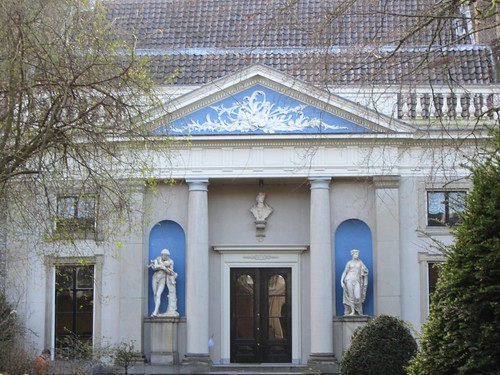
and on up to Walpole's own bedroom, with windows designed to make the most of the then river view and plenty of fresh air:


And one last domestic item - this bowl was used to keep goldfish in, but sadly proved too tempting to Walpole's cat - it fell in and drowned.


Wednesday, 7 July 2021

En route to an appointment at the Palace (all right, a visit to the new exhibition at the Queen's Gallery), one doesn't expect this sort of wildlife in Green Park:


Further on, there was a large herd:


and they appeared to be heading towards the Palace:


The head of the herd was calling, far far away, so Nellie and her chums plodded on:

It turns out that this is only one of several such herds across London, promoting an elephant conservation charity. Close up, one can see that each has been made of plant stems, an immense amount of skilled craftsmanship. 

As indeed was the Queen's Gallery exhibition - paintings usually seen (if you get to visit the State Rooms in the Palace) hung close together in several ranks, as used to be the show-off fashion. Refurbishing the Picture Gallery provided the opportunity to spread them out through three rooms, hung at eye level, and with time-slot admission allowing plenty of space for everyone to spend some time looking at close detail, helped along by the audio guide pointing out various technical details I wouldn't have known to look for.

Wednesday, 28 March 2018

Well, there's a thing

After months of not finding anything that novel to say about the usual annual round of events, what does it say that inspiration strikes at the sight of a load of old muck?

The Museum of London has a new section on the monster fatberg of Whitechapel, a vast conglomeration of (mostly) fat, setting to concrete as it accumulated around various sorts of undissolvable waste, grit and calcium in the sewers underneath an area with a high proportion of takeaway food joints.  As you enter,  a display cabinet shows you the sewer workers' protective suit - and the shovels they had to resort to at times to dig it out.

There's also an informative video, complete with questing rat, showing just how huge the problem was, and outlining the facts and figures, together with the issues in creating a museum display (how to protect conservators and public from potential infection, not to mention the pong, and will it gradually break down till there's not much left to show anyway?).


As is traditional in high-profile exhibits, the headline item is reserved for its own special spotlit case within a darkened inner sanctum: no more prepossessing than a piece of rubble on a demolition site, but what lump of gunk could be anything else?

It serves as a warning of the damage simple carelessness can do, and a reminder of the things so many unseen workers do to keep the city going. There is some good news : it can all be used, refined for fuel for buses, with the residue burnt in power stations.

And, of course, the museum shop serves handy mementoes: badges, T-shirts, shopping bags, cuddly toy rats, and should you feel like a themed snack, a bag of toothsome "Fatberg sludge".

Friday, 18 October 2013

Fun day at the museum

Perhaps not the best day  to visit the Museum of London's new exhibition of the restored Cheapside Hoard of jewellery: a teachers' strike, a couple of days after a TV documentary all about the exhibition, and apparently in the middle of half-term holidays for Dutch schools. The Museum was packed with people, and the school parties seemed busy and active, and a bit noisy: but that, after all, is the London the museum celebrates.

Inside the special exhibition gallery, despite timed entrance tickets, it could still feel crowded. Since the special beauty of so many of the pieces on display is in how small they are -  this scent bottle is barely an inch high, for example - you had to lean over the case with the borrowed magnifying glass,  blocking the view for anyone else behind. And it only took a couple of vocal and scampering toddlers to cause a fair amount of tutting.

But with a little patience, detachment and observation, it was possible to see the seemingly miraculous fine details, explore where the jewels come from, and how the pieces were made - together with the beliefs around different jewels and the illnesses they supposedly warded off, the iconography of the way they were worn, even have a sniff of the sort of scent the bottle might have contained. It was particularly powerful and pungent, but it probably would have had to be to cope with the stink of London - and Londoners - of those days.

And then, of course, there's the mystery of how this collection came to be lost or abandoned: since that must have happened any time after 1640 up to about 1680, you can take your pick of explanations - someone who went to fight in the Civil War and never came back, someone who went into exile when their side was out of favour (and never came back), a family that died in the Great Plague and left no heirs or records? We shall never know.

Wednesday, 9 October 2013

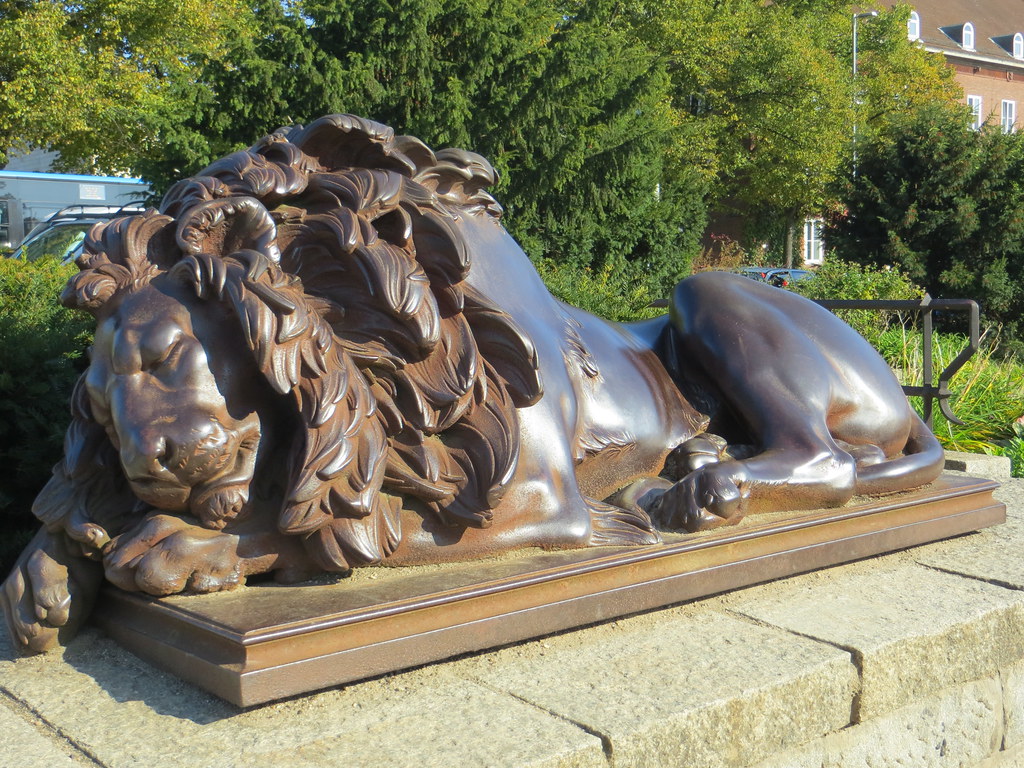
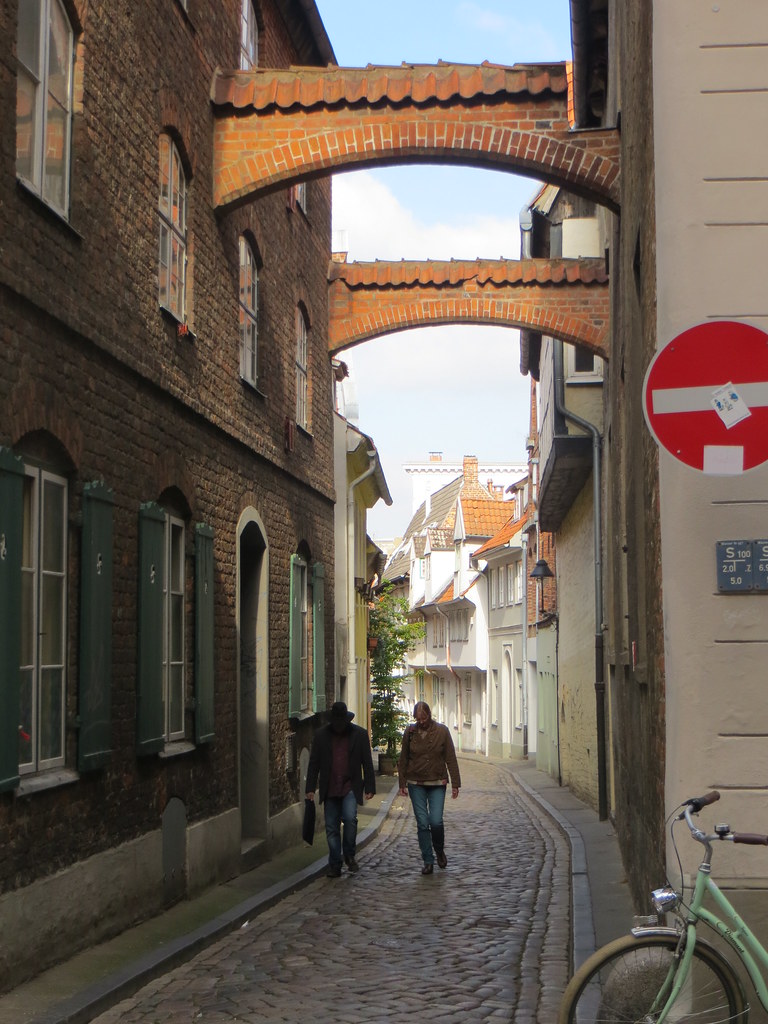
This sleepy fellow is nominally on guard at the old city gate of Lübeck, a short commuter train ride away from Hamburg.

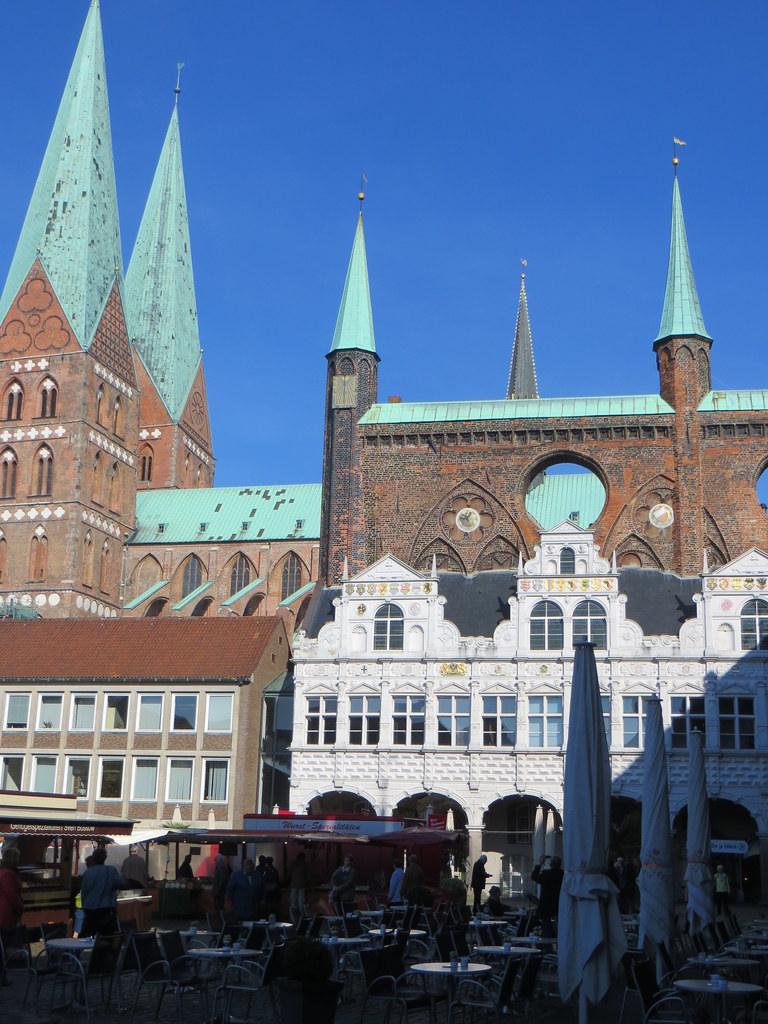
Another Hanseatic trading city, it links to the Baltic as Hamburg does to the Atlantic; but it feels much smaller, and
with more of its mediaeval and merchant core retained (or restored and re-created), the focus seems to be on a much more relaxed sort of tourism (especially on a sunny day warm enough for summer).

But for all that, it boasts connections to three significant modern Germans, so the historically-minded culture vulture could spend a fair amount of time finding out more about Willy Brandt, Günter Grass, or (as I did, since that was the only one open that day) Thomas and Heinrich Mann.

Or you could just stroll the remaining cobbled streets and snaffle up the products of the Niederegger marzipan factory.


Sunday, 27 January 2013

Over the years, street organs seemed to have become less and less in evidence in Amsterdam. Bearing in mind what I'm guessing must be quite a cost in getting and maintaining one, it can't be easy to make much of a living from them. But this weekend, I not only saw one in one of the main shopping streets in Amsterdam, but also in the middle of some fairly heavy snow in Utrecht: maybe the Saturday shopping crowds brought them out.

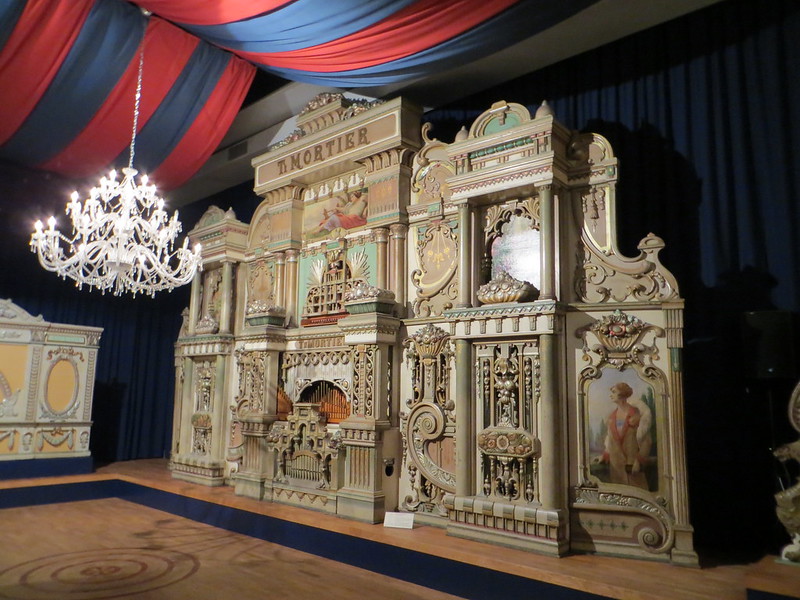
In Utrecht, too, you can surfeit yourself at Museum Speelklok with all kinds of draaiorgels, circus organs, hurdy-gurdies, pianolas, orchestrions, polyphons, musical boxes, some monsters built for dance halls, and some strange mechanical musical instruments (I once saw a machine here that played four violins).

Visitors have the chance to wander around some of the many different examples, but the main interest is the tour of selected machines (though this does include plenty of chances for little ones, and one lucky grown-up, to turn a handle). There's even a bit of singsong, as was once traditional, though at least one of the old songsheets on display suggests something rather racier than you might expect.

Wednesday, 3 October 2012

Normal

The Wellcome Collection's offering for the summer of the Olympics has been the "Superhuman" exhibition, on the science and engineering of "human enhancement", its medical applications and artistic responses to it.

It starts with Icarus, and moves swiftly through glasses, false teeth, and false noses for syphilitics. It soon expands through the kind of prosthetic developments we're familiar with nowadays, to ever more mind-boggling possibilities (although there's an artwork connecting different sorts of life support machines to act together like a body to point out how difficult much of this work is).

What may be technically possible, in all forms of biotechnology, raises difficult questions. Among them (perhaps the organisers could not have foreseen how much the response to the Paralympics would bring it into general discussion) is: what is "normal"?
Who defines (and how) the "normality" that prosthetics are supposed to restore in those perceived to be impaired? What defines the exceptional human (rather than technology-assisted) performance we celebrate in competitions (and will we come to value "performance" in general rather than trying to focus on the specifically human quality of it? Who pays for, and what do we do about unequal access to, all these new technologies? Where are the boundaries beyond which enhancements make us "abnormal"?

And if you think there should be a limit, one of the exhibition's video contributors points out that, eventually, if life as we value it is to survive in the universe, our successors will have to enhance themselves enough to find or build another planet to live on, before the sun's collapse envelops the entire solar system. Don't worry, we've a few million years left: climate change and new diseases are far more likely to get us, in a much nearer future.
On which cheery thought, time for another cup of tea, I think.

Wednesday, 11 July 2012

Vienna (1)

You rarely get the best view of a city on the journey into it, and Vienna is no exception. The train from the airport loops around this refinery; this sort of complex elaboration turned out to be something we would meet again.

In their heyday, the Habsburg emperors acquired (mostly by marriage, it would seem) the overlordship of many different realms and territories. In one Tirolean village, I saw from the bus a wall painting recording some mediaeval grant or honour to a worthy local citizen, in a text where the recipient got the briefest mention, but the emperor's titles were recorded in full: not just Holy Roman Emperor, but Archduke of Austria, King of Hungary, Bohemia, Moravia, Portugal and every separate province of Spain, Duke of Burgundy, with various titles relating to Silesia, Galicia, Bukovina, etc., etc., - and thanks to Columbus, "King of the Atlantic Ocean" into the bargain.

This profusion of detail is emphasised in the vast size of the Hofburg palace. On the outside, there are images of heroic struggle: pompous roof statues celebrate victories and the Labours of Hercules loom over leisurely fiaker rides.

Inside, the Schatzkammer holds some ancient treasures - a crown from the 10th century, an agate dish from the 4th century - but it's noticeable that many of the symbols of all the different titles and realms of the Habsburgs seem to be designed - like so much of our George IV's grandiosities - as a riposte to Napoleon. If he was going to declare himself an Emperor and the Holy Roman Empire dissolved, then the Habsburgs would become Emperors of Austria, and carry on adding titles (with the crowns and robes and assorted bling to go with them). By the time you get to the state apartments, that kind of excess applied to things like massive silver and gilt tableware, combined with the relatively spartan military discipline with which Franz Josef conducted his life makes the story of his wife Elizabeth (Sisi) entirely understandable.

No wonder that, like many other nineteenth-century women, she developed the kind of undefinable illness that required extensive "cures" away from court life (though it's quite another story why that, even combined with her assassination on her travels, should have led, some 60 years and more later, to such a Diana-like cult in the German-speaking world that there's a special exhibition just for her).

Thursday, 26 April 2012

It's not often one gets to drink a coffee with 1000 tons of ship hanging overhead, but now you can (at a price). The Cutty Sark has been reopened, and I managed to get in with the first group of visitors this morning.

The ship has been raised several metres to rest on a secure steel framework rather than its own keel (which was deforming its shape and threatening eventual collapse of the hull), and the wear and tear of decades (not to mention the damage from the fire during restoration work) has been repaired and refurbished with a degree of care and resort to traditional materials and craftsmanship that borders on the obsessive.

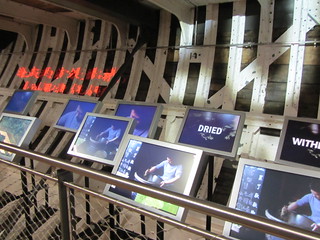
You enter through the lower hold, with the bones of the ship on full display, along with plenty of information about the tea trade (including a special space for the tiniest children).

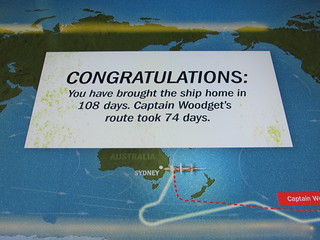
Then it's up to the tween-deck, a broad open space for cargo (and for the captain to practise his cycling and roller-skating), with most of the crew squeezed into quarters in the bows. Here the focus of the displays shifts to the wool trade and to the experience of working on the ship: there's a chance to practise your skill at steering to catch the fastest wind, and to sit on a seat that rolls while you watch old film of sailing ships in the roughest of seas.

Onward and upward to the top deck, with the officers' quarters, the galley (and pens for pigs and chickens, complete with sound effects), and the masts and rigging towering above. Then you "go ashore" into a staircase and lift block, to take you down to the dry dock itself, and the most dramatic element:
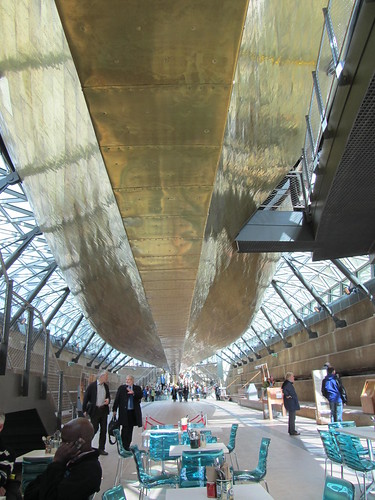
coming out from an anonymous corridor to find the shining brass cladding of the hull and keel lowering above the open space (which will of course be let out for lucrative private shindigs).

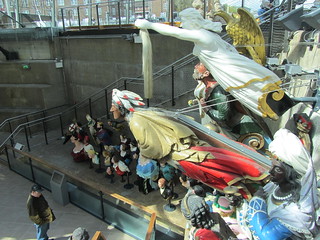
Here there is a small cafe, and a striking collection of ships figureheads,
dominated by Nannie, the Cutty Sark herself, clutching the tail of Tam o' Shanter's horse. More displays on the restoration of the ship and its impact over the years of its being a tourist attraction, and then, as ever, one exits via the gift shop.

It's not cheap (and not just to get in - nearly £5 for a coffee and small cake?!), but then neither was the restoration. Worth it? It was for me: but it may be years before I go again.

Friday, 3 February 2012

A weekend in Amsterdam (4)

I wouldn't want you to think I totally neglected kulcher on this trip. There were a couple of museums I've not visited in the thirty years or so that I've been going to Amsterdam.

One was the Tropenmuseum, originally devoted to the wonders of the Netherlands' overseas empire in Indonesia and the West Indies, but now expanded to include the cultures and environment of the tropics generally, in Africa, Latin America and South Asia, focussing on changes resulting from development and interaction with new ways of living. Alongside that are regular art installations and events on similar themes. Even though the content is more contained than its equivalent in Paris, the Quai Branly, it could be just as exhausting - it would repay an early start and a leisurely tour.

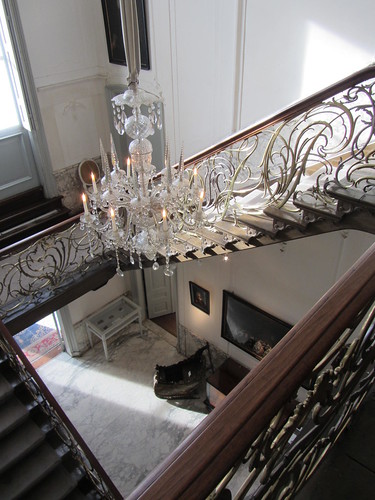
Another is the Museum Van Loon, an imposing canalside residence restored to something like the style of its wealthy 18th century owners, but full of mementoes of successive families living there. It's a slightly odd mix of a very Dutch worthy restraint and the opulent, as the pictures below would suggest. The grand staircase is in largely unadorned marble; but the very last picture shows not the main residence but - the coach house and stables.

Saturday, 17 September 2011

Another of life's little embarrassments

What is the world coming to, when you remember the name of your neighbour's dog but not of the neighbour?

Thursday, 18 August 2011

Back from the depths: 2

A more cheerful resurgence this time: the Cutty Sark is starting to emerge from its protective covers and scaffolding:

The hull has been lifted on to a cradle so that it no longer rests on its keel, and the museum and exhibition space underneath her is in development; there's a new coat of paint, and a definite air that she's well on the way to recovery and complete restoration.

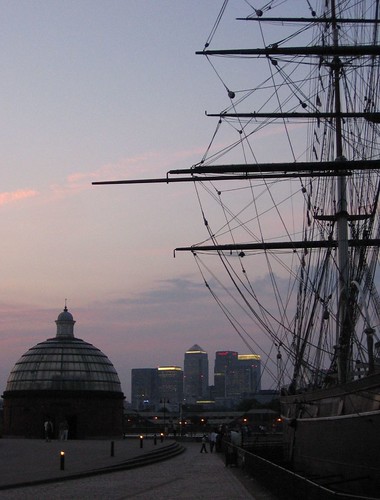
Here's how impressive she looked on a hot and sultry evening five years ago; this time next year, she should be riding higher still:


Friday, 12 August 2011

Treasures

Somehow managing to avoid much of the week's excitements elsewhere in London, I've found nothing out of the ordinary on a couple of bike rides up to the West End this week - except at the end of one, at the British Museum's Treasures of Heaven exhibition. This takes the visitor through the story of devotional and votive objects from pre-Christian times to the Middle Ages, from humble lead pilgrimage tokens to the gilded and bejewelled reliquaries owned and presented by kings and aristocrats.

Whatever the miracles that might have been attributed to these objects in the past, today one wonders at the simple fact of their survival. Two votive discs with gold decoration on were displayed side by side, looking almost identical: one was dedicated to Roman divinities, the other to Christian saints - but both were of glass, and are more or less intact after two thousand years. There is a moulded glass beaker from 12th century Syria, delicate carvings in ivory, minute and intricate mosaic and enamelling - one could go on.

In this of all weeks, it isn't surprising that over the centuries many of these objects were looted and damaged (many of those on display have holes where once there were precious stones); nor to be reminded of the way relics - and their decorative containers - were acquired/expropriated/distributed as objects and symbols of power and prestige, as the Byzantine Emperors, Kings of western Europe and the Church itself contended for supremacy - the oil or aircraft carriers of the mediaeval world, perhaps.

The exhibition concludes with a reminder of the different ways in which people today feel the need to collect and display reminders of celebrities, or visit their homes, or lay objects to commemorate them at sites of mourning, and leads the visitor to exit - of course - through the gift shop for that votive postcard or pilgrim token pen, fridge magnet or tea-towel. It did occur to me that there's one modern parallel the exhibition doesn't draw attention to: is the heir to the ostentation of the gilded, enamelled, carved and bejewelled shrine or reliquary, presented to a cathedral by a king or aristocrat, the named bequest or donation to a museum?

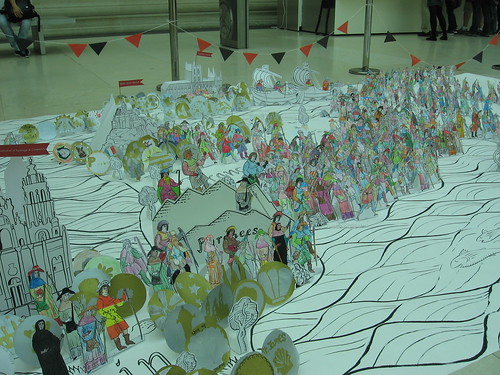
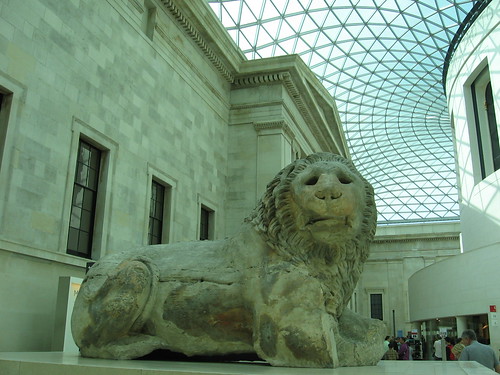
Outside, there is a less ambitious display as part of an activity for children: paper "pilgrims" coloured and attached to a map of the major European pilgrimage routes. And above, the Lion of Knidos looks as though he could do with a miracle to cure a toothache that's lasted several thousand years.


Wednesday, 10 August 2011

Back to the future*

Yesterday turned out to be a good day to revisit the South Bank's commemoration of the 1951 Festival of Britain. When I went in April, not everything had got under way, but, especially this month, there's a whole series of events going on. In particular, there's a "Museum of 51" display, tucked into a side entrance of the Festival Hall, about the experience and construction of the Festival. This sign from the "Dome of Discovery" exhibition rather sums up the ambitious aspirations of the time, as did the Skylon - couldn't some sponsor be persuaded to create a modern version on the same spot? With today's technology, it could be much lighter (on both weight and illumination) and look even more spectacular.

Outside, the brave attempt to evoke the seaside had attracted a fair crowd, and rather more of the beach hut artworks were open. I was particularly taken by these ideas for modern coin-operated machines, now that the Haunted House and What the Butler Saw machines would seem so old hat.

They've made a nod to the various themes of the Festival,such as the Land (a roof garden on the brutally concrete Queen Elizabeth Hall), Industry (a photographic exhibition), and Transport (some upcoming events on new developments - and a Floral Bicycle Parade later this month!); and on the theme of the future, there's quite a focus on children's and young people's art.

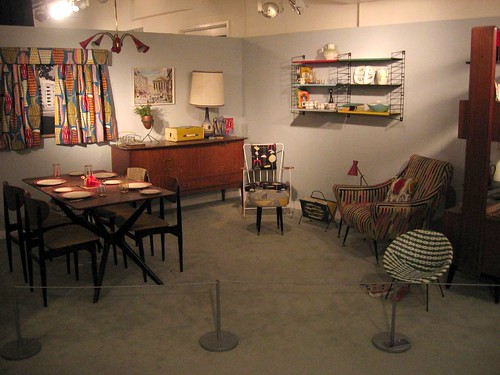
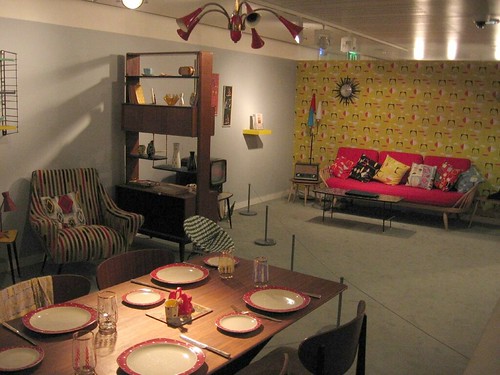
But overall, it feels a bit thin and hollowed out, as if all we have to show today is ideas and responses to ideas, rather than the concrete trade show aspects of the original Festival. This seems to reflect the determination of the incoming government of 1951 to remove as much as possible of the physical symbols of its predecessors' spirit: in the end, the Museum exhibition can only point to memories, the odd surviving relic and the revitalising influence of the Festival spirit on domestic design:


PS: Yes, I am deliberately not saying A WORD about the recent/current unpleasantness. I haven't actually seen any myself.

Saturday, 18 June 2011

Ingenuity

A couple of examples that caught my eye recently:

In Paternoster Square, the new-ish development behind St Paul's (which, incidentally, looks splendid now it's been thoroughly re-cleaned), is this solar calendar.

Clever, but is anyone likely to want to remember to be outside at noon on a sunny day to work out they're in the middle of June?

Just as clever, in the British Museum, is this lightbox re-evocation of an old Chinese painting of mountains and trees. It may look like a pen-and-ink wash, but it's done with the shadows of twigs, staw, pieces of paper and leaves (apologies for the wobbliness of this little video from my phone camera):


The Museum is full of surprises. Just at the moment, it has an Australian theme on, so the forecourt has a garden of Australian plants; once inside, this installation takes the visitor to China, and a small diversion finds (just at the moment) a display of ornate silver jewellery and brilliantly-coloured clothing from Oman, together with a similar display from the Balkans. And that's without spending any money to see, for example, the current special exhibition of treasures from Afghanistan. You could spend a lifetime travelling around the world without ever leaving Bloomsbury. Now that's ingenuity.

Saturday, 26 March 2011

Goodness me, nearly a fortnight and I never finished writing up What I Did On My Holidays (or, rather that weekend in Paris). This is partly a matter of being out of touch with the news, which somehow made the images from Japan all the more shocking and somehow shaming when I did see them (by a strange coincidence I was on a train to Paris the morning of 7/7 and frivolled the day away in blissful ignorance); and partly to do with just the business of everyday life.

But back to Paris: I had no particular plans this time, but I did drop in to a couple of the free city museums that I hadn't seen before. The Cognacq-Jay is a collection of 18th-century art and furniture assembled by the founders of the Samaritaine department store, originally set up for the edification of the staff, and now housed in a restored 18th century house in the Marais. To judge by the photographs and portraits, M. Cognacq rather enjoyed being a public benefactor; Mme Cognacq-Jay rather had the look of the traditionally watchful wife in a family business. I didn't gain much impression of the reaction of the store's staff, or whether they thought them more benevolent owners than their successors (who closed the store down and sold the building off for development at very short notice, not so long ago).

It's an interesting collection, not as stuffily worthy or full of mimsy floweriness as I feared it might be: on the contrary, some lively portraits, some wonderful marquetry and other furniture, and intricately beautiful Meissen figurines. I'm not quite sure if it was meant as a joke that a corridor full of genre paintings aabove a line of small tables and cupboards was simply described as showing how furniture like that might have been used in domestic settings: for if you look at the paintings, a hastily sketched table or bedside cupboard is merely incidental to various saucy shenanigans. Here's a gentleman peeking round a lady's boudoir door, or hurriedly hiding in her wardrobe while her husband swaggers in, or stretching his riding crop in through an open window to lift the scarf from a sleeping lady's generous embonpoint; or there's a kitchen maid with an apron-full of eggs embraced by a scullion whose breeches are clearly round his ankles while the cat devours the fowl laid out for dinner. Did Mme Jay approve?

I also went down to the twin museums at the Gare Montparnasse dedicated to the General Leclerc and Jean Moulin, the heroes of the Liberation and the Resistance, respectively. Around the outsides, an overview of what was happening generally in their respective fields (building up the Free French armies, and the internal politics of collaboration and resistance), in the centre show cases of documents and videos of reminiscences, much of it now very familiar from TV documentaries. One of the most striking things to me was the extraordinarily old-fashioned way André Malraux, as Minister of Culture, intoned his speech when opening a memorial to Moulin in the 1960s. Old films suggest that was what high-flown French orators used to do as a matter of course; but by then it must have been starting to look ridiculous. As I left, the receptionist showed just what a sense of humour you can find in France: I said I'd come to collect the backpack I'd left with her, and without a pause and with the most deadpan face she simply said "Oh that? I've sold it".