
Saturday, 20 August 2011


Thursday, 18 August 2011
Back from the depths: 2
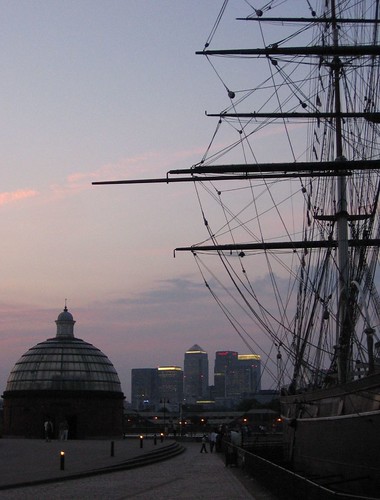
A more cheerful resurgence this time: the Cutty Sark is starting to emerge from its protective covers and scaffolding:

The hull has been lifted on to a cradle so that it no longer rests on its keel, and the museum and exhibition space underneath her is in development; there's a new coat of paint, and a definite air that she's well on the way to recovery and complete restoration.
Here's how impressive she looked on a hot and sultry evening five years ago; this time next year, she should be riding higher still:


The hull has been lifted on to a cradle so that it no longer rests on its keel, and the museum and exhibition space underneath her is in development; there's a new coat of paint, and a definite air that she's well on the way to recovery and complete restoration.
Here's how impressive she looked on a hot and sultry evening five years ago; this time next year, she should be riding higher still:
Back from the depths: 1
Most of last week's hooha in London seemed at the time to pass us by, though after the event, it turned out there was a rather nasty attack on one particular house not too far away (rumoured to be something to do with ongoing "postcode" gang troubles) and a window was smashed in a Tesco.
 It seemed there might be something riot-related happening last Friday, in the sudden arrival of police helicopters hovering almost directly overhead for what seemed like half an hour; but it turned out that there'd been an accident on the river, with a tug somehow run over and capsized by its tow, a barge with a large crane on it. In a matter of seconds the tug had sunk, and sadly one of its crew was lost. I was reminded of the time when I was living on the other side of London, and was woken in the early hours of a Sunday morning by helicopters going backwards and forwards along the river, searching for people from the Marchioness.
Today, on my way to Greenwich, the tug was visible again, raised from the bottom by this colossal crane (presumably not the guilty party). One more reminder that Old Father Thames can be dangerous.
 It seemed there might be something riot-related happening last Friday, in the sudden arrival of police helicopters hovering almost directly overhead for what seemed like half an hour; but it turned out that there'd been an accident on the river, with a tug somehow run over and capsized by its tow, a barge with a large crane on it. In a matter of seconds the tug had sunk, and sadly one of its crew was lost. I was reminded of the time when I was living on the other side of London, and was woken in the early hours of a Sunday morning by helicopters going backwards and forwards along the river, searching for people from the Marchioness.
Today, on my way to Greenwich, the tug was visible again, raised from the bottom by this colossal crane (presumably not the guilty party). One more reminder that Old Father Thames can be dangerous.
Wednesday, 17 August 2011
Disappointment
It was a surprise to find that it's been more than five years since my last visit to the National Archives.
It must be more than fifteen years since the family history bug bit me (a little before the big explosion of interest), and quite a few since a series of what seemed to be dead ends (short of trawling through parish registers in county records offices up and down the land) dampened the enthusiasm a bit. But a recent email from the grand-daughter of a friend of a now-deceased cousin of my mother's (that's what the internet makes possible) raised some new ideas; and a little work on the internet showed how much more is now online, and crucially, indexed.
Within an hour or so, I'd tracked down online a whole family of one great-great-grandmother across several different registers, with a father in the militia, raising the prospect that there would be some sort of military record for him. More checking revealed a list of Crimean War soldiers sharing the name of one great-grandfather, showing their regiments - the key piece of information make searching the military records of the National Archives a manageable prospect. So it was off to the other side of London this morning to renew my registration and get stuck into my list of file references.
Except that it's no longer possible to inspect the original paper records in the ordinary way: the Archives have contracted with a commercial service to make images of them available online, and to index them. This is all entirely understandable. At the start of the genealogy boom, the official records services set out to modernise their access arrangements, and developed some very pleasant research rooms and helpful enquiry services (at least in London): but within a few years it must have become clear this was a very expensive way to provide the service. The principle that public records should be available to the public doesn't, of itself, justify spending a lot of taxpayers' money to make them easily accessible for what is, after all, a hobby, and a rather obsessive one at that: only sensible, then, to let a commercial service take on the cost of photographing, transcribing and indexing the records most people are likely to search and let the internet absorb the bulk of searches from people like me.
Except that, at least in the case of the series of individual soldiers' records, the chosen partners haven't made a very good job of the transcribing, indexing and search mechanisms. I would expect that setting additional parameters, like dates and places, would act as a search filter, removing those that did not include that information: but not in this case - mainly because the transcription included no dates. As it happens, this particular organisation charges six times as much in pay-as-you-go credits to view a full image as opposed to the transcript (entirely accidentally, no doubt*), so it's very easy to run through £25 on a search specifying records between 1854 and 1860 only to discover that all of those listed are actually from much later.
*sarcasm alert
I am in full Mr. Growser mode. Emails are in draft......
It must be more than fifteen years since the family history bug bit me (a little before the big explosion of interest), and quite a few since a series of what seemed to be dead ends (short of trawling through parish registers in county records offices up and down the land) dampened the enthusiasm a bit. But a recent email from the grand-daughter of a friend of a now-deceased cousin of my mother's (that's what the internet makes possible) raised some new ideas; and a little work on the internet showed how much more is now online, and crucially, indexed.
Within an hour or so, I'd tracked down online a whole family of one great-great-grandmother across several different registers, with a father in the militia, raising the prospect that there would be some sort of military record for him. More checking revealed a list of Crimean War soldiers sharing the name of one great-grandfather, showing their regiments - the key piece of information make searching the military records of the National Archives a manageable prospect. So it was off to the other side of London this morning to renew my registration and get stuck into my list of file references.
Except that it's no longer possible to inspect the original paper records in the ordinary way: the Archives have contracted with a commercial service to make images of them available online, and to index them. This is all entirely understandable. At the start of the genealogy boom, the official records services set out to modernise their access arrangements, and developed some very pleasant research rooms and helpful enquiry services (at least in London): but within a few years it must have become clear this was a very expensive way to provide the service. The principle that public records should be available to the public doesn't, of itself, justify spending a lot of taxpayers' money to make them easily accessible for what is, after all, a hobby, and a rather obsessive one at that: only sensible, then, to let a commercial service take on the cost of photographing, transcribing and indexing the records most people are likely to search and let the internet absorb the bulk of searches from people like me.
Except that, at least in the case of the series of individual soldiers' records, the chosen partners haven't made a very good job of the transcribing, indexing and search mechanisms. I would expect that setting additional parameters, like dates and places, would act as a search filter, removing those that did not include that information: but not in this case - mainly because the transcription included no dates. As it happens, this particular organisation charges six times as much in pay-as-you-go credits to view a full image as opposed to the transcript (entirely accidentally, no doubt*), so it's very easy to run through £25 on a search specifying records between 1854 and 1860 only to discover that all of those listed are actually from much later.
*sarcasm alert
I am in full Mr. Growser mode. Emails are in draft......
Friday, 12 August 2011
Treasures
 Somehow managing to avoid much of the week's excitements elsewhere in London, I've found nothing out of the ordinary on a couple of bike rides up to the West End this week - except at the end of one, at the British Museum's Treasures of Heaven exhibition. This takes the visitor through the story of devotional and votive objects from pre-Christian times to the Middle Ages, from humble lead pilgrimage tokens to the gilded and bejewelled reliquaries owned and presented by kings and aristocrats.
Whatever the miracles that might have been attributed to these objects in the past, today one wonders at the simple fact of their survival. Two votive discs with gold decoration on were displayed side by side, looking almost identical: one was dedicated to Roman divinities, the other to Christian saints - but both were of glass, and are more or less intact after two thousand years. There is a moulded glass beaker from 12th century Syria, delicate carvings in ivory, minute and intricate mosaic and enamelling - one could go on.
In this of all weeks, it isn't surprising that over the centuries many of these objects were looted and damaged (many of those on display have holes where once there were precious stones); nor to be reminded of the way relics - and their decorative containers - were acquired/expropriated/distributed as objects and symbols of power and prestige, as the Byzantine Emperors, Kings of western Europe and the Church itself contended for supremacy - the oil or aircraft carriers of the mediaeval world, perhaps.
The exhibition concludes with a reminder of the different ways in which people today feel the need to collect and display reminders of celebrities, or visit their homes, or lay objects to commemorate them at sites of mourning, and leads the visitor to exit - of course - through the gift shop for that votive postcard or pilgrim token pen, fridge magnet or tea-towel. It did occur to me that there's one modern parallel the exhibition doesn't draw attention to: is the heir to the ostentation of the gilded, enamelled, carved and bejewelled shrine or reliquary, presented to a cathedral by a king or aristocrat, the named bequest or donation to a museum?
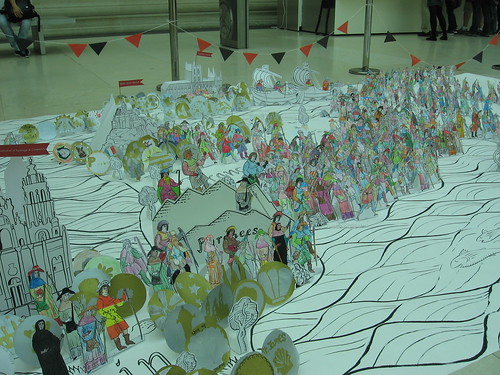
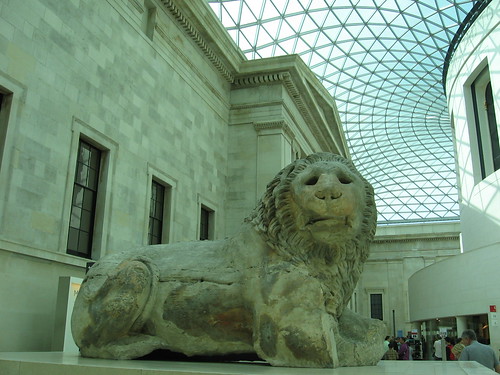
Outside, there is a less ambitious display as part of an activity for children: paper "pilgrims" coloured and attached to a map of the major European pilgrimage routes. And above, the Lion of Knidos looks as though he could do with a miracle to cure a toothache that's lasted several thousand years.
Wednesday, 10 August 2011
Back to the future*
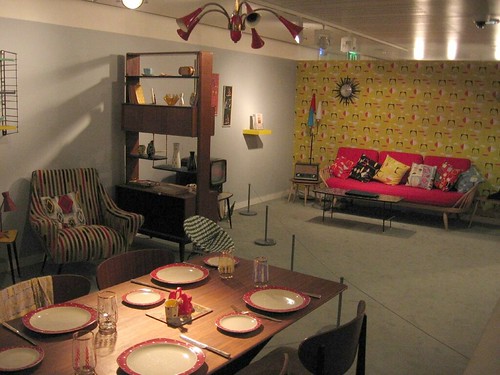
 Yesterday turned out to be a good day to revisit the South Bank's commemoration of the 1951 Festival of Britain. When I went in April, not everything had got under way, but, especially this month, there's a whole series of events going on. In particular, there's a "Museum of 51" display, tucked into a side entrance of the Festival Hall, about the experience and construction of the Festival. This sign from the "Dome of Discovery" exhibition rather sums up the ambitious aspirations of the time, as did the Skylon - couldn't some sponsor be persuaded to create a modern version on the same spot? With today's technology, it could be much lighter (on both weight and illumination) and look even more spectacular.
 Outside, the brave attempt to evoke the seaside had attracted a fair crowd, and rather more of the beach hut artworks were open. I was particularly taken by these ideas for modern coin-operated machines, now that the Haunted House and What the Butler Saw machines would seem so old hat.
They've made a nod to the various themes of the Festival,such as the Land (a roof garden on the brutally concrete Queen Elizabeth Hall), Industry (a photographic exhibition), and Transport (some upcoming events on new developments - and a Floral Bicycle Parade later this month!); and on the theme of the future, there's quite a focus on children's and young people's art.
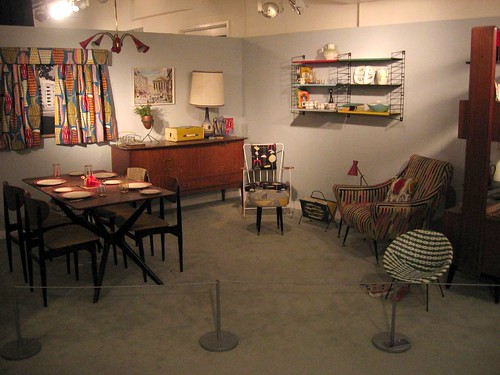
But overall, it feels a bit thin and hollowed out, as if all we have to show today is ideas and responses to ideas, rather than the concrete trade show aspects of the original Festival. This seems to reflect the determination of the incoming government of 1951 to remove as much as possible of the physical symbols of its predecessors' spirit: in the end, the Museum exhibition can only point to memories, the odd surviving relic and the revitalising influence of the Festival spirit on domestic design:
PS: Yes, I am deliberately not saying A WORD about the recent/current unpleasantness. I haven't actually seen any myself.
Monday, 1 August 2011
Summer's back
 The sun came out of its recent sulk over the weekend: better get the best of it before it changed its mind, so out came the bike for a trip up to the Grapes in Limehouse.
It prides itself on being the original (more likely, one of many for a composite picture) of the Six Jolly Fellowship Porters, the riverside tavern in Dickens's Our Mutual Friend.
It is certainly an old narrow building (in Narrow Street), the bar barely the size of an ordinary room in any of its residential counterparts of the period, the bare wood of its floors and furniture suggesting no great changes in a couple of centuries (though the frosting on the front windows is evidently more 1970s than 1870s).
The walls and any available surface are covered with Victorian and Dickensian memorabilia, and light flooding through from the back invites you out on to a little deck overlooking the river, to watch the boats passing by.
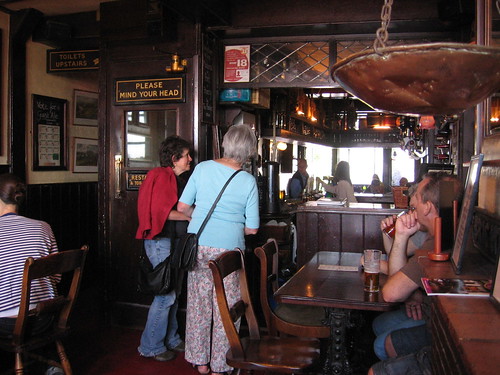

None of the skullduggery and shady business of the novel, just the usual procession of Clipper riverbuses, pleasure cruises, refuse barges - and, just at the moment, rather a lot of yachts from the Netherlands, for some reason.
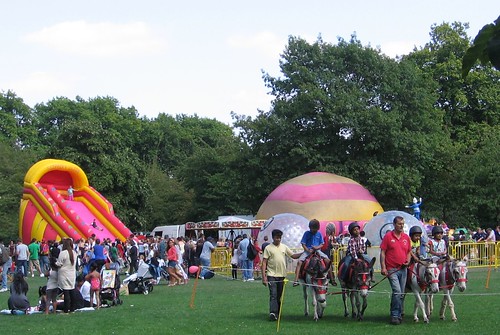
After that, a gentle ride up the canal, past Mile End and Victoria Parks. This weekend, there was some municipally-sponsored fun and games in Victoria Park:
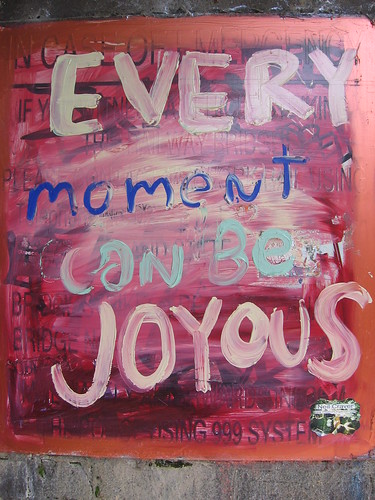
Then up to Broadway Market for a cup of tea along the canal, where the graffiti seemed to become more thoughtful, the closer they were to the Alternative Central of Hackney. On a day like this, you could almost forgive them for painting over the instructions in case of emergency (though it could be frustrating, should you happen to see a heavy lorry careering up the towpath and crashing into the railway bridge):
More adventures with jam
 Ever since I learnt to trust the wrinkle test, I've had a yen to have another go at making gooseberry jam. They seem to have such a fleeting season in the shops, and to involve so much faff to prepare for cooking, as to make it doubtful whether there's much of a commercial future for them: so you have to grab them while you can. It doesn't help that my supermarket has only had the most perfect-looking "dessert" gooseberries in tiny punnets that work out at £12 a kilo; but I found a stock of normal ones at less than half the price. A first batch was stewed down for the freezer; one of these punnets became jam, and the other an experimental batch of chutney.
The chutney, made with brown sugar, just looks like sludge, and the recipe says to leave it to mature, so it will be three months before I can tell if the gooseberry flavour has been swamped by the vinegar and spicing. But the texture of the jam is just about right (trusting the wrinkle test worked!), the flavour has a slight prickle of ginger (from one of those Christmas presents of preserved fruits in syrup that just seem to hang around for years); and best of all is the way the colour changes from the insipid grey of stewing to the rich orangey-red of the boiled jam:


Thursday, 28 July 2011
Clanking and bonging
Sometimes it seems as though all the interesting events are repeats of ones that I've posted about before. Next year, of course, it will be different, with the Really Big Event. Yesterday, an uneasy mix of ceremonial and young people's rally in Trafalgar Square (with Our Beloved Mayor™ sounding even more like an over-caffeinated pre-teen than usual: over-generous hospitality from the Official Olympic Cola Beverage?) announced that we have less than a year to go, and we saw the inside of the Olympic Aquatic Centre in use for the first time (and very impressive it looks, too).
But this week saw a number of other events designed to get us all in the mood, and not all sporting, for there is to be a whole Cultural Olympiad programme as well.
It was a pity the Sky Orchestra launched so early in the morning with the wind in the wrong direction to come our way, as it looked spectacular on the TV news: but it was flying over bits of London that could do with some cheering up.
 Nearer to home, Trinity Buoy Wharf staged an open weekend, with some of its resident artists showing their wares. The mixture wasn't too different from the last open weekend I visited there. Andrew Baldwin's mechanical sculptures were much in evidence, clanking away deconstructing human figures and re-assembling them with as industrial a sound as might have been heard on the site when it was building ships and light-buoys, all under a pair of majestic, if slightly alarming, mechanical wings.
 A couple of studios in the Container City were open, if not exactly inundated with people, and there would have been music workshops for enthusiastic children, if I had stayed.
In the lighthouse, the Longplayer's singing bowls continue to bong away mysteriously and evocatively, as they will be for the next 988 years or so (all being well).
It tends to make you wonder just how soon all the new buildings around the riverside here will seem to have been as passing an event as the Olympics.
But this week saw a number of other events designed to get us all in the mood, and not all sporting, for there is to be a whole Cultural Olympiad programme as well.
It was a pity the Sky Orchestra launched so early in the morning with the wind in the wrong direction to come our way, as it looked spectacular on the TV news: but it was flying over bits of London that could do with some cheering up.
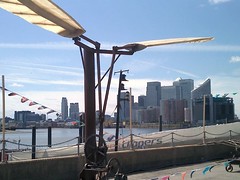 Nearer to home, Trinity Buoy Wharf staged an open weekend, with some of its resident artists showing their wares. The mixture wasn't too different from the last open weekend I visited there. Andrew Baldwin's mechanical sculptures were much in evidence, clanking away deconstructing human figures and re-assembling them with as industrial a sound as might have been heard on the site when it was building ships and light-buoys, all under a pair of majestic, if slightly alarming, mechanical wings.
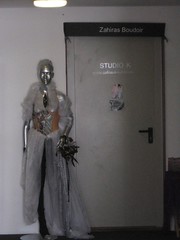 A couple of studios in the Container City were open, if not exactly inundated with people, and there would have been music workshops for enthusiastic children, if I had stayed.
 In the lighthouse, the Longplayer's singing bowls continue to bong away mysteriously and evocatively, as they will be for the next 988 years or so (all being well).
It tends to make you wonder just how soon all the new buildings around the riverside here will seem to have been as passing an event as the Olympics.
Tuesday, 26 July 2011
Big Breakfast
Oh dear.
I went into the kitchen this morning and filled the kettle to make tea to have with my breakfast, filled a bowl with cereal and some milk from the fridge, wondering when I'd emptied the milk jug, and took the bowl through to the living room.
Only to find the bowl of cereal I'd taken through barely minutes before.
Thank goodness I don't have gas.
I went into the kitchen this morning and filled the kettle to make tea to have with my breakfast, filled a bowl with cereal and some milk from the fridge, wondering when I'd emptied the milk jug, and took the bowl through to the living room.
Only to find the bowl of cereal I'd taken through barely minutes before.
Thank goodness I don't have gas.
Friday, 15 July 2011
Busy day in Canary Wharf
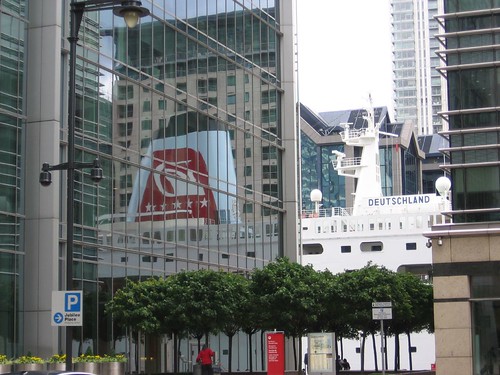
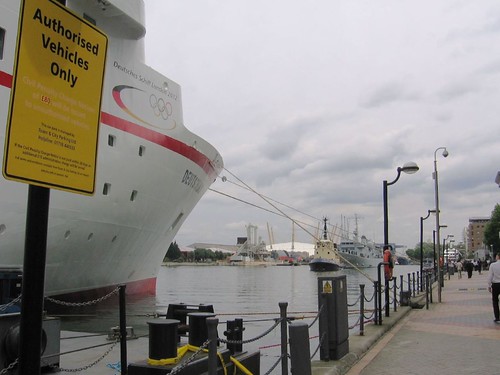
We're quite used to finding a cruise ship moored opposite the estate, at the grandly-name London Cruise Terminal (a couple of portakabins on a pontoon, which moves up and down the river according to where the mooring has been booked). Yesterday, it was a surprise to find it at Canary Wharf, for the Deutschland (it would have been even more of a surprise for any late risers in the flats beside the dock when they opened their curtains).
Apparently she is on a proving trip for use in next year's Olympics (are they really not putting up their Olympic team in the Village?). Yesterday's passengers, though, looked as though they would, at best, be competing in the 100-metre shopping saunter (my last remaining chance of an Olympic medal).
But we also had more familiar visitors. As I arrived, a couple of ships from the Belgian Navy were passing through the lock from the river, their military fearsomeness rather overshadowed by the size of the Deutschland, and (it has to be said) their rather unwarlike names - Godetia and Primula.


Apparently she is on a proving trip for use in next year's Olympics (are they really not putting up their Olympic team in the Village?). Yesterday's passengers, though, looked as though they would, at best, be competing in the 100-metre shopping saunter (my last remaining chance of an Olympic medal).
But we also had more familiar visitors. As I arrived, a couple of ships from the Belgian Navy were passing through the lock from the river, their military fearsomeness rather overshadowed by the size of the Deutschland, and (it has to be said) their rather unwarlike names - Godetia and Primula.
Thursday, 14 July 2011
Monday, 27 June 2011
Sunday, 26 June 2011
Street cries
You might not think it odd, indeed rather sweet, to hear a Columbia Road trader advertising "The bees come free with every lavender!", but how about:
"It's all stolen! That's why it's cheap, ladeezgenlmen, we nicked it!"
"It's all stolen! That's why it's cheap, ladeezgenlmen, we nicked it!"
Saturday, 25 June 2011
Sum
I'd forgotten the review that made me reserve David Eagleman's "Sum: Forty tales from the afterlives" at the library, so it came as the surprise it needs, for full effect, to be.
Forty pieces (essays? meditations? fables? science fiction flights of fancy?) each propose some different idea of an afterlife, and let it run.
Suppose there are all the "yous" that ever were, or might have been: what would that be like? Suppose there are only the people closest to you in life, and nothing of what was in the background: "The missing crowds make you lonely. You begin to complain about all the people you could be meeting. But no one listens or sympathizes with you, because this is exactly what you chose when you were alive."
Or consider it from the point of view of the atoms of which we are composed, disbanded like a platoon of soldiers or the cast of a long-running play: "They part ways, moving off in their separate directions, mourning the loss of a special time they shared together, haunted by the feeling that they were once playing parts in something larger than themselves, something that had its own life, something they can hardly put a finger on." But, in another piece, "In the form of a human, the atoms suffer a claustrophobia of size... And in this form, they find themselves longing to ascend mountains, wander the seas and conquer the air, seeking to recapture the limitlessness they once knew."
Each piece is a miniature, almost a prose poem, no more than a couple of pages long, but a delayed-action idea-bomb, waiting to knock off-kilter your perspective on this life.
Forty pieces (essays? meditations? fables? science fiction flights of fancy?) each propose some different idea of an afterlife, and let it run.
Suppose there are all the "yous" that ever were, or might have been: what would that be like? Suppose there are only the people closest to you in life, and nothing of what was in the background: "The missing crowds make you lonely. You begin to complain about all the people you could be meeting. But no one listens or sympathizes with you, because this is exactly what you chose when you were alive."
Or consider it from the point of view of the atoms of which we are composed, disbanded like a platoon of soldiers or the cast of a long-running play: "They part ways, moving off in their separate directions, mourning the loss of a special time they shared together, haunted by the feeling that they were once playing parts in something larger than themselves, something that had its own life, something they can hardly put a finger on." But, in another piece, "In the form of a human, the atoms suffer a claustrophobia of size... And in this form, they find themselves longing to ascend mountains, wander the seas and conquer the air, seeking to recapture the limitlessness they once knew."
Each piece is a miniature, almost a prose poem, no more than a couple of pages long, but a delayed-action idea-bomb, waiting to knock off-kilter your perspective on this life.
Saturday, 18 June 2011
Ingenuity
 A couple of examples that caught my eye recently:
In Paternoster Square, the new-ish development behind St Paul's (which, incidentally, looks splendid now it's been thoroughly re-cleaned), is this solar calendar.
Clever, but is anyone likely to want to remember to be outside at noon on a sunny day to work out they're in the middle of June?
Just as clever, in the British Museum, is this lightbox re-evocation of an old Chinese painting of mountains and trees. It may look like a pen-and-ink wash, but it's done with the shadows of twigs, staw, pieces of paper and leaves (apologies for the wobbliness of this little video from my phone camera):
The Museum is full of surprises.
 Just at the moment, it has an Australian theme on, so the forecourt has a garden of Australian plants; once inside, this installation takes the visitor to China, and a small diversion finds (just at the moment) a display of ornate silver jewellery and brilliantly-coloured clothing from Oman, together with a similar display from the Balkans. And that's without spending any money to see, for example, the current special exhibition of treasures from Afghanistan. You could spend a lifetime travelling around the world without ever leaving Bloomsbury. Now that's ingenuity.
Wednesday, 15 June 2011
Monday, 13 June 2011
Something new
Lying in wait on the peaceful bit of cycle path through St James's Gardens in Limehouse, a couple of earnest young people trying to interest people - and yes, get their bank details for direct debit donations - in Sustrans. A worthy cause, and in all fairness it wasn't a terribly hard sell to escape, but irritating all the same. So now we have bicycle chuggers - you can make up your own name for them.
Friday, 10 June 2011
Getting out and about
It's always the little things. Playing with Developing a thorough understanding of how to get the best out of all the functions of a smartphone (OK, trying to organise my music files, with the pretty album pictures, the way I want) turned out to mean hours of fiddling with metadata for a couple of thousand files: or more or less my job for the last ten years or so. So much for all the leisurely outings....
However, one warm and sunny day (remember them?), a quick flick through a book of walks brought something else to mind. These two slides were taken some time in early 1967, somewhere near the village of Ashwell in Hertfordshire, which I dimly remembered as rather picturesque, and here it was, mentioned in the guidebook.


What better incentive to go and see it again?
Barely an hour from London by train, and within five minutes of leaving the station, all that could be heard was the faint whine of planes going in and out of Stansted, and much more insistent bird song. Passing through prairies of wheat, there were skylarks trilling overhead, and moving along past the dog roses in the hedgerows, a pair of partridges flew out in opposite directions.


 Up hill and down dale, and, fortunately just as lunch was required, the village church came into view across the fields:

It turned to be every bit as picturesque as memory said, with half-timbering, pargetting and cottage gardens straggling along the main street.

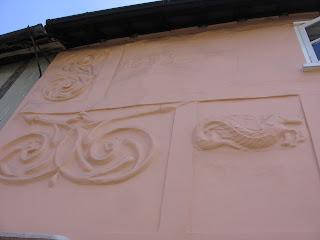
Click on the image to see when the pargetting was done
But, lest you should think the place was pickled in about 1954, the church was packed with excited children of all races rehearsing for a steel band concert.

The guidebook's route back to the station offered one last panoramic prospect of the village (click to enlarge this photo for the full effect):

However, one warm and sunny day (remember them?), a quick flick through a book of walks brought something else to mind. These two slides were taken some time in early 1967, somewhere near the village of Ashwell in Hertfordshire, which I dimly remembered as rather picturesque, and here it was, mentioned in the guidebook.


What better incentive to go and see it again?
Barely an hour from London by train, and within five minutes of leaving the station, all that could be heard was the faint whine of planes going in and out of Stansted, and much more insistent bird song. Passing through prairies of wheat, there were skylarks trilling overhead, and moving along past the dog roses in the hedgerows, a pair of partridges flew out in opposite directions.


 Up hill and down dale, and, fortunately just as lunch was required, the village church came into view across the fields:
It turned to be every bit as picturesque as memory said, with half-timbering, pargetting and cottage gardens straggling along the main street.


Click on the image to see when the pargetting was done
But, lest you should think the place was pickled in about 1954, the church was packed with excited children of all races rehearsing for a steel band concert.

The guidebook's route back to the station offered one last panoramic prospect of the village (click to enlarge this photo for the full effect):

Thursday, 9 June 2011
Subscribe to:
Posts (Atom)