Sunday, 6 June 2010


Tuesday, 1 June 2010
I am a guinea pig
I'm not allowed to give blood (some teenage jaundice), and I doubt there'll be many takers for my clapped out old organs by the time this cadaver is ready for disposal, so the invitation to contribute medical research data to the UK Biobank came as a rare chance to demonstrate a little altruism.
In one of those depressingly anonymous office blocks in Croydon, I joined a fair number of other people passing through a (very efficient) conveyor belt of assessments and tests.
Signing away all rights to my urine (the commercial possibilities of which escape me for the moment) and blood samples (no more than three teaspoons, they assure you, which neatly stops anyone making jokes about "very nearly an armful"), racking my brains trying to remember, amongst other distant history, just how many childhood episodes of sunburn I suffered (a lot, I think, but is that just the memory of the stories we tell ourselves?) and happily punching the screen through the computerised hearing and mental recall puzzles, I passed along the chain of technicians and their various physical assessments.
There were the familiar weight, lung volume (the lady in the next cubicle was having an operatic time of that), exercise and bodily fluid tests (blood comes next to last, no doubt in case of fainting fits, and the - ahem - other samples discreetly round the corner).
I see medical people so rarely, there is always some amazing new equipment, and for an operation like this, even more so: scary machines to photo my retinas, pocket-sized computers linked to a plastic clothes-peg on my thumb that between them graph out my blood circulation. And the output from everything is automatically stored on a simple pen-drive to carry on to the next technician.
After a last bout of confessing shaming truths to the computer about diet and physical activity (How many minutes a day do I actually walk anywhere, and does shuffling to and from the kettle count? What exactly was in that sandwich I ate yesterday?), I collected the only visible token of my contribution to science, a printout of the immediately available vital signs (no, not even tea and biscuits). Hardly surprising to be told I can afford to lose a bit of weight and need to watch my blood pressure, but reassuring that my heart and lungs are sound. I'll probably be bulking out their averages column for a few more years yet.
In one of those depressingly anonymous office blocks in Croydon, I joined a fair number of other people passing through a (very efficient) conveyor belt of assessments and tests.
Signing away all rights to my urine (the commercial possibilities of which escape me for the moment) and blood samples (no more than three teaspoons, they assure you, which neatly stops anyone making jokes about "very nearly an armful"), racking my brains trying to remember, amongst other distant history, just how many childhood episodes of sunburn I suffered (a lot, I think, but is that just the memory of the stories we tell ourselves?) and happily punching the screen through the computerised hearing and mental recall puzzles, I passed along the chain of technicians and their various physical assessments.
There were the familiar weight, lung volume (the lady in the next cubicle was having an operatic time of that), exercise and bodily fluid tests (blood comes next to last, no doubt in case of fainting fits, and the - ahem - other samples discreetly round the corner).
I see medical people so rarely, there is always some amazing new equipment, and for an operation like this, even more so: scary machines to photo my retinas, pocket-sized computers linked to a plastic clothes-peg on my thumb that between them graph out my blood circulation. And the output from everything is automatically stored on a simple pen-drive to carry on to the next technician.
After a last bout of confessing shaming truths to the computer about diet and physical activity (How many minutes a day do I actually walk anywhere, and does shuffling to and from the kettle count? What exactly was in that sandwich I ate yesterday?), I collected the only visible token of my contribution to science, a printout of the immediately available vital signs (no, not even tea and biscuits). Hardly surprising to be told I can afford to lose a bit of weight and need to watch my blood pressure, but reassuring that my heart and lungs are sound. I'll probably be bulking out their averages column for a few more years yet.
Monday, 31 May 2010
Rearrangement
The prospect of yet another grey and gloomy Bank Holiday (pray, whom do we sue?) seemed the perfect incentive to have a look at the Museum of London's remodelled Galleries of Modern London.
It must be some years now that its displays on twentieth century London have been mostly packed away. The last few times I've been, it looked as though it had little or nothing to say about it, let alone about the twenty-first century. No doubt there has been a lot of curatorial debate about how to squeeze an ever-expanding story into the space (to judge by the credits listed in various places, there must have been quite a fundraising effort too). It felt even more squeezed with the crush of people attracted by the publicity for the re-opening (including, I noticed, our former, and wouldbe once again, Mayor).
The upper floor retains the chronological flow from prehistoric times to the Great Fire. Here there's a much quicker canter than there used to be through the Saxon, mediaeval and Tudor periods, and what was once a whole caseful of the Cheapside Hoard is now shrunken to a single necklace, pending a complete exhibition in 2012. The old favourite model panorama of the Great Fire is still there, but has been amplified by a film projected behind it, with other contemporary accounts added to the Pepys version.
The new galleries are downstairs, where "modern London" begins with the rebuilding of the 1670s onwards. Chronology is downplayed, the story being split into main thematic segments (Expanding City, People's City, World City) that take a broad period of time each. Major structural features (the Victorian street of salvaged shopfronts and interiors, the Selfridges lift, the 18th century prison cell) remain where they were, but within each main segment, there are themed sections (for example, Empire, War, Struggle) displayed through a kaleidoscope of vignettes, rather than an extended narrative.
 Every inch of space is used, with old newspapers, posters and playbills all over the walls; detailed timelines are relegated to translucent window blinds showing significant events and personalities.
The need to make room for new material means that a lot of older material is skated over or barely mentioned. The suffragettes seem to get far more coverage than the labour struggles of the nineteenth century, the General Strike and the First World War seem barely to have happened, and a great deal seems to have been designed to give teachers something to work with, rather than to explain itself in context. There is an alcove papered all over with the Booth poverty map, and a Googlemaps-style interface to let you examine different parts of London in more detail. But the basic description of what it is, and what is was for, is on a very modest wall plaque that, on a busy day, was easily overlooked, leaving a visiting French couple completely baffled.
 But even without much traditional explication, there is an exhausting amount of content to inspect - not just to gawp at in cases or on the walls, but to explore interactively.
 Explanatory text and lots of labelled examples of individual items are often replaced by film - as in this case showing a model of the Skylon at the Festival of Britain in 1951, or the recreation of the 18th century pleasure garden, where some of the fantastical costumes of the period are framed with video of fops out on the pull, and nearly coming to blows with their white-painted ladies crying out the Georgian equivalent of "Leave 'im, 'e ain't worth it!". The frontage of a 1920s Lyons teashop has a lifesize video of a smiling nippy delivering the same scone over and over again, while outside the café tables give puzzled children the chance to learn the mysteries of the rotating dial on old telephones. A 1930s-costumed attendant by the Selfridges lift explains what's in the store and what it's like to work there.
Elsewhere, there are touch-screens to allow adults to persuade themselves they're not playing, but exploring information in more detail, while below the 1920s taxi, there's a very conceptual model of an underground railway at toddler height.
That, by the way, seems to be as much as is said about transport, nor is there much about housing, or the usual demonstrations of how the city has grown and what that meant for public services and government.
But there needed to be space made for all that's been happening in the last few decades. How odd to think that one's own lifetime is now museum material: clothes, posters and pamphlets from the 60s, 70s and 80s, early desk-top computers, the posters and leaflets of the "Less Passion from Less Protein" campaigner, the passionate debates about race, identity and diversity.
At last one catches sight of the café, and passing through some samples of London-inspired art and a special section for the star attraction (the Lord Mayor's coach, now surrounded by some - but somewhat limited - information on the City of London rather than, as I remember it, marooned in a corner) you come to a section on Londoners, with projected videos of a succession of people talking about their lives, and finally an interactive section asking for opinions on future London issues like housing, transport and so on. In the café, you're surrounded by a scrolling display of random statistics to inspire some "well, fancy that" responses while you recover, over a cup of tea:

It must be some years now that its displays on twentieth century London have been mostly packed away. The last few times I've been, it looked as though it had little or nothing to say about it, let alone about the twenty-first century. No doubt there has been a lot of curatorial debate about how to squeeze an ever-expanding story into the space (to judge by the credits listed in various places, there must have been quite a fundraising effort too). It felt even more squeezed with the crush of people attracted by the publicity for the re-opening (including, I noticed, our former, and wouldbe once again, Mayor).
The upper floor retains the chronological flow from prehistoric times to the Great Fire. Here there's a much quicker canter than there used to be through the Saxon, mediaeval and Tudor periods, and what was once a whole caseful of the Cheapside Hoard is now shrunken to a single necklace, pending a complete exhibition in 2012. The old favourite model panorama of the Great Fire is still there, but has been amplified by a film projected behind it, with other contemporary accounts added to the Pepys version.
The new galleries are downstairs, where "modern London" begins with the rebuilding of the 1670s onwards. Chronology is downplayed, the story being split into main thematic segments (Expanding City, People's City, World City) that take a broad period of time each. Major structural features (the Victorian street of salvaged shopfronts and interiors, the Selfridges lift, the 18th century prison cell) remain where they were, but within each main segment, there are themed sections (for example, Empire, War, Struggle) displayed through a kaleidoscope of vignettes, rather than an extended narrative.
 Every inch of space is used, with old newspapers, posters and playbills all over the walls; detailed timelines are relegated to translucent window blinds showing significant events and personalities.
The need to make room for new material means that a lot of older material is skated over or barely mentioned. The suffragettes seem to get far more coverage than the labour struggles of the nineteenth century, the General Strike and the First World War seem barely to have happened, and a great deal seems to have been designed to give teachers something to work with, rather than to explain itself in context. There is an alcove papered all over with the Booth poverty map, and a Googlemaps-style interface to let you examine different parts of London in more detail. But the basic description of what it is, and what is was for, is on a very modest wall plaque that, on a busy day, was easily overlooked, leaving a visiting French couple completely baffled.
 But even without much traditional explication, there is an exhausting amount of content to inspect - not just to gawp at in cases or on the walls, but to explore interactively.
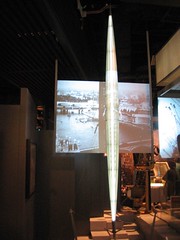 Explanatory text and lots of labelled examples of individual items are often replaced by film - as in this case showing a model of the Skylon at the Festival of Britain in 1951, or the recreation of the 18th century pleasure garden, where some of the fantastical costumes of the period are framed with video of fops out on the pull, and nearly coming to blows with their white-painted ladies crying out the Georgian equivalent of "Leave 'im, 'e ain't worth it!". The frontage of a 1920s Lyons teashop has a lifesize video of a smiling nippy delivering the same scone over and over again, while outside the café tables give puzzled children the chance to learn the mysteries of the rotating dial on old telephones. A 1930s-costumed attendant by the Selfridges lift explains what's in the store and what it's like to work there.
Elsewhere, there are touch-screens to allow adults to persuade themselves they're not playing, but exploring information in more detail, while below the 1920s taxi, there's a very conceptual model of an underground railway at toddler height.
That, by the way, seems to be as much as is said about transport, nor is there much about housing, or the usual demonstrations of how the city has grown and what that meant for public services and government.
But there needed to be space made for all that's been happening in the last few decades. How odd to think that one's own lifetime is now museum material: clothes, posters and pamphlets from the 60s, 70s and 80s, early desk-top computers, the posters and leaflets of the "Less Passion from Less Protein" campaigner, the passionate debates about race, identity and diversity.
At last one catches sight of the café, and passing through some samples of London-inspired art and a special section for the star attraction (the Lord Mayor's coach, now surrounded by some - but somewhat limited - information on the City of London rather than, as I remember it, marooned in a corner) you come to a section on Londoners, with projected videos of a succession of people talking about their lives, and finally an interactive section asking for opinions on future London issues like housing, transport and so on. In the café, you're surrounded by a scrolling display of random statistics to inspire some "well, fancy that" responses while you recover, over a cup of tea:

Sunday, 30 May 2010
The world's most expensive karaoke night
Well, that's over with for another year.
Despite the attempts to add a little local folk touch to their songs, this year more than ever, the finalists all seemed to come from the mysterious world of Popland. Forget Molvania - this is the land that time didn't exactly forget, it merely distorted, in a way one could only explain in one of those warp-speed pseudo-scientific gabbles with which Dr Who gets over an impossibility in the plot.
This is a land where the most banal of sentiments requires firework displays, wind machines and striding about self-importantly. If, that is, one can actually make sense of the sentiment. Almost all the songs are now sung in something that sounds like a Babelfish translation into English; the phrases make a sort of sense, but somehow don't belong together. To add to the phenomenon of Chinglish, you could call it Ponglish.
But never mind, the spectacle has taken over. Leather catsuits, double-keyboard perspex pianos (eat your heart out, Udo Jürgens) and the usual complement of fey young men and fine big women (I could have sworn that Armenia's backing singers included Montserrat Caballé's stunt double) to add to the succession of identikit magazine cover models in interchangeable floaty dresses.
And the BBC's instant subtitling had its moments. According to them, the commentator described the Icelandic entry as "a big blubing anthem", and its singer (a classic Fine Big Woman, in a volcanic explosion of maroon chiffon) as dressed "to go to a welding".
The UK entry, competently about twenty years behind the times, left us once again in Millwall mode (for non-British readers, that's a football team whose supporters regularly chant "No-one likes us, we don't care").
The result was less incomprehensible than in some years - the winner's already been a big hit across the continent, it seems:
Despite the attempts to add a little local folk touch to their songs, this year more than ever, the finalists all seemed to come from the mysterious world of Popland. Forget Molvania - this is the land that time didn't exactly forget, it merely distorted, in a way one could only explain in one of those warp-speed pseudo-scientific gabbles with which Dr Who gets over an impossibility in the plot.
This is a land where the most banal of sentiments requires firework displays, wind machines and striding about self-importantly. If, that is, one can actually make sense of the sentiment. Almost all the songs are now sung in something that sounds like a Babelfish translation into English; the phrases make a sort of sense, but somehow don't belong together. To add to the phenomenon of Chinglish, you could call it Ponglish.
But never mind, the spectacle has taken over. Leather catsuits, double-keyboard perspex pianos (eat your heart out, Udo Jürgens) and the usual complement of fey young men and fine big women (I could have sworn that Armenia's backing singers included Montserrat Caballé's stunt double) to add to the succession of identikit magazine cover models in interchangeable floaty dresses.
And the BBC's instant subtitling had its moments. According to them, the commentator described the Icelandic entry as "a big blubing anthem", and its singer (a classic Fine Big Woman, in a volcanic explosion of maroon chiffon) as dressed "to go to a welding".
The UK entry, competently about twenty years behind the times, left us once again in Millwall mode (for non-British readers, that's a football team whose supporters regularly chant "No-one likes us, we don't care").
The result was less incomprehensible than in some years - the winner's already been a big hit across the continent, it seems:
Tuesday, 25 May 2010
Sunday in the Park
Last Sunday's blazing sun and somewhat discombobulating heat meant only one thing for most people - get out into the open air.
 Along the Regent's Canal, narrowboats were working the locks; with the new student residences has come a faint echo of Oxbridge, as the industrial surroundings now frame the sight of nervous people getting used to a punt:


To add to the gentrifying atmosphere, there were people clearing litter from the bushes along the canal; but they would have trouble shifting this evidence of a not uncommon use for London's canals.
 Everywhere, patches of greenery were attracting people to sit and enjoy the long-delayed warmth.
 Regent's Canal also borders Victoria Park, a masterpiece of nineteenth-century concern for the overcrowded and unhealthy poor.
Divided into two by a main road, the Park has a western end with the full complement of elegant iron benches and lamp-standards, and the obligatory lake and fountain:

Here the lawns, trees and flowerbeds were almost swamped with people. Picnicking, lazing, reading, setting up volleyball nets and dozens of barbecues, seemingly half of East London was out for a good time in the sun:


If most of the people had squeezed themselves into the western section, the east seemed less crowded (though no less noisy as most of it's given over to playing fields, and half a dozen matches were in progress).
 But there was space to move, and to admire a now rather dilapidated memorial to Victorian philanthropy and a couple of recycled shelters from the eighteenth-century version of London Bridge:
On this side, the Park stretches along the Hertford Union canal to almost within touching distance of the Olympic Park. Come 2012, visitors to the Olympics will have a huge bike park here, and a walk along the Greenway into Olympic Park. The two together will make an eastern "green lung" to match the Royal Parks in the west: something the founders couldn't have dreamed of, but would surely have won their approval.
 Along the Regent's Canal, narrowboats were working the locks; with the new student residences has come a faint echo of Oxbridge, as the industrial surroundings now frame the sight of nervous people getting used to a punt:

To add to the gentrifying atmosphere, there were people clearing litter from the bushes along the canal; but they would have trouble shifting this evidence of a not uncommon use for London's canals.
 Everywhere, patches of greenery were attracting people to sit and enjoy the long-delayed warmth.
 Regent's Canal also borders Victoria Park, a masterpiece of nineteenth-century concern for the overcrowded and unhealthy poor.
Divided into two by a main road, the Park has a western end with the full complement of elegant iron benches and lamp-standards, and the obligatory lake and fountain:

Here the lawns, trees and flowerbeds were almost swamped with people. Picnicking, lazing, reading, setting up volleyball nets and dozens of barbecues, seemingly half of East London was out for a good time in the sun:


If most of the people had squeezed themselves into the western section, the east seemed less crowded (though no less noisy as most of it's given over to playing fields, and half a dozen matches were in progress).
But there was space to move, and to admire a now rather dilapidated memorial to Victorian philanthropy and a couple of recycled shelters from the eighteenth-century version of London Bridge:On this side, the Park stretches along the Hertford Union canal to almost within touching distance of the Olympic Park. Come 2012, visitors to the Olympics will have a huge bike park here, and a walk along the Greenway into Olympic Park. The two together will make an eastern "green lung" to match the Royal Parks in the west: something the founders couldn't have dreamed of, but would surely have won their approval.
Saturday, 22 May 2010
It's that time of year again
Yes, the Eurovision Song Contest is almost upon us. But it appears the Russians decided not to send us their Spice Girls tribute band:
Wednesday, 19 May 2010
I'm not, by nature, particularly demonstrative. In all my time as a student in the 1960s, the only time I took part in a demonstration was an accident (I was waiting to cross the road and realised the blockage was due to a protest march about the visit of a particularly execrable politician; so I joined it). And it's taken me half a week to write up the fact that I actually joined a demonstration last Saturday (having been busy redecorating, but there's nothing interesting about the trials and tribulations of that - such as why it is that one doesn't discover the bit one's missed until after everything's put away and cleared up).
 Organised by a coalition of various worthy organisations concerned with electoral and constitutional reform, Take Back Parliament has been organising a petition for a change to the voting system - the major reason why I was for quite a time an activist for the Liberal Democrats (and the Alliance before it). When I stumbled across their first demonstration last week, it seemed like yet another lost cause, given that the Conservatives were in the driving seat after the election. But in the coalition negotiations, they were induced to at least offer a referendum on a change to the Alternative Vote (a preferential voting system, but not a proportional one), so it's a live issue once again.
The problem is that our First Past the Post voting system is really designed for a two party system, when the voters no longer want one. Since the 1970s, voters have been drifting away from the two main parties, not only to other parties, but even more to not voting at all. As a result, we've now had three elections in a row in which the two main parties together got less than half the electorate out to vote for them, and the "winning" party had fewer people voting for it than didn't vote at all. This time, over a third didn't vote, less than a quarter voted Conservative, less than a fifth voted Labour and just more than a fifth voted for some other party. A tiny proportion of MPs won more than half the votes of those who did vote in their constituencies: but far too many constituencies are still considered "safe" for one party or another. The system, basically, is broken.
And this is the best chance for decades to change it: hence the excitement.
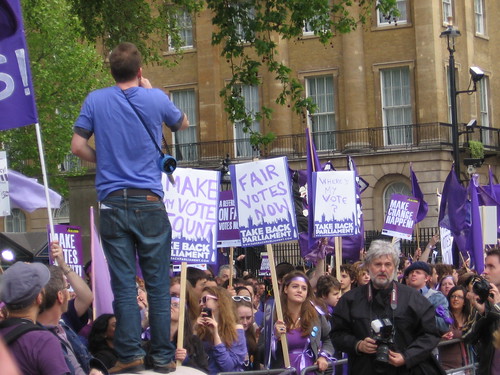
 It wasn't the most revolutionary of atmospheres. There were people from Class War around the fringes, but their efforts seemed to be confined to politely asking if one would like a poster calling the new Prime Minister rude names (probably nothing he hasn't heard plenty of times before and may well hear again from his own back-benchers). Some people seemed to be there to protest that the new coalition wasn't what they'd voted for (forgetting that any reform is likely to make it impossible for anyone to get exactly what they'd voted for - nor should we if we continue to divide much as we have done). Only one speaker seemed to focus on the need for the system to be fair to voters' wishes rather than on the outcome for parties. The speeches from various luminaries were interspersed with slogan-chanting, but alongside the obvious "Fair Votes Now" and "No More Wasted Votes", proceedings were lightened by the surprising precision with which "What do we want?" was answered by "Electoral reform!" and "When do we want it?" by "Subject to referendum!"

 The gathering was colourful and loud enough to attract plenty of attention from both locals and tourists on passing buses.
The main business of the day was to make a mark on Parliament and then present the petition at Downing Street, so after all the speeches, the crowd moved on.
No chaining ourselves to the railings (yet?), but there was the less inconvenient tying on of ribbons and banners (which no doubt disappeared by the time the MPs actually turned up on Monday)

And eventually the meeting reconvened opposite Downing St (clearly we were on the late shift, as there was a collection of pro-Palestinian banners gathered up on one side), with some more sloganeering as the petition was delivered, with plenty of passing tourist cameras clicking:
 .
.
 Organised by a coalition of various worthy organisations concerned with electoral and constitutional reform, Take Back Parliament has been organising a petition for a change to the voting system - the major reason why I was for quite a time an activist for the Liberal Democrats (and the Alliance before it). When I stumbled across their first demonstration last week, it seemed like yet another lost cause, given that the Conservatives were in the driving seat after the election. But in the coalition negotiations, they were induced to at least offer a referendum on a change to the Alternative Vote (a preferential voting system, but not a proportional one), so it's a live issue once again.
The problem is that our First Past the Post voting system is really designed for a two party system, when the voters no longer want one. Since the 1970s, voters have been drifting away from the two main parties, not only to other parties, but even more to not voting at all. As a result, we've now had three elections in a row in which the two main parties together got less than half the electorate out to vote for them, and the "winning" party had fewer people voting for it than didn't vote at all. This time, over a third didn't vote, less than a quarter voted Conservative, less than a fifth voted Labour and just more than a fifth voted for some other party. A tiny proportion of MPs won more than half the votes of those who did vote in their constituencies: but far too many constituencies are still considered "safe" for one party or another. The system, basically, is broken.
And this is the best chance for decades to change it: hence the excitement.
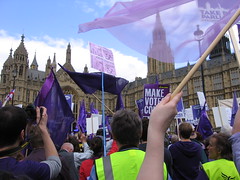 It wasn't the most revolutionary of atmospheres. There were people from Class War around the fringes, but their efforts seemed to be confined to politely asking if one would like a poster calling the new Prime Minister rude names (probably nothing he hasn't heard plenty of times before and may well hear again from his own back-benchers). Some people seemed to be there to protest that the new coalition wasn't what they'd voted for (forgetting that any reform is likely to make it impossible for anyone to get exactly what they'd voted for - nor should we if we continue to divide much as we have done). Only one speaker seemed to focus on the need for the system to be fair to voters' wishes rather than on the outcome for parties. The speeches from various luminaries were interspersed with slogan-chanting, but alongside the obvious "Fair Votes Now" and "No More Wasted Votes", proceedings were lightened by the surprising precision with which "What do we want?" was answered by "Electoral reform!" and "When do we want it?" by "Subject to referendum!"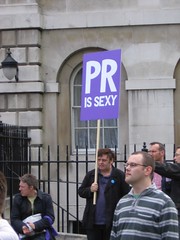
 The gathering was colourful and loud enough to attract plenty of attention from both locals and tourists on passing buses.
 The main business of the day was to make a mark on Parliament and then present the petition at Downing Street, so after all the speeches, the crowd moved on.
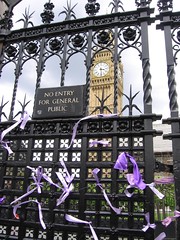
No chaining ourselves to the railings (yet?), but there was the less inconvenient tying on of ribbons and banners (which no doubt disappeared by the time the MPs actually turned up on Monday)

And eventually the meeting reconvened opposite Downing St (clearly we were on the late shift, as there was a collection of pro-Palestinian banners gathered up on one side), with some more sloganeering as the petition was delivered, with plenty of passing tourist cameras clicking:
 .
.
Friday, 14 May 2010
Highways and byways
Even traffic jams have their advantages. Finding my usual route off Tower Bridge blocked, I had to explore some different Bermondsey backstreets.
First, Druid Street became Crucifix Lane, a fairly standard row of Victorian terraced shops

You might think the transition from one name to another justified ponderous musings about historical symbolism, but it seems these are Victorian whimsies - the "crucifix" apparently referring to an old pub sign.
However, layers of history are revealed, if you look.
In the typically grimy and gloomy railway arches in Druid Street, some 50-odd people taking shelter during the Blitz were killed by a direct hit.
Round the corner, in Bermondsey Street, an archway opening into the remains of a cobbled lane suggest the hugger-mugger of a Dickens novel, but the lane points to one of the many postwar public housing estates of the area.

Further on, the romantically named Snowsfields, and Ship and Meadow Row, show different ways, from mid- and late Victorian times, of dealing with the difficulties of life in what was then, and until relatively recently, an area of some poverty.


Nowadays, this is the kind of "bourgeois bohemian" area that boasts the Zandra Rhodes Fashion Museum, where young adults zoom to work in some media-related office on shiny children's scooters without a trace of self-consciousness, and even the security grilles have the arty designer's touch:

First, Druid Street became Crucifix Lane, a fairly standard row of Victorian terraced shops

You might think the transition from one name to another justified ponderous musings about historical symbolism, but it seems these are Victorian whimsies - the "crucifix" apparently referring to an old pub sign.
However, layers of history are revealed, if you look.
In the typically grimy and gloomy railway arches in Druid Street, some 50-odd people taking shelter during the Blitz were killed by a direct hit.
Round the corner, in Bermondsey Street, an archway opening into the remains of a cobbled lane suggest the hugger-mugger of a Dickens novel, but the lane points to one of the many postwar public housing estates of the area.

Further on, the romantically named Snowsfields, and Ship and Meadow Row, show different ways, from mid- and late Victorian times, of dealing with the difficulties of life in what was then, and until relatively recently, an area of some poverty.


Nowadays, this is the kind of "bourgeois bohemian" area that boasts the Zandra Rhodes Fashion Museum, where young adults zoom to work in some media-related office on shiny children's scooters without a trace of self-consciousness, and even the security grilles have the arty designer's touch:

Saturday, 8 May 2010
A cold and drizzly day in Trafalgar Square
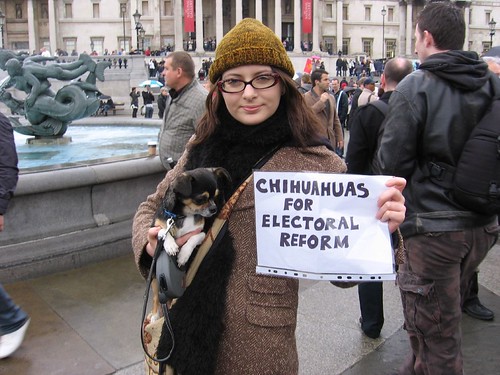
.. and what could more appropriate than those great English traditions - Morris dancing and a demonstration about the vote.

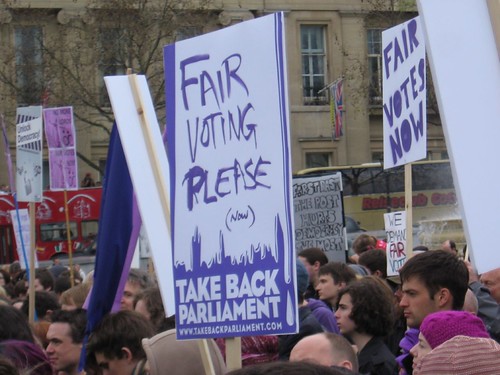
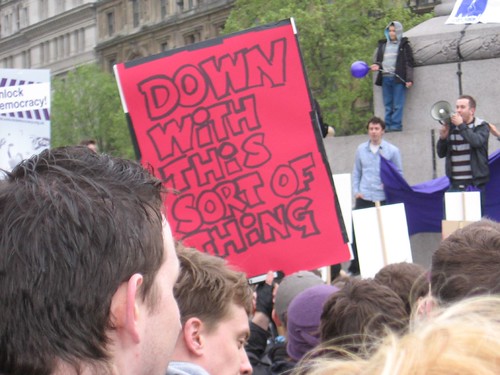
I'm assuming there'd been a double-booking. The Morris dancing was obviously a festival for different teams or groups, or whatever they're called, and the demonstration looked as though it had been rather improvised in the light of the outcome of Thursday's election. Not much had been provided in the way of amplification for the speakers, who were competing with the jaunty jingles from the dancers and their concertina accompaniment, and some of the improvised banners looked a little less than revolutionary (I'm all in favour of the cause, but this was hardly Athens):


I'm assuming there'd been a double-booking. The Morris dancing was obviously a festival for different teams or groups, or whatever they're called, and the demonstration looked as though it had been rather improvised in the light of the outcome of Thursday's election. Not much had been provided in the way of amplification for the speakers, who were competing with the jaunty jingles from the dancers and their concertina accompaniment, and some of the improvised banners looked a little less than revolutionary (I'm all in favour of the cause, but this was hardly Athens):
Friday, 7 May 2010
What's the first thing you do...
 ...when you look at a map?
You try to place yourself on it, or at least where you live, or if not that, then somewhere you've been. That seems to be a general rule, to judge by the people who were at the British Library's Magnificent Maps exhibition on Bank Holiday Monday. People from all over were poring over the maps on display pointing out to each other places they knew.
But the range of the exhibition was much broader, more imaginative than it might sound. From the mediaeval mappa mundi to the present day, there were examples of maps (almost all from Europe) as artefacts for religious contemplation, as conspicuous display for monarchs to overawe visiting diplomats or to remind neighbours of their vulnerability, as news reports of great victories, as speculative indicators of wealth to be gained as well as charts of seafarers' waypoints and friendly harbours (never mind about the hinterland), as political satires and propaganda, before we got anywhere near the conventional instructional maps we know today. It was a useful reminder to see them in a context that underlined how much subjectivity there can be in choosing what to represent, and how to do so.
I shouldn't have gone on a chilly Bank Holiday - half the world seemed to have had the same idea. But since it's free, it would be worth going back on a quiet weekday morning - the star attractions included Stephen Walter's The Island, a combination of local and personal London lore that one could spend all day on. There's a world map of facts and fancies to do with tea, that I think I remember seeing as a child, and that I wouldn't mind looking over again. And I'd like to spend more time on Grayson Perry's personal take on a mappa mundi, the Map of Nowhere: here the conceptual relationships of various places in the known world to Jerusalem or Rome are replaced with so many concepts floating around in public discussion, media cant and boilerplate artspeak:
Thursday, 6 May 2010
Election day
 My local polling station is the school across the road, so it's easy to drop in on the way to work.
Today was the first occasion I can remember actually having to queue. In a constituency with a traditionally low turnout record, this is encouraging.
But it may have had something to do with the fact that we had three ballot papers (parliamentary, local council and local referendum) to be registered out to us and explained (I'll bet the explanation gets a bit more perfunctory as the day wears on); or that the officials for the other part of the reguister from mine were being a bit too officious or slow, or more people were turning out at that time for that bit of the register.
Either way, once I'd got to the right point, it was the usual five minute in-and-out, and my democratic duty was done. It seems so mundane for something with such important consequences; but perhaps it should - there's too much showbizzy hoopla about elections already.
And no, I'm not staying up all night to watch the results.
Sunday, 2 May 2010
Is it the law?
It's a Bank Holiday weekend and it's bucketing down. And I was thinking it might be worth taking a look at the Fun Day in the local cemetery (no, seriously)
Instead, I shall continue with digitising my CDs (8GB so far and rising), and leave you with this seasonally-themed (and, for the weather, suitably melancholic) music:
Instead, I shall continue with digitising my CDs (8GB so far and rising), and leave you with this seasonally-themed (and, for the weather, suitably melancholic) music:
Tuesday, 27 April 2010
The magic fridge
It seems that if a woman just puts her head into a John Lewis fridge, she comes out six months pregnant:
http://www.youtube.com/watch?v=zMtyOCoqHTk
http://www.youtube.com/watch?v=zMtyOCoqHTk
Monday, 26 April 2010
Facebook wit and wisdom
What kind of tortured genius was it that programmed Facebook to suggest that you "friend" yourself - and then, if in a moment of devil-may-care whimsy you attempt to do so, to tell you
"You cannot connect with yourself."
Is this some profound observation on online social networking? Or have they been watching me all my life? I could get a complex, or something.
"You cannot connect with yourself."
Is this some profound observation on online social networking? Or have they been watching me all my life? I could get a complex, or something.
This Sunday morning brought the sound of pounding feet, shouts and cheers down our main road. Not election canvassers, but the London Marathon once again.
Once again, a kind neighbour with a prime balcony view of the oncoming crowds of runners had a viewing party. It all looked much the same as the last time I posted photos and videos of it. For a couple of hours, once the international elite and competitive club runners had passed, we had a parade of firemen, soldiers, cavemen, supermen, wonderwomen, cowboys, leprechauns, fairies, smurfs, Minnie Mice, Simpsons (and every other cartoon character you can imagine), an Avatar character, tigers, lions, a beer bottle or two, some whoopee cushions, a telephone, guide dogs, rhinos, a camel, a record-breaking caterpillar of 34 people, men in tutus, a rhino in a tutu, a giraffe with a 20ft neck, and extraordinary ordinary men and women of all ages, shapes, sizes and colours.
The Marathon's exhausting. It takes dedicated preparation and careful attention to the right kind of fortifying food.
For watching it, that is. So we had Spanish omelettes, sandwiches and sausage rolls, salads, cheese straws, sundry other savouries, and cake. And tea - lots of tea. And more cake.
My small contribution involved a few mini-pizzas (thanks to Walt's relay of a foolproof dough recipe - who'd have thought yeast would work better when it's kept in the fridge overnight?) and some chocolate macaroons (nice to eat, but there must be a better way than piping the mixture out of a bag - they looked like something that you mustn't leave lying in the street).
Eventually the last stragglers had passed, fortified in their turn by the slices of orange, chocolates and so on handed out by the spectators.
By the early evening, all the detritus of water bottles, orange peel, balloons and banners had disappeared : whether that has anything to do with the fact that our estate houses a local councillor and candidate for Parliament in this election - well, I couldn't say.
Once again, a kind neighbour with a prime balcony view of the oncoming crowds of runners had a viewing party. It all looked much the same as the last time I posted photos and videos of it. For a couple of hours, once the international elite and competitive club runners had passed, we had a parade of firemen, soldiers, cavemen, supermen, wonderwomen, cowboys, leprechauns, fairies, smurfs, Minnie Mice, Simpsons (and every other cartoon character you can imagine), an Avatar character, tigers, lions, a beer bottle or two, some whoopee cushions, a telephone, guide dogs, rhinos, a camel, a record-breaking caterpillar of 34 people, men in tutus, a rhino in a tutu, a giraffe with a 20ft neck, and extraordinary ordinary men and women of all ages, shapes, sizes and colours.
The Marathon's exhausting. It takes dedicated preparation and careful attention to the right kind of fortifying food.
For watching it, that is. So we had Spanish omelettes, sandwiches and sausage rolls, salads, cheese straws, sundry other savouries, and cake. And tea - lots of tea. And more cake.
My small contribution involved a few mini-pizzas (thanks to Walt's relay of a foolproof dough recipe - who'd have thought yeast would work better when it's kept in the fridge overnight?) and some chocolate macaroons (nice to eat, but there must be a better way than piping the mixture out of a bag - they looked like something that you mustn't leave lying in the street).
Eventually the last stragglers had passed, fortified in their turn by the slices of orange, chocolates and so on handed out by the spectators.
By the early evening, all the detritus of water bottles, orange peel, balloons and banners had disappeared : whether that has anything to do with the fact that our estate houses a local councillor and candidate for Parliament in this election - well, I couldn't say.
Saturday, 24 April 2010
Sunday, 18 April 2010
A tree with an identity crisis
Another sunny day without aeroplane noise, and today the sun had real warmth. Time for the annual pilgrimage to Columbia Road, and £15-worth of instant gardening to rescue my reputation from the sorry accumulation of brown bits in my window-boxes - quite a few of which are showing signs of new growth despite my ungrateful neglect over the winter.
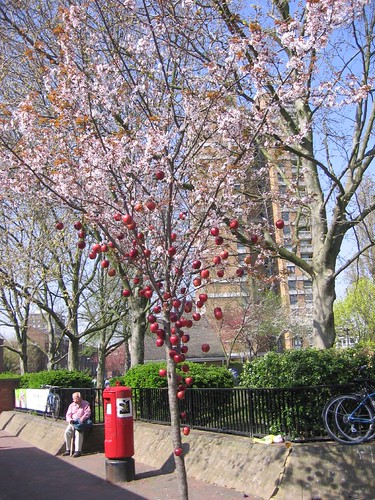
Among the crowd-pleasing entertainments today was this unusual hybrid.....

Among the crowd-pleasing entertainments today was this unusual hybrid.....
Saturday, 17 April 2010
It's an ill wind..
No sign of volcanic ash here in London. The sky has been more or less cloudless all day - indicating, apparently, high pressure preventing all that volcanic ash from moving on at any speed, which in turn means that the skies have been quiet. No stream of jets lining up to process up the river past us into Heathrow, no smaller prop-jets and the like circling round into City Airport - and no helicopters either.
However, as if it weren't bad enough that the ice-cream vans and their jingles are now making their tinny appearance, this morning I saw what I had thought a forgotten breed - an election loudspeaker van. And not for one of the major contenders, either. This was for the English Democrats, a somewhat Poujadist outfit demanding a parliament for England, and a mishmash of various populist eyecatchers (if UKIP is the party for Poujadists who don't care for foreigners, the English Democrats is the party for Poujadists who'd rather not notice them). What's more it wasn't hired for the occasion, nor was it an ordinary car with the passenger leaning out of the window with a handheld megaphone. This was all painted up in party colours, and a website address for the local party organisation (so, apparently not a van that's on loan around the country). One wonders where the money comes from, given that they'll almost certainly lose their deposit.
For this constituency, once considered safely working-class Labour, with just the occasional protest vote for the extreme right, is now considered highly marginal.
The demographic changes around here (that is, lots and lots of expensive rabbit hutches for bankers and City workers) have fuelled an upsurge of support for the Tories, who now hold the local council seats for this end of the constituency. The Liberal Democrats, who for a time held the local council, were strong in the Borough's other constituency, but not here, although they're putting up one of the party's stronger campaigners.
The Tories' hopes have been encouraged by the prospect of Labour losing votes to the egregious George Galloway and his rum collection of perpetual oppositionists, who for some reason have decided to move on from the neighbouring constituency, for which he was elected (though you wouldn't know it) last time, and devote their attentions to us.
And as if that weren't enough reason for this to be one of the constituencies to look out for, we're also to be asked to vote on whether we should have a directly-elected executive mayor for the borough.
But for all the hoopla, and the apparent sudden opening up of the national campaign after the response to the first leaders' debate on TV, there really only seems to be one option for my vote, here, since I don't want Galloway or a Tory government.
However, as if it weren't bad enough that the ice-cream vans and their jingles are now making their tinny appearance, this morning I saw what I had thought a forgotten breed - an election loudspeaker van. And not for one of the major contenders, either. This was for the English Democrats, a somewhat Poujadist outfit demanding a parliament for England, and a mishmash of various populist eyecatchers (if UKIP is the party for Poujadists who don't care for foreigners, the English Democrats is the party for Poujadists who'd rather not notice them). What's more it wasn't hired for the occasion, nor was it an ordinary car with the passenger leaning out of the window with a handheld megaphone. This was all painted up in party colours, and a website address for the local party organisation (so, apparently not a van that's on loan around the country). One wonders where the money comes from, given that they'll almost certainly lose their deposit.
For this constituency, once considered safely working-class Labour, with just the occasional protest vote for the extreme right, is now considered highly marginal.
The demographic changes around here (that is, lots and lots of expensive rabbit hutches for bankers and City workers) have fuelled an upsurge of support for the Tories, who now hold the local council seats for this end of the constituency. The Liberal Democrats, who for a time held the local council, were strong in the Borough's other constituency, but not here, although they're putting up one of the party's stronger campaigners.
The Tories' hopes have been encouraged by the prospect of Labour losing votes to the egregious George Galloway and his rum collection of perpetual oppositionists, who for some reason have decided to move on from the neighbouring constituency, for which he was elected (though you wouldn't know it) last time, and devote their attentions to us.
And as if that weren't enough reason for this to be one of the constituencies to look out for, we're also to be asked to vote on whether we should have a directly-elected executive mayor for the borough.
But for all the hoopla, and the apparent sudden opening up of the national campaign after the response to the first leaders' debate on TV, there really only seems to be one option for my vote, here, since I don't want Galloway or a Tory government.
Thursday, 15 April 2010
Saturday, 10 April 2010
Belated Easter photographs
I would have posted these earlier, but for a senior moment while packing after my Easter weekend away. Nothing like a picture-postcard village in the spring, is there?

 A little stroll with the children round the houses to work off some of the Easter eggs, and then a stop to see the dragon outside the house of an enterprising gardener (incidentally, this one's got a head at each end).
But the pub has a more traditional sort of guardian:

And then it was back to work......

 A little stroll with the children round the houses to work off some of the Easter eggs, and then a stop to see the dragon outside the house of an enterprising gardener (incidentally, this one's got a head at each end).
But the pub has a more traditional sort of guardian:

And then it was back to work......
Subscribe to:
Posts (Atom)