| Name: Cheapo Microwave | ||
| Subject | Mark | Comments |
| Porridge | Tick VG | The best results to date; care and attention needed to prevent natural exuberance from causing entirely avoidable explosions. |
| Frozen scones | Tick VG | Very pleasing presentation. |
| Buns and muffins | Satisfactory | Results acceptable, but a little more work needed to arrive at a happy medium between flabby and stodgy. |
| Scrambled eggs | Good | Results very acceptable, but seems to require close and repeated attention, showing little improvement over traditional methods. |
| Baked potato | Passable | Timidity tending to excess effort for less than optimum results. |
| Suet rolypoly | Passable | See Baked potato. |
| Curly kale | Good | Very acceptable results. |
General comments: A good start. | ||
Thursday, 21 January 2010
Report


Sunday, 17 January 2010
Intrigued by the mysteriously glowing yellow/orange thing in the sky (what do they call it again? I've forgotten), I dragged the bike out of the garage to see if I - and it - could actually move again.
 Where to go? A quiet ride up the Regent's Canal, with a coffee break at the Pavilion Café in Victoria Park (the Sunday clientele here very much the knit-your-own-bicycle antithesis of what you might see around Canary Wharf).
Not so quiet, as it turned out. The towpath was approaching congestion, what with family groups out for a stroll and endless runners - clearly training for the marathon is getting under way. At an emptied council housing block in Hackney, windows are boarded up with photos of former residents, in this installation.
After following the canal to Islington, it's downhill all the way through Clerkenwell to Bloomsbury, to pick up a new book about one of my heroes, what to do? Well, once in Bloomsbury, the British Museum always has something new, and for the moment, it's the "Staffordshire Hoard", a newly-found collection of battered and crumpled Anglo-Saxon gold artefacts found in a field. No-one yet knows what it was all about, though to me it looks distinctly like the quickly-stashed proceeds of looting.
As a relief from all this high-mindedness, just around the corner is the Cartoon Museum, whose current exhibition on the magazine Viz is for the easily amused, but not for the easily shocked.
And on the way home in Shadwell, in the late afternoon sun (ah yes, that's what it's called), a blackbird was singing.
Saturday, 16 January 2010
Extraordinary
The temperature may not have been much above freezing for nearly a month, with barely a couple of hours of sunshine in all that time. But, in amongst the dead and wilting remains in my window-boxes, the pelargoniums and petunias are still putting out the odd floret, and I'm sure there's a new clump of nemesia - in full flower.
Wednesday, 13 January 2010
Toys
The best part of two weeks since I've been home, and next to nothing to write about. I blame the weather, of course: trudging through the slush encourages a sense of trudging through the days.
But there's been some fun playing with my Christmas toys. I've loaded up my spiffy new digital photo frame as far as I can. Once again, I contemplate the thought of digitising all my old photos, and then all the different forms of audio recording I have (hundreds of 78s, vinyl LPs, cassette tapes). After about five seconds of that, contemplation passes to procrastination - indefinitely.
I have another new (to me) toy, the penny finally having dropped that perhaps it would be more economical on electricity to use a microwave for the amount of stuff I freeze. So far, it works excellently on soups and scones, but not at all on crumpets (might as well put those straight into the toaster). I shall leave it to the weekend before I risk experimenting with (if the Internet is to be believed) exploding porridge.
For a while, e-book readers intrigued: Waterstone's have been pushing the latest model of the Sony, and the papers are full of Amazon's apparent success with the Kindle and the new business-oriented Que. Looking at an apparently ever-increasing collection of books (they breed, I tell you), the thought of having everything on one pocket-sized machine is immensely appealing.
But then, so much depends on how one actually uses books. Books are more than just the words on the page. For many, the physicality of paper, illustrations and layout is an important part of the experience. For others, books need to be read in context with others: researchers need to be able to cross-refer, so what would help them is the ability not just to make notes, but to link, and perhaps (assuming e-book files can have a standard set of bibliographic data) automatic construction of citations and bibliographies.
What we have here is the issue of convergence that makes so many new technology developments uncertain: which digital functions do you combine with which in a single device? I know someone who reads books on her i-Phone; the Que runs diary functions, spreadsheets and other office documents, and can download news updates; the Sony not only has an MP3 player built in, but it displays photographs (though the particular screen technology it uses renders them as a rather pale monochrome which soon loses its appeal). If there were a way a user could, on a single device, switch between the e-paper technology of e-book readers, and the backlit screen of a conventional computer (with, of course, full colour).......
And then there's the book-on-the-beach problem: a book can still be used even covered in suntan oil and ice-cream, and it can be left on the towel with far less worry than a £150 piece of electronic kit. And who wants to lose those stocks of abandoned books that some hotels accumulate, providing an opportunity on a rainy day for an in-depth study of the appeal of Netta Muskett?
Saturday, 2 January 2010
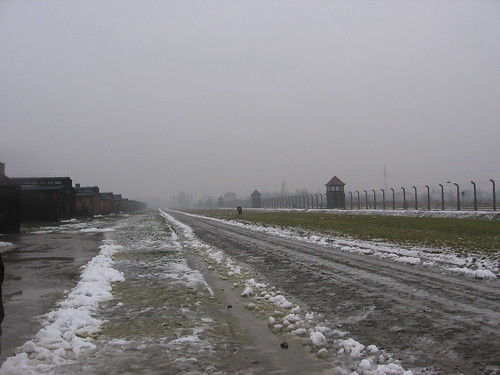
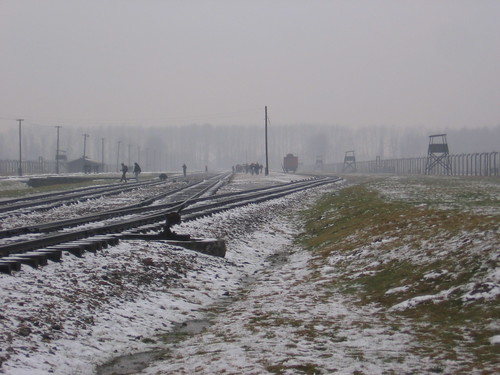
One of my reasons for going to Krakow was that my father was, as a prisoner of war, working in a coal mine in the area in 1943/44. I'd been able to find in the National Archives a report from the Red Cross inspectors of the time that identified the place (Bory, near Jaworzno) from the camp number, and with a bit of digging on the internet I'd been able to link the German names of that time to the Polish ones.
 A bit more digging with Google maps and satellite views, and the local bus company's own online information made it possible to work out how to get there and back by train and bus, reasonably simply.
Jaworzno made a change from tourist Krakow, at the very least. An agglomeration of small villages into modern town planning and development, mixing little streets of one-storey cottages reminiscent of parts of Scotland (a few of the cottages appearing, where the dilapidated render is crumbling, to be built like crude drystone walls) with Soviet-era housing estates and half-hearted shopping centres along modern by-pass roads, and an attempt at a modern town centre. It's actually quite reminiscent of similar attempts in British industrial centres.
Eventually, the bus route ends outside the most likely candidate for Dad's mine. What can I say? I don't quite know what I hoped to find, or what he would have made of it. Had he wanted and been able to visit for himself, he would probably have said - more or less politely - that he recognised bits of it, whether he did or not. It's a mine like many another; the winding gear is spruced up and brightly painted, and most of the buildings are anonymous and undateable. Some of the outbuildings look old and crumbling, but the remains of slagheaps look more like ski-slopes in the morning's fresh fall of snow. The cold at least gives a sense of the desolation I'd have expected to feel in Dad's situation.

There doesn't appear to be anywhere to eat nearby, and if I don't get the bus that's coming, I'll have to wait an hour, since it's Saturday. The only thing to do is to run for the bus, head back to the train for Krakow - and be grateful I've got the option.
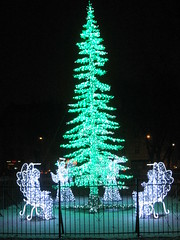 I've never been a great one for celebrating New Year's Eve, and even less on a cold and slushy evening after a day at one of the most miserable places in human history. There was a stage show on the main square, apparently, but a pop concert doesn't appeal at the best of times. So after catching some photos of the more striking Christmas lights and decorations, it was an early night in for me, and Sasha the cat (who comes with the flat). I watched some TV, but the English language world news channels don't hold the attention for long, and the main Polish TV channels have a strange habit of not just dubbing foreign programmes, but overlaying the dubbing on top of the original soundtrack, parts of which remain just audible in the background. Maybe it makes for subconscious language practice, but I found it damned annoying.
The obligatory fireworks took up quite a bit of the night - not much to see in view of the general murk, but plenty to hear, not just a half hour fusillade at midnight, but occasional resurgences throughout (and occasionally the next day, too). Sasha the cat (who comes with the flat) hid under the bed - no more to be said (I'd better stop before I start imagining that Sasha the cat has a big hat, etc., etc.).
Apart from the fireworks, it was also possible to hear that rain was clearing the snow a bit, which meant that New Year's Day was misty. It was also very, very quiet. Not much was open, so I waited to watch the Vienna New Year's Day concert on TV before a brisk walk around the Wawel hill and its cathedral (the decorative rain-spouts making their function very clear).
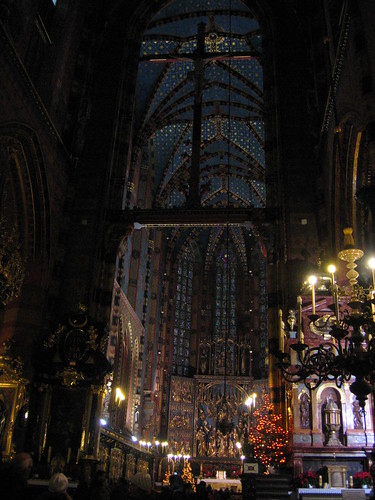
On my way back to the tram, I discovered that the Mariacka church was open to visitors, and stopped to - well, sorry, gawp at the profusion of gilding and the detail of the mediaeval altarpiece:
Thursday, 31 December 2009


Wednesday, 30 December 2009
Krakow in the snow
After the first evening, as in every home exchange, of orienting myself to someone else's way of organising their home (so many keys! no teapot! have I, the invading stranger, put the cat off its food?*) and the neighbourhood (evidently the would-be trendy/arty bit of Krakow), it snowed overnight.
 Even under skies that stayed leaden-grey all day, there was a certain extra charm to seeing real snow weighing down Christmas trees and street decorations alike.
As the morning wore on, though, the mixture of slush and occasional rain made this a day for indoor sightseeing. In the Czartorysky Museum, one is introduced to a dizzying succession of Polish monarchs and marshals of the 16th-18th centuries and their various portraits, acquisitions and knick-knacks (the glory days of richly-decorated armour and sumptuous carpets and tents acquired as booty from defeating the Ottomans soon give way to more domestic goods), and then a collection of paintings, which likewise rather tails off after the mediaeval, Renaissance and the Rembrandt.
I had lunch in a cellar which also offered a fortune-teller (no-one seemed to need her services, and she didn't seem bothered - no doubt it was no surprise to her).
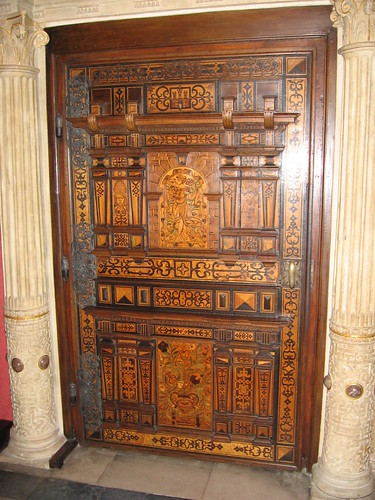
In the Collegium Maius, the mediaeval base and current museum and ceremonial heart of the Jagiellonian University, not everything is mediaeval: it's the closest I shall ever come to an Oscar, and Olympic gold medal or a Nobel prize (this must be one of the few places where you can see them all in one cabinet, as they have been presented to the university by former students). The main impression, however, is of the solemnity with which great institutions like this present their history (all the more understandable here, given what's happened to Poland over the centuries); much is familiar to anyone who's seen an Oxford or Cambridge college chapel or library, but there are some really impressive examples of decorative art and craft:

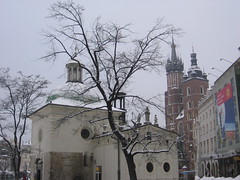 Even under skies that stayed leaden-grey all day, there was a certain extra charm to seeing real snow weighing down Christmas trees and street decorations alike.
As the morning wore on, though, the mixture of slush and occasional rain made this a day for indoor sightseeing. In the Czartorysky Museum, one is introduced to a dizzying succession of Polish monarchs and marshals of the 16th-18th centuries and their various portraits, acquisitions and knick-knacks (the glory days of richly-decorated armour and sumptuous carpets and tents acquired as booty from defeating the Ottomans soon give way to more domestic goods), and then a collection of paintings, which likewise rather tails off after the mediaeval, Renaissance and the Rembrandt.
I had lunch in a cellar which also offered a fortune-teller (no-one seemed to need her services, and she didn't seem bothered - no doubt it was no surprise to her).
In the Collegium Maius, the mediaeval base and current museum and ceremonial heart of the Jagiellonian University, not everything is mediaeval: it's the closest I shall ever come to an Oscar, and Olympic gold medal or a Nobel prize (this must be one of the few places where you can see them all in one cabinet, as they have been presented to the university by former students). The main impression, however, is of the solemnity with which great institutions like this present their history (all the more understandable here, given what's happened to Poland over the centuries); much is familiar to anyone who's seen an Oxford or Cambridge college chapel or library, but there are some really impressive examples of decorative art and craft:
*This is a rhetorical question. There is a cat. There is food. What - by one letter - is the most economical response?
Tuesday, 29 December 2009
Euphemism corner
Spotted en route to Stansted Airport and the delights of Ryanair (no, there were some things I didn't have to pay for, I made sure I went before I got on the plane):
A truck advertising 'End of Life Vehicle Specialists' - not, I suspect, hearse suppliers, but scrap dealers.
A truck advertising 'End of Life Vehicle Specialists' - not, I suspect, hearse suppliers, but scrap dealers.
Thursday, 24 December 2009
Merry Christmas!
Just to get you in the mood, here are some lovely ladies knocking out (literally) some seasonal music:
Monday, 21 December 2009
Getting there..
These last few days before Christmas are eerily quiet in the office - a bare handful of people under the ever-so-slightly-overplanned ranks of our Space Invader decorations, and round the corner even fewer under our neighbours' efforts (they tried to compete, but it has to be said, Christmas spirit notwithstanding, that it looks like an explosion in a pound shop).
No more tea-point two-step, for these few days. Long years ago, some genius decided a building full of civil servants would need no more than two tiny spaces per floor, each of which might just about pass muster for a one-bedroom flat for those of modest income. As a result, gasp as one might, making a cuppa usually necessitates a polite wait while strangers from other sections exchange mysterious gossip and air incomprehensible grievances, and then a polite excuse-me and might-I-just of manoeuvres between the boiler, the sink and the fridge. Not today.
It's all the quieter because of the snow, the worst effects of which don't seem to have had any effect where I live, but to the south and east of London, people were taking three hours to get home last night, it seems. Less than ten days ago, I was still not using my winter outerwear, the encircling gloom not being that cold.
But with the snow, the Christmas season is at last (and somehow rather late, by comparison with previous years) perceptible; it seemed only appropriate to seek out the seasonal photo-opportunity I missed last year (you may attribute the camera movement to seasonal shivers):
Sunday, 20 December 2009
Somebody stop me
Waitrose had a reduction on packs of Green and Black's chocolate yesterday. I thought it might be something to keep me going until Christmas. Won't last till Monday at this rate....
Friday, 11 December 2009
Senior moments
I've never been particularly interested in shoes: all they need to be is comfortable and long-lasting. I usually have a couple of pairs of black and a couple of pairs of brown shoes, in different styles, and wear each pair on alternate days. I only mention this because today, on picking up the waiting pair of black shoes so neatly (for once) aligned in the corner, I realised I must have spent yesterday wearing the left of one style and the right of another.
On a seasonal note, one advantage of the colder weather is that, on a crowded tube train, people are so much better padded and less sharp-elbowed. It's like being gently (but firmly) swaddled in a constricting maze of pillows.
On a seasonal note, one advantage of the colder weather is that, on a crowded tube train, people are so much better padded and less sharp-elbowed. It's like being gently (but firmly) swaddled in a constricting maze of pillows.
Tuesday, 8 December 2009

Saturday, 28 November 2009
Desperation
In the hardware and household shop, among the novelty items, tucked in beside the granny race tracks, a box of wind-up condiment shakers, with the slogan: "Passing the salt and pepper has never been so much fun!!!!"
Tuesday, 24 November 2009
 What happens to electoral registers may seem a very dull subject. But did you know the "edited register" (the basic names and addresses, and the electoral ward they're in) has for ten years been on sale to all and sundry to use as they wish?
Last summer, a review for the Ministry of Justice made a firm recommendation that this should stop. Now the Government has put out a consultation - mainly, it seems, aimed at the commercial and charity marketing interests who would be affected - asking for opinions about what should happen.
Well, I've had my say and sent it in.
I may have been less than sympathetic to the idea that direct marketing people would have to set up and maintain their own registers (the word "Tough!" may have slipped in there somewhere).
I may not have shrunk from expressing outrage: Tunbridge Wells can be proud of me.
You may have your own opinions. But if you don't express them now, who knows what they might let the moneybags get away with?
Saturday, 14 November 2009
Who'd have thought soft furnishings could cause such homicidal rage?
Strictly speaking, it was the hardware attached. I've never been that fond of the curtain poles I inherited, and recently both the rings and the fixings have been looking increasingly precarious. The time has come for something shiny and new.
I had tested to see what sort of wall plugs I might need, honestly. What I didn't realise was that the builders of this flat had been sneakily inconsistent: at one place there might (as I'd found) be a void between the wall surface and whatever lintel they'd put in, but (as I had not found before today) at another there'd be none. All I could do was drill a hole roughly where I needed it, and only then work out how to fix a screw into it. It all served to prove the first rule of DIY: whatever you need (especially when you need it right now, before everything falls down) is still in the hardware shop - and the only really well-stocked one near here is two bus rides away.
But at last I have managed to ensure a modicum of privacy at, at least, the bedroom window. One of the brackets seems already to be plotting a bid for freedom, but sufficient unto the day, and all that. As I relax a little, I can pass on the observation that, if you should see someone in the street muttering darkly to themselves about the injustice of the world of curtains and hardware, there might be some semi-rational explanation.
These things, as my mother used to say, are sent to try us, and worse things happen at sea. Judging by the violently gusty winds and squalls of rain we've had today, the latter's all too evidently true. A night for listening to the Shipping Forecast in one's own cocoon (especially now that I can close the curtains), and particularly to the soothing midnight play-out music:
Saturday, 7 November 2009
Conversation piece
Cycling over Tower Bridge needs concentration, even more than on other roads. Going to work or coming home, I need to bear over to the right as I come off the bridge - so relative pace and position in the traffic lanes need to be thought out. To add a complication, there's a nasty pot-hole on the northbound lane that needs to be avoided.
So I was in no mood to be distracted by some indistinct shouting from a car to my right. It's not unheard of, whether it be someone trying to share his (it's usually his) interesting variations on motorists' vernacular for cyclists, or someone asking for directions (yes, they will do it even at some speed, and even leaning right across to the passenger-side window). But I ignored it, until I heard the word "gadget".
Then the penny dropped. He wanted to talk about my Winkku.
I couldn't make out any more, as he continued to bellow indistinctly, keeping pace alongside me, so I just made non-committal noises, until the point where he really had to decide which lane he was in, and he drew ahead to stop in the queue at the lights. I rather ostentatiously put on my indicator as I moved to the right and pulled up behind him.
He poked his head out of the driver-side window and shouted "What happens when you want to turn left?"
But the lights changed and he did not stay for an answer.
Monday, 2 November 2009
Chord
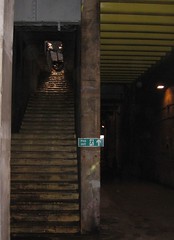 Not the most likely venue for an artwork, you might think; one of London's little seen spaces, the old Kingsway tram tunnel. Here, once upon a time, trams rattled between the Embankment and the top of Kingsway.
Ever since the trams were withdrawn in 1952, the space has been closed off to the public, part used for an underpass for cars, part set up for a control room for emergencies like the Great London Flood that we're still waiting for, part leading to mysterious offices for "other government functions". Of the rest, what isn't simply used for storing stuff has served for film sets, but most of us only know of the tunnel by reputation and odd glimpses through littered gratings and over the walls of the old entrance way.
So there's been a lot of interest in the opportunity to see it offered by Conrad Shawcross's Chord, an installation that takes advantage of the long straight tunnel.
Entering down the surprisingly steep slope (imagine how the tram wheels must have squealed as they strained their way up), I was struck by the height and angularity of the tunnel. This isn't a tube, it's a straight cut down, made all the deeper for double-decker trams. We were ushered past still-surviving elements of the old tramway station: a narrow central platform and the kind of steep stairs that wouldn't pass a health and safety inspection nowadays, but the torn, stained and flapping station signs and maps on the wall are simply film props.
Skirting puddles and cables, we went on into the gloom, and came to two large contraptions, a good 4-5 metres high, set on a rack-and-pinion rail track. Three arms, each with three branches, and each of these with three sets of six spools of thick thread, each of a different colour (but related to the other five in the set). All these elements rotate independently, driven by intricate cogs from a single, modestly small, motor on each machine. Starting 10 metres apart, the machines move slowly apart, making a rope at a rate of 5cm an hour. After three days, the machines move back together and the process starts again.
Though the classically-minded might think of Ariadne, she made her thread at home (sensible girl) and for a labyrinth, not a straight tunnel. But here the floodlighting from the sides, keeping pace with the machines and the rope as they move, accentuated the gloom on the farther side. One might fancy that anything could be lurking in the dark, beyond the heaps of indeterminate shapes and the mysterious closed-off world of troglodytic securocrats. Appropriately perhaps, the machines let out an eery wail, like a modern jazz trumpet in a film noir soundtrack - or the squeal of a ghost tram grinding around a curve.
The enthusiasts for forgotten heritage, weeping concrete and the like had been flashing away with the cameras; we were asked not to photograph the artwork, but this doesn't seem to have been a universal rule, so you can get a better idea from these photos, or these.
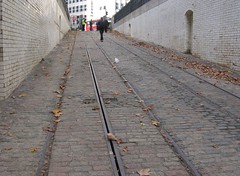 It takes less than half an hour, it seems, to contemplate the interchangeability and limitations of time and space; all too soon, we were being ushered up the surprisingly steep slope back to the street (imagine the noise of trams labouring up this!).
One last fact: when I asked the guide what the material for the rope was, he said the only material available in a sufficient range of colours for all those spools was "anorak cord".
Friday, 30 October 2009
Krispy Kreme, please note....
It isn't the most winning of sales techniques to greet a customer's order by adopting a Lady Bracknell tone of mildly outraged incredulity to say "Just the one?"
Subscribe to:
Posts (Atom)