Heron Island, Great Barrier Reef, Australia

Monday, 28 July 2008

More passing shows

I was thinking I might not be posting much for the next couple of weeks: I'm doing a home exchange to Paris, which means I've got to get down to all those cleaning and minor repair jobs I've been putting off. It's all planned out: perhaps I'm being too fussy (I won't be looking so carefully at their place), but I'll know what I've left behind, and I'd rather have a certain peace of mind.

However, one of the put-off jobs (getting a new printer, so I can leave all my handy household hints written down) took me past the display window of the St Martin's School of Art tonight.

The last time I was here, there was a young woman licking chocolate off the inside of the window. Tonight, a pair of young women impassively manoeuvred three separate strands of coloured string around - not exactly cat's cradle, more a case of moving, inverting and distorting a frame. Come to think of it, the clever thing was that the tension (in the string, if not in the spectators) was never lost.

Tuesday, 22 July 2008

These cheery chappies preside over the café in the Museum in Docklands. It's a far cry from the "char and a wad" in their hands to the espressos and Danish pastries now on offer.

In what was once a sugar warehouse in "Blood Alley" (so called from the injuries dockers received from the raw sugar inadequately cushioned by simple sacks), the Museum in Docklands tells the story of the importance of the river and the docks to London's life and prosperity, from Roman times through to the "Warehouse of the World" in the 19th and 20th centuries.

There are large and suitably Dickensian reconstructions (complete with sound-effects) of narrow alleys and their different shop-fronts and interiors. One of my great-great-grandfathers, who was a porter-labourer for wine importers near the St Katharine Docks, quite possibly lived in a room like this.

The material expands as it gets into the 19th and 20th centuries, of course. There are large sections on life and labour in the Victorian expansion (I passed on paying extra for a special exhibition on Jack the Ripper - what is this fascination with something so squalid?), the role of the river and docks in the Second World War, with much graphic detail of how the Blitz affected the East End, and ends with a canter round the decline of the 1960s and 1970s, and the debates over redevelopment since.

Both the products and the means of handling them are covered: the development of docks, bridges, tunnels, railways and warehousing, with replicas of the kind of stores used for handling and measuring tobacco and wines, a blacksmith's forge, a cooper's workshop, boxes of spices to smell, features on shipbuilding (including the works that was on the site where I live now), whaling and the never-ending battles over the regulation of trade and labour and the control of thieves and pirates.

Most striking - and sobering - is the one thing I haven't yet mentioned. This building was a sugar warehouse in the West India Docks: there's no getting round the grim fact of slavery and the slave trade, and how so much of our modern prosperity is derived from its legacy. Until recently, this was not so much in evidence in the museum. Now much detailed material has been moved into store to make space for a gallery that shows not only the shaming realities of the trade (for example, shipping lists recording the numbers of enslaved people on each ship - or often more shamingly, not even that) and conditions on the plantations (with original records), but also examples of the lives of black Londoners from the eighteenth century onwards - as well as the products of their labours and the comforts of life for those who profited.

Not surprisingly, there's also a "quiet space".

Back in the entrance hall, there's a small - perhaps too small - shop. This coming weekend, entrance to the museum is free: and what's more, it offers its visitors a nice lie-down with their cuppa.

It's Doggett as does it..

I never could resist a feeble pun, but it seems appropriate since today's event, the Doggett's Coat and Badge Race, requires more than a bit of dogged determination.

A sculling race taking around 30 minutes through central London, from London Bridge to Chelsea, it has been raced by newly-qualified watermen since 1715, since it was founded in Commemoration of His Majesty King Georges happy Accession to the Brittish (sic) Throne.

Watermen were central to the movement of people and goods in London: the equivalent of today's bus, taxi and lorry-drivers. Now they handle the pleasure and commuter boats, the tugs that move visiting cruise liners and warships into place and drag freight and refuse containers up and down the river: now they'll be used to ferry building materials in and out of the 2012 Olympics building site. Not so long ago, a name I recognised as that of an all-conquering sculler of my schooldays (and winner of the Doggett's) turned up in another context altogether: as the expert adviser to a TV programme on finding and handling a craft to re-create the original performance of Handel's Water Music.

The relevant City livery company still regulates the training of watermen and lightermen. The Coat and Badge winners have their place in the annual Lord Mayor's Show, accompanying the carriages as their predecessors would have powered the barges that took the great and the good from ceremony to celebration (among them last year was someone else I recognised, a regular waterman on the commuter boats I use).

In those days, the race would have been even more of a test of both power and endurance than today (though not that different from the regular demands of work on the river at that time). Not only was it rowed against the tide in heavy passenger wherries: the water around London Bridge ran dangerously fast to get through its narrow arches (until a broader-spanned bridge was built in the late eighteenth century). Nowadays, the power of the tide serves as a help rather than a challenge, and the distance is not unprecedented - it's about the same as the course used for the Head of the River Race in west London; but where the HORR is a processional race against the clock, this is a side-by-side tactical race, and there is just as much watermanship needed to take advantage of the tide moving with you as against. Don't forget, the tide rises and falls by something like 20-30 feet twice a day, which is a powerful amount of water sloshing in and out of London.

It's not a spectacle like a grand Venetian regatta: you could pass by the river and not really notice it. I rowed at school and university, and I'll admit most rowing races are really rather dull to watch unless (or even when) you know someone involved: everything happens too far away to see much detail, and the competitors pass in and out of sight within a very short time. This race, with its small pool of eligible competitors, has an even smaller pool of interested parties than most club rowing events: look through the list of past winners and you'll see some repeating family names, for professional watermanship (if there's such a word) has tended to become a family business, even rather clannish.

Still, it takes place at lunchtime, which allowed me to forgo the debatable delights of the office canteen for a sandwich on Waterloo Bridge. Sure enough, there were barely a handful of people looking as though they were waiting for the race. When eventually it appeared in the distance, there were four competitors, one well in the lead, who steered so sharply to the inside of the bend, towards the National Theatre, that I thought he was off his course and would crash into the boats moored along there - but he was deliberately cutting the corner. Normally, this would be a risky tactic, since it abandons the power of the stream running slightly to the outside of the centre; but the second and third competitors didn't seem to make enough headway to compensate. By the time they were at Waterloo Bridge, the leader was well past the next bridge along.

The fourth-placed had clearly gone too wide on the outside of the stream in the first part of the race, and he was struggling well behind by the time they passed me: the two launches of officials had passed him to keep up with the others. He was left to be followed by the safety dinghy and, no doubt most galling all, the two spectators' launches, one with a gaggle? a shoal? a rowlock? of watermen (previous winners?) in their redcoats observing from the upper deck: and he still had a good three miles to go under their gaze.

There were one or two desultory horn-blast salutes from the cruise boats, halted while the race passed; for all the pain and effort of the oarsmen, they had barely disturbed the normal business of the river for ten minutes.

Monday, 21 July 2008

Passing through..

.. Canary Wharf on my way to the Museum in Docklands (of which more another time), I noticed a mock-up of a golf course putting green floating in the middle of the dock, with a number of golf balls scattered around the hole. I guessed there'd been some sort of wacky competition, then I saw a banner advertising a "male cancer" charity (golf.. I dn't have to spell it out, do I?): but I wonder if they really thought through the mental associations:

Friday, 18 July 2008

"Hooray hooray hooray....

Misery's on the way!" (Noel Coward, if you don't already know, at a previous time of endless gloom-and-doom stories in the newspapers). But there's no misery in this house. I may be a smug old baby-boomer with a paid-off mortgage and a reasonably reliable pension scheme (because I suppose that's what I am), but even on a damp grey evening, there is plenty to look forward to. A fortnight in Paris soon, for one thing, but more immediately...

The Proms start today: 84 concerts over the next eight weeks, covering not quite everything, but enough to justify the BBC licence fee on their own, in my view.

I suppose I will find a few things to huff and puff about. No doubt the televised concerts will again have irritating celebrity interviews and embarrassing quizzes in the interval to persuade us all how classical music can be the thing for cool people (as if the people watching needed persuading). Fortunately, on TV and radio, you're not aware of the more self-important and jealously-guarded "traditions" of the long-standing Prommers (and the less said about the Last Night, the better). I suspect my shiny new TV will provide even more detailed evidence to justify founding a Committee to Buy Charles Hazlewood a Razor.

But every year there are predictable wonders and wonderful surprises. Over the years, I think of Renée Fleming's Four Last Songs, the Cleveland Symphony under Maris Janssons, Placido Domingo's Wagner début, the National Youth Orchestra's performance of Messiaen's Turangalila (I thought I'd hate it, but no) - I could go on. Last year, the highlight of the opening concerts, for me, was the Buskaid group from Soweto (French Baroque with Zulu gumboot dancing - it worked, trust me); and just about everyone is still buzzing about the Simon Bolivar Youth Orchestra from Venezuela. How can one not be excited that all this is available (that might explain why the audiences tend to be generous with their applause)? Who knows, I might even take myself halfway across London to see a concert in person.

This was just one of the Bolivarians' encore pieces last year - a reprise of part of Bernstein's West Side Story suite (there are other clips of the concert on Youtube, so you can see what built up the audience's rapturous enthusiasm):

Sunday, 13 July 2008

In the kitchen - this week's learning points

I'm not a great gourmet - or gourmand for that matter. I enjoy reading people like Elizabeth David and Nigel Slater, who can convey the experience and idea of food in all its meanings, as well as occasionally inspiring an attempt at something out of the ordinary; but I tend to stick to the familiar and easy, and rarely set out to cook for cooking's sake. Once in a while, some respect for the seasons (gooseberries any day now, blackberries all too soon) might get me to do something different.

This weekend, it was this magazine recipe for a chocolate cake.

Memo to self:

(a) There is a reason why cooks wore pinafores: using an electric whisk for the final beating-in requires a much higher-sided mixing bowl if you - and the kitchen - are not to look as though an incontinent chimpanzee's paid a call.

(b) Cakes are not bread or puddings: they don't necessarily look or taste better still hot from the oven.

(c) At 220 calories for one-tenth of the cake, that first slice equates to something close to a five-mile run.

Friday, 11 July 2008

Oops..

Tonight, as ever, I put the kettle on to boil, poured the water into the teapot, let it stand, and eventually sat down in front of the TV to pour myself a cup: only to find I'd forgotten to put any tea in the pot.

I have seen something like this before.

It's official. I have become my mother.

Thursday, 10 July 2008

It's that time of year..

A year ago today, I wrote up the Big Event of the weekend - the opening of the Tour de France in London, stuck in some photos and a little video clip, and put it in a blog. Start as you mean to go on, eh?

I'd always been a bit snooty about blogging, mainly in reaction to the way it - like so many new Internet developments - was initially overhyped as the most unprecedented/amazing/sweeping-all-before-it thing (since the last thing and until the next thing, that is). I just couldn't see how it was, in essence, different from any other personal website.

In essence, it isn't: but a pre-set format does mean new users don't have to keep reinventing the wheel in presenting what they want to present, and know roughly how to understand what other people are presenting (and when you see what some people still do with self-designed websites, the benefits of an off-the-peg solution are obvious).

But, oh dear me, did I really say
It's the focus on someone's stream of consciousness I find strange. I don't think I work all that hard nowadays, but after working, commuting, eating, housework, reading books and keeping up with what's going on in the world, it's hard to find the time (and the temerity) to just witter on to the world at large. Organising your thoughts, on any basis other than 'and another thing', takes even longer. What do all these people do all day?

Well, I'm managing to find the time now, though it is hard to organise one's thoughts. Which is why I'm wittering on, I'm suppose. Now, what can I do now that all the same events are coming around again?

Friday, 4 July 2008

Wilderness

I don't often rave over books (I don't often rant about them either, but don't get me started on The D* V*nc* C*de), but I'm about to now.

I've finally got round to reading Robert MacFarlane's The Wild Places, which I bought some time ago, and I'm loving it.

It's an exploration of different wild landscapes in Britain: he describes long walks, nights in the open and cold-water swimming, on an island that served as a hermitage for Celtic monks, on moors, mountains, rivers and coastlines, and so on, as a foundation for discussions of ideas and uses of wildness and wilderness through our history.

Thus far, it could be just another way for townies like me to feel a vicarious share in the wildness our cosy lives shield us from - and all, of course, without having to put ourselves to the discomfort of actually experiencing it, just as people snuggle up in bed with their cocoa to listen to the nightly recital of that secular litany, the shipping forecast.

But what grabs and holds me is not only the detailed observation of the naturalist, but the precision of language (he teaches philosophy), coupled with an poet's ear for the rhythm of a sentence. See what you think of these:

On swimming at dusk:

It was dark in the cove, and there was little loose light in the sky, and I realised I could not see myself, only the phosphorescence that surrounded me, so that it appeared as though I were not there in the water at all: my body was unclear, defined only as a shape of darkness set against the swirling aqeuous light.

In the Black Wood, near Rannoch Moor:

Around dusk, there was a drop in the wind, and coppery clouds pulled slowly overhead, their high cold bosses still struck with the light of the low sun. Then it started to snow - light flakes ticking down through the air, settling on every upturned surface. A flake fell on the dark cloth of my jacket, and melted into it, like a ghost passing through a wall.

On nights in the open, in different landscapes:

I awoke into a metal world. The smooth unflawed slopes of snow on the mountains across the valley were iron. The deeper moon-shadows had a tinge of steel blue to them. Otherwise, there was no true colour. Everything was greys, black, sharp silver-white. Inclined sheets of ice gleamed like tin.
....

I lay in the warm darkness, breathing in the scents of the field, brought out by the gentle dew that had settled after nightfall. I could hear the ongoing business of the meadow - the shifting of grass stalks, the shy movements of animals and insects - and again I felt a sense of wildness as process, something continually at work in the world, something tumultuous, green, joyous."


Enough: there's nothing more irritating than having gobbets forced on you. Read it for yourself.

Thursday, 3 July 2008

Pride

I'm an odd sort of joiner-in. I've worked at organising organisations, I spent a good few years as a political activist, I'm interested in the social internet, and I'm here, aren't I? But I'm ambivalent about parties and big communal celebrations. I've never been to a festival (not my sort of music, and you don't need wellyboots at the Wigmore Hall); and in any crowd, even if by any criterion I'm part of it, I somehow feel like the MP whose only appearance at Westminster was to "abstain in person".

So it's no great surprise that much though I like my own family, the phrase "family fun day" doesn't really appeal, so I wouldn't have been very attracted to either of local events today, at the city farm and city airport (not even if they got together so that pigs might fly).

Likewise, today's big event, London Pride was the day for my team, but I'm just not the demonstrative kind. I had an added interest in one float, since some colleagues were very involved in preparing the float for NHS staff, marking the service's 60th birthday, this very day. Now that is something we can all be proud of.

Last year, Pride was only a day or two after the foiled bomb plots, and the rain on the day added a certain grimness to the determination to show we carry on (and how). This year we had better weather, and the added frisson of wondering what our new Mayor would say or do. Never known for verbal continence in the face of modern conventional pieties, how would he cope with having to utter welcoming words to a crowd of homosexuals at an event that his office spends taxpayers' money to support?

As it happens, he led the parade (you can catch a glimpse in the video clip below) and even made a few attempts to blow a whistle. He's game, I give it that: and it must have occurred to him that it's now almost taken its place as a conventional summer ritual, somewhere between a village carnival and Trooping the Colour.

The parade itself seemed bigger than I've ever seen before - it took an hour for the floats and the bulk of the larger banner-waving groups to pass, and I would guess there were a lot more people following on. The Mayor and various organising bigwigs seemed to be in a special gaggle at the front, and after a gap, the uniformed service groups, then the various charities and community and campaigning groups, unions, political parties, religious and corporate groups and social, sports and leisure groups of all kinds, someone offering free hugs, and even one lone enthusiast in a Bond Bug. More floats than I remember from previous years (time was, the police insisted more than a handful just wouldn't be safe), but none that I could see sponsored by the commercial gay pubs and clubs for once - unless they were in the bit I didn't wait a second hour to see. The familiar gallimaufry of drummers, dancers and drag queens, of course; a solitary Hare Krishna finger-cymballed his way through the crowds on the pavements, but was rather ignored (is that considered good for the soul, or should I say karma?).

The parade isn't the only part of the event, of course. In Trafalgar Square, the main stage hosted speeches and singers (I've always been fascinated by the signing for the singers) and stalls for the various community organisations, and different stages and events were set up elsewhere in Soho.

Once again, it seemed the video button on my camera was more in use than the still photos:

Saturday, 28 June 2008

Passing show...

I sometimes think that might have been a better title for this blog. Life in London - no doubt in any big city - is such a Dickensian succession of events and sensations. Currently, we're in the middle of a festival of architecture. Now, London has architects the way it has foxes: often a surprise, sometimes charming (some diddums cubs playing on a railway embankment), sometimes not (a desperately flapping bird dragged off into the undergrowth) - and my, can they leave a mess around.

I'm being unfair, I know, but the genius of this place is that is an undesigned mishmash: and its real life tends to happen outside those designs that have been attempted.

But the umbrella festival listed some events at one of our more intriguing local sights, Trinity Buoy Wharf. At the point where the River Lea enters the Thames, between industrial detritus and mudflats opposite the Dome, the Wharf was where Trinity House built navigation buoys and tested and engineered lights for lighthouses - so it has "London's only lighthouse", and a number of other surviving industrial buildings put to other uses (the English National Opera will be storing costumes and scenery here).

It's also famous(ish) now for "Container City" - shipping containers constructed into artists' studios (as elsewhere in London they have been converted into housing), and for an original American diner that's somehow washed up here. Some of these were open today, as were a number of exhibitions and artworks supposedly doing something related to architecture - a nice new bridge over the Lea, a tour of the Container City, and something on high rises that didn't appear to be off the ground yet.

What did intrigue me (which is an evasive way of saying I smiled but thought 'Yes, and?' - the passing show again, you see) were the things that didn't really have much to do with architecture: a machine designed to clank evocatively like dockside machinery, the longplayer, which sets the sounds of singing bowls to echo round the empty lighthouse until the end of this millennium without repeating (only another 991 years and a bit to go - or are we going to have the argument about 'year zero' again?), and a set of rotating wheels which assembled and dis-assembled a rather classical statue of a lady called Wendy:


It's only taken me three years to work out how to optimise the quality of video out of my camera and on to Youtube, but I'm so proud of doing so that I'm going to post my journey home on the Thames Clipper service as well:

Thursday, 26 June 2008

Seen in the papers...

(rustling of paper...)

I know they say genius is an infinite capacity for taking pains, but really....

(more rustling)


I gather Barack Obama has been seen with holes in his shoes: this reminds me that, much as I want him to win, he is not the first articulate ideas man from Illinois who energised an enthusiastic new generation of activists - and faced a military hero with unacknowledged outriders who don't mind spreading a smear or two about their opponent. Is Obama this year's Adlai Stevenson?

Saturday, 21 June 2008

Deptford High Street

Mention Deptford to most Londoners, and if they don't say "Where?", they'll quite likely pull a face. At best, it has the image of just another featureless sprawl of council housing and Victorian terraces interspersed with grubby small factories and warehouses, like so many of the parts of London that most Londoners actually live in. At worst, it's thought of as rather rough.

It's the bit between Greenwich, New Cross and Rotherhithe, just across the river from where I live. It has its place in history. Somewhere here, Christopher Marlowe was murdered; later it became the dockyard where Pepys laboured to build up the Royal Navy, Peter the Great came to study shipbuilding (and ruined his host's garden), and Captain Cook left for his journeys around the Pacific - and to Australia.

Following up on a suggestion from a neighbour and this intriguing post on Going Underground, I went for a wander down Deptford High St this afternoon. Unfortunately for me, my camera decided to give up the ghost this afternoon, so I don't have any photos of my own to show.

But what do you know, it's a real High Street. We don't really have one where I live, for all sorts of historical reasons, but this is a High Street, not quite as they used to be, but not mucked about by drastic redevelopment. Along either side, the buildings remain two-storeyed, and the shops are nearly all independent businesses. The reason is fairly clear: most of them are pound shops or charity shops or catering for local niche tastes, chiefly African or Caribbean, but there are also shops specialising in sewing machines, car parts and even nothing but balloons.

This is not a street where the major chains feel there's room for their kind of shop. Thank goodness, for what is there is a lively street market: not just the usual range of things for mobile phones and clothes that oughtn't to go too near naked flames or electrical circuits, but the complete range of household bits and pieces, fruit and veg, secondhand books and records, nuts, fish (even lobsters!). The pound shops are as fascinating as anywhere I've seen: saucepans and hair curlers, crockery and mysterious kitchen gadgets, plastic flowers, a fibre optic fairy (with wings that move!) and a pink mosquito net (uh-oh). Ooh and a big bumper pack of pot-scourers, which was handy since I'd forgotten I needed some more. And what's more, plenty of jolly banter, which doesn't happen everywhere else.

This must be the only part of London that claims a Ugandan-Senegalese restaurant: there's also a Chinese (with red-glazed chickens in the window), a Nigerian and two Vietnamese, and that (now rare) marker of classic working-class London, not just one tiled pie-and-mash shop with hard church-pew cubicles, but two - Goddard's on one side and Manze's almost opposite.

There's one latte-and-cappuccino café already, and of course the Deptford Project café-in-a-train. I hate the "X is the new Y" formulation, but this has the feel of the next place for "alternative" gentrifiers.

Walking further on to the riverside, I could see money's clearly gone into things like the biggest adventure playground I've ever seen, and there's an interesting-looking real ale pub I'd like to go back and investigate some time. There are various industrial premises being converted into housing for sale: famously, one of the council tower blocks on the riverside was controversially sold off to developers for conversion to much more upmarket housing. And round the corner there's just a trace of the old village around St Nicholas's church. A jocular description of the undeveloped riverside as the "Deptford Riviera" now looks like a gift to the estate agents.

Arriving at the riverside, I was stopped on the way to the boat home by a couple of people planning a mural to go on that controversial tower: would I just talk into their recorder about my thoughts and feelings about what I could see along the river and around the area? Would I? Well, what do you think?

Thursday, 19 June 2008

Down the spiral walkway..

Last weekend was one of those when the public at large can see a bit more inside City Hall than we normally can. Not that there's a great deal to see - this new building doesn't have the imperial self-satisfaction of its Edwardian predecessor. Instead City Hall speaks to more modest concerns: this is not a city government responsible for everything, it's home to a mayor who's mainly responsible for appointing people to some administrative agencies, and developing London-wide policies and strategies by knocking heads together amongst all those organisations he doesn't directly control (which is most of them). It's also about transparency (so it's all glass), and a low eco-footprint. You can go into the main foyer and visit the café and any exhibitions any time, and you can sit in the public galleries for open meetings; but you can't get into the meeting/reception space at the top of the building, or walk on the building's most spectacular feature, its spiral walkway.

Except for two weekends a month: then you can go straight up in the lift to "London's Drawing Room" (or you could also book it for a private do - some friends of mine had their commitment ceremony there), stroll around the balcony and admire the views (well, one view really - most of the rest is rather dull stretches of south London, but you can look down on the people queueing for the Telectroscope), and then move on to what you really came for (admit it - it's all about that wonky spiral).

The architects had their eco-reasons for stepping the building off-centre as they did. It allows the walkway to curl up above the assembly meeting chamber, providing space for the hot air to rise from debate (ho-ho) to heat the building in winter and disperse in summer without air-conditioning. Or something of the sort.

There really isn't much of note in the offices that look into (and are looked into from) the walkway (do they have a special tidy-up before the open weekends, I wonder?). No sign of Boris's new Routemaster, no plans for sacking the police commissioner, just the occasional fluffy pen-holder - and a solitary orange providing almost the only point of colour.

Once you've made your way downstairs, past the purple-carpeted chamber, there's an exhibition of ideas for the Fourth Plinth in Trafalgar Square - shortlisted artists on the main floor, school-children's (much more entertaining) ideas on the way into the café. Outside, there's a mini-amphitheatre ("the Scoop"), on this occasion offering various demonstrations of things to do with sound - but it's used for all sorts of meetings and performances, such as free movie showings.

But all that steel and glass doesn't make the building feel transparent and welcoming so much as rather strange, a science fiction set. Perhaps I should find some suitably Doctor Who music to put over this:

Tuesday, 17 June 2008

Seen in our garage..

.. a lone abandoned aubergine. Classy people, my neighbours.

Saturday, 14 June 2008

About turn.....

Today was our annual festival of shouting, stamping, marching and oompah, dedicated to Saints Brasso and Blanco (with perhaps an echo of our prehistoric ancestors' worship of the horse).

I mean, of course, the Queen's Birthday Parade (or Trooping the Colour). No need to send a card or pressie, since it's the "official" day, not the real one. And like so many royal celebrations, it's not really about her as a person or an institution: it's often been noted that "royal" events are really about a communal celebration of - well, our capacity to celebrate.

In this case, the military celebrate their own ability to mount impressive demonstrations of somewhat baffling technical skills in moving large numbers of people around a defined space without bumping into each other - and doing so in gorgeous outfits with bags of swank and swagger. It can't be denied it's impressive. The processions and events that we plebs can see without invitation are striking enough - here's some clips I took this morning:


It's often seen as the closest we come to a British national day (our diplomats overseas tend to have major receptions and parties to coincide, just as the French do on Bastille Day or the Americans on 4th July). Different members of the Government keep suggesting such a day (without doing anything about it). If we wanted to, we could move the second May Bank Holiday (which no longer has its original religious connection) to this weekend (which tend to have the better weather). It's also conveniently close to the anniversary of Magna Carta. Admittedly, that was a showdown between Norman barons and a Norman king over the governance of England alone (and I have no idea what status or influence it had over Scottish law): but it's worth celebrating as a concept that unites us all its core principles - that all authorities are subject to law and due process, and above all To no one will we sell, to no one deny or delay right or justice.

That was, of course, until this week's shameful parliamentary shambles.

Friday, 6 June 2008

Mea culpa..

I am a backslider.

I have had an on-off relationship with sports and physical activity. I ran around a lot as as child, but never got the hang of ball games at school, particularly those that involve charging at larger people or rolling around in the mud. Being one of those who it really wasn't worth putting into a rugby team on a Wednesday afternoon, I was regularly consigned to the group that ran vaguely around under the even vaguer direction of the school chaplain - in the unenlightened early 60s, we were charmingly listed on the noticeboards as "Remnants" (but I'm not bitter, honestly).

Eventually, I discovered rowing which - joy of joys - one can do sitting down. And I actually did quite well at it, with a few battered pewter pots sitting on a shelf.

Since then, I've tried. Fresh fruit genuinely is my snack of choice, I don't keep biscuits in the house, and I have only a nodding acquaintance with strong drink and cream cakes. I don't keep a car, and, unlike many of my neighbours, I find it quite normal to walk. I've had periods of going to gyms - indeed a large chunk of the service charge on my flat goes to maintaining one here. So when a few months ago a routine check showed some of the vital measurements on or over the "Do something about it, NOW" level, I started again; and the belt came in a few more notches, I was running for the bus without turning purple, and generally feeling all the better for it. What's more, I work at the kind of place that goes in for claiming to support healthy activity, and we had a challenge to log our activity as a group "marathon" (20 minutes = 1 mile).

And somehow I fell off the wagon. Too much staring at the screen at work tiring me out, the odd minor injury - who knows why these should give me an excuse now when they didn't a month or two ago? I have back-slid: and there is no health in me.

That, I suspect, is the root of the odd relationship many people have with both intake (food and dieting) and output (activity). We talk about it in the language of sin, fault, virtue and reward, and put too much emotional strain on ourselves as a result.

After all, I am still walking up the escalator on the underground. But only when they're going up.

Tuesday, 3 June 2008

If I believed..

in St Peter and all that, I might be speculating about the conversation in the queue at the Pearly Gates: my newspaper has side-by-side obituaries for Yves St Laurent and Bo Diddley.

Saturday, 31 May 2008

How lucky we are to have so much open space in London: actually, luck has much less to do with it than a lot of hard work fighting off Victorian property developers and pressing local authorities to maintain parks - but the result is a blessing. Not so long ago, I went on a group walk that started at one of the less attractive stations in south-east London: but someone had cleverly worked out a route that snaked through local parks and woods, and although we were never more than a few hundred yards from main roads and suburban streets, it seemed we were in open country. Passing across one "village green", though, we came across a local kabbadi competition, which you wouldn't expect in Lower Dozing-on-the-Wold.

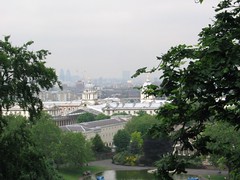
On a buckshee day off work this week, uncertain weather having encouraged my natural laziness against going for a walk in the country, I simply went out locally instead: there's a clear mile or so through Greenwich Park and across Blackheath.

Avoiding the be-touristed paths up to the Royal Observatory, there's a slightly less kempt path up to One Tree Hill, with its own view, and a verse carved into the seats around the eponymous tree.

Carrying on, there's a rather Victorian flower garden, with some beautiful old trees and lots of island beds, and around the edges rhododendrons in full flower.

Through the high surrounding wall (this was once a palace, after all), you come to Blackheath, a wide open stretch of green with its own vivid history, criss-crossed by some of the busiest main roads in London, but still with plenty of space, not only for people to run around but for more rural touches - a little village pond over by Blackheath villages, and wild flower verges much visited by bees.

More remarkable still, to me, was how chatty people were. I'm not the world's most sociable person, but little incidents (a lost toy perched on the garden railings, a dog stalking a squirrel - clearly without quite knowing why) seemed to spark a series of jokey conversations with complete strangers.

Also in Greenwich Park, of course, is the National Maritime Museum, so I stopped there on the way home. I still think it's a rather bitty collection of seemingly unrelated themes (polar exploration, the Atlantic, how different peoples learnt to navigate, passenger ships, Nelson and Trafalgar, and a hands-on area for children to experiment with all sorts of nautical principles and practice - including, I'm pleased to say, Morse code), but there are plenty of boats, bits of ships and other nautical artefacts to look at and admire. They also have art installations, on this occasion Simon Patterson: he's most well known for his "Great Bear" application of the London tube map to various cultural luminaries, but a lot of what's here passes me by. I liked the sails, though, if only because I love Sterne's Tristram Shandy. They do a nice cream tea, too.

Last stop on the way home was a quick look at the Painted Hall, a celebration of the Glorious Revolution of 1689, the Hanoverian succession and the confounding of Louis XIV. For all the bombast of the decoration, the light of those huge Restoration windows seems very calm and austere.

And best of all, all this is on the doorstep: the trouble with country walks is that it takes such a time to get home afterwards.

Sunday, 25 May 2008

Hallo Belgrade

Last night we had our Eurovision party. I don't know what they do in other countries, but in the UK, we long ago gave up taking the song contest all that seriously - it seems as though even the BBC thinks the point is the party. In ours, we draw for who to "support", and we also run a "tatbola": three tickets a pound (for charidee, of course) and if you're really unlucky you win something. And we drink and eat a bit, of course.

I'm a traditionalist about these things and don't check out the competing songs in advance (life's too short, for heavens' sake), so my perceptions are (perhaps like however many others of the watching millions) based mostly on what I saw, since not that much was audible over the party chitchat, hoots of laughter and so on.

The range was much as usual. We had

- well-intentioned sentiments from the relative newcomers, seemingly delivered by a Desperate Housewife
- "all join in" party songs that might just be heard on coach trips and in Mediterranean holiday resorts this summer (Latvia, Denmark, Spain)
- big belter ballads, up a tone for the final chorus, surely the laziest gimmick ever: Serbia, Romania, Portugal, Poland
- cut-rate Kylie: Ukraine, Greece, Norway, Armenia
- eye-candy for the contest's core fanatics (you know who you are, boys): Israel, Russia, Turkey
- candidates for any drag act looking for an easy laugh: (Bosnia, Azerbaijan).

Sweden appeared to represented by Jocelyn Wildenstein, it looked to me as though the singer for Iceland had sweetly asked his mum to join in, and Finland stuck to the heavy metal style they won with a couple of years ago.

Our entry was competent enough, but came on second and ended up bottom (again). I still think we should have gone for this.

I have no idea what the French song was about, since the BBC has apparently still not learnt how to put pre-prepared English lyrics on its subtitles. In this case, I think he might have singing about "shivers", but from the subtitles I guessed it might have been meant to be Chivas (as in whisky), but the subtitling kept giving us "Chivers" (as in marmalade). But that's one of the incidental charms of the whole ludicrous gallimaufry.

How different it all is from the days of Pearl Carr and Teddy Johnson, Udo Jürgens and "Can you hear me, Zurich?"

Keen students of electoral processes might have wondered why the presenters in Belgrade seemed to know how the announcer from Azerbaijan had got her results in the wrong order, before she did....

But for all the chuntering about countries voting for their neighbours or on political affinity, is it so very different from the days when the French record companies got three or four entries, what with Monaco, Luxembourg, Belgium and Switzerland from time to time? It's something positive that - say - people in the former Yugoslav countries do show some solidarity with each other after all they've been through. More and more it's being treated as a self-parodying festival of frou-frou, a multinational Mornington Crescent - about as close as most heterosexual people get to camp: that's better than some other ways of expressing international rivalries, isn't it?

But I could wish it didn't go on quite so long. Perhaps there should be some more qualifying rounds done with videos to produce a final of about a dozen for the final live show. Or is that too prosaic?

Oh, Russia won, by the way. Expect a spate of anguished young men baring their midriffs next year.

And on the tatbola, I won some very dull posters for a computer game. So I know what I'm giving to it next year....