Heron Island, Great Barrier Reef, Australia

Sunday, 29 August 2010

Back on the bike, to Broadway Market

I haven't been cycling much: too lazy when it was hot, too comfort-loving when it was raining, and all the time too aware of various creaks and rattles and too mean to pay for professional servicing (the place I bought it from ended up charging me, for its first annual service, about half what it cost in the first place).

With some help from the local cycle group's monthly maintenance workshop, I sorted out the wobbly wheel with a spoke-wrench and a new tyre; only to find that somehow I'd misadjusted the gears, and couldn't work out whether I had the cable too tight or too loose. Finally, after weeks of on-and-off ineffectual prodding and puzzled staring (I'm good at that), the gears magically relented, and suddenly worked as the shift control said they should.

So yesterday I went for a gentle ride up the Regent's Canal to Broadway Market. This is a short street between the canal and London Fields, barely a hundred yards long, nowadays the heartland of the knit-your-own-vegan-bicycle classes.

Above the street, there is a fine display of flags of all nations, suggesting a high proportion of transient flatsharers from other parts of the world alongside the established immigrant communities (in this part of London, noticeably Turkish and Vietnamese).

Further gentrification is clearly on the way in the surrounding neighbourhood, to judge by the estate agents' windows, but for now, there's a mix of old and new, with art bookshops and upmarket florists cheek-by-jowl with secondhand furniture, the Turkish barber, and a traditional tiled-interior pie and mash shop:

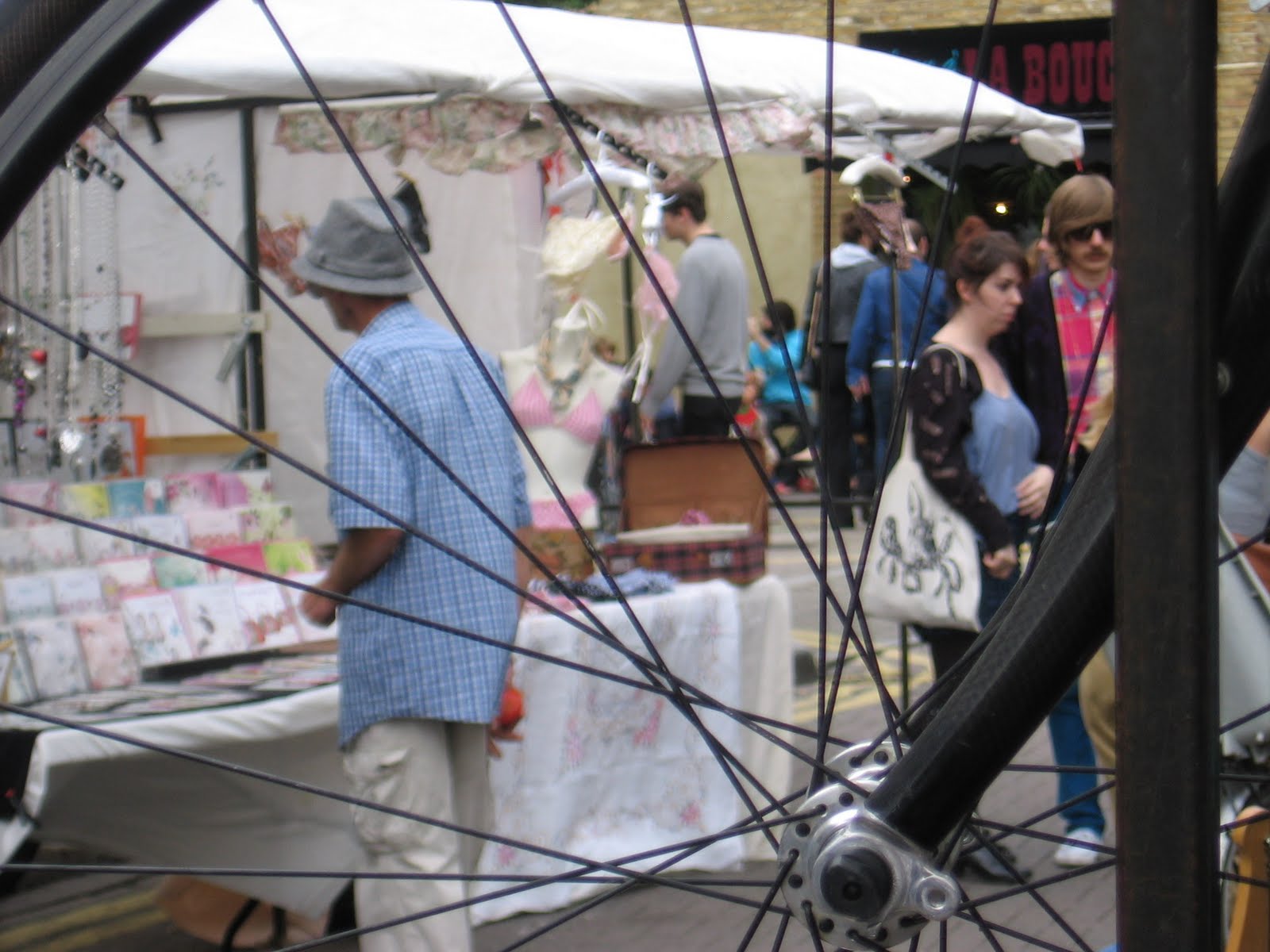
This isn't really a general, buy anything you need, sort of market. True, there are ordinary shops along the street, but I only saw one greengrocer's stall. This market is more about entertainment and casual, fancy-that, shopping. Beside the street musician, there were crocheted blankets, knitted teacosies and winter coats for your hairy-handbag dog, handmade guitars, secondhand bikes, homemade birthday cards and ladies' scanties:


Mostly, what's on sale is food - and more food. On top of the cafés and restaurants spilling out on to the street, you can browse the stalls, and let yourself be tempted by Portuguese hog-roast, German bratwurst, Polish pastries, Italian varietal olive oils, fish, fudge - and (this year's craze) cupcakes:

Wednesday, 18 August 2010

Lovely Eleanor

Well, I don't know that she was, but Eleanor of Castile inspired one of the more romantic mediaeval acts of love.

Passing through Charing Cross, I noticed that the huge stone cross in the forecourt has been restored and cleaned up. It's a Victorian reinvention of the memorial cross put up by King Edward I to Eleanor of Castile, his wife. She died near Lincoln in 1290, and her body was brought back to London; everywhere the cortège rested for the night, Edward had a memorial cross built. The last night before her interment in Westminster Abbey was reputedly spent just here.

The romance of it seems all the more remarkable, bearing in mind that in those days royal marriages were about dynastic business and strategic relationships; and Edward himself was one of the grimmer examples of a warrior king, known as "Hammer of the Scots", and conqueror of the last native Welsh princes, famously tricking the Welsh nobles into accepting his infant son as Prince of Wales (because they said they would only accept one who spoke no English).

The original mediaeval cross was removed in the iconoclasms of the Civil War in the 17th century, and not replaced until the railway company commissioned something grand to mark their new station in 1865. And now the grime and decay of the industrial era has been scraped away, and graceful and delicate details can be seen once more - if you dodge the circling taxis, that is.

Saturday, 14 August 2010

Borcling

I've just seen someone use this word, evidently to mean cycling on what I suppose we must now submit to calling a Borisbike (it does at least pre-empt any possible use by the tabloids the next time they want to suggest he may have a play-away-mate).

Logically, one might expect it to be "boricling", but that obviously would refer the visible adherence of lycra after exceptional exertions on one of these wonder-machines.

Friday, 13 August 2010

What personality?

My sister-in-law is mystified at being identified as a mechanic.

Such is the world of psychometric testing, particularly when it's yoked to some automatic prose analysis system. I've done more than one Myers-Briggs test; I can never remember what it said, though I'm sure I winced in recognition at being consistently labelled an introvert, and that it didn't leave me aghast, or rolling on the floor in laughter.

This, on the other hand, seems particularly fanciful. I wasn't surprised to find that the results varied according to the prose that's fed into it. Some very dull and factual stuff had me among the INTJ "Scientists", but two separate submissions of this blog had me first among the ENTP "Visionaries":

They highly value knowledge, and spend much of their lives seeking a higher understanding. They live in the world of possibilities, and become excited about concepts, challenges and difficulties. When presented with a problem, they're good at improvising and quickly come up with a creative solution. Creative, clever, curious, and theoretical"

and then among the ESTP "Doers":

The active and playful type. They are especially attuned to people and things around them and often full of energy, talking, joking and engaging in physical out-door activities.

The Doers are happiest with action-filled work which craves their full attention and focus. They might be very impulsive and more keen on starting something new than following it through. They might have a problem with sitting still or remaining inactive for any period of time.


I may be inclined to start things without finishing them, but I have absolutely no problem about sitting still and inactive. The two traits are not unrelated.

What does surprise me (though perhaps it shouldn't) is the suggestion of an inner extrovert, just waiting to burst out of this blog, vuvuzelatastically spurting party poppers and goosing passers-by.

I rather suspect, though, that if I give it another go, it'll tell me I'm something else, but will never be uncomplimentary. So keep trying, Nancy, you could turn out to be among the Performers, Artists, Inspirers or Idealists. Perhaps it just needs to be given a biscuit.

Saturday, 7 August 2010

A musical offering

A colleague, whose mind is often more on music than current affairs, found himself referring to Baroque Obama.

Saturday, 17 July 2010

Faux amis

I've learnt a new French verb from Claude's blog: "je fessebouc" (think about it).

Does that mean that the French think of the world's largest online network as "Bumgoat"?

Friday, 16 July 2010

Multiple personalities

Alerted by Mizz Scarlet, I have been undergoing analysis - stylistically, that is - through this enterprising site.

Depending on which particular past posting I submit to it, I write like

(a) Oscar Wilde
(b) H. P. Lovecraft
(c) Ernest Hemingway
(d) D*n Br*wn (the horror! the horror!).

Perhaps I should settle for being Walt Whitman (who, on this evidence, apparently wrote like Charles Dickens) with his grandiloquent excuse:

Do I contradict myself? Very well, then I contradict myself, I am large, I contain multitudes.

Fortunately, I don't think their database encompasses Enid Blyton - their analysis of an example of her oeuvre entitled Big-Hands and Nobbly is that she wrote like J. K. Rowling.

Saturday, 10 July 2010

And there's me wondering...

is someone trying to make tripe look glamorous?

Sunday, 4 July 2010

Circuses for not much bread

Suddenly we seem to be in the middle of festivals and other cultural events that are, happily, free.

The Greenwich and Docklands International Festival (mostly dance and performance arts) is coming to an end, though there is plenty more happening in Greenwich over the summer. On Friday, the big local (i.e., within walking distance) interest was another waterborne late night performance by Ilotopie, on Millwall Dock. Last year's spectacular, if somewhat Frenchly surreal, performance, full of grotesques, movement and fireworks, had us all agog with expectation.

Oh dear. Some caricaturish people drifted around having animated, if silent, conversations on mobile phones. Some tall structures looking vaguely like reindeer skeletons circled around. A rocky island somehow inflated itself. A long platform hauled itself into view, along which various grotesque characters ran or wheeled themselves in various contrivances. One or two jumped into the water, for no obvious reason, while others threw various objects away (searing condemnation of our wasteful lives, no doubt). The rest began a parody of consumerist babble all together at full pelt, one breaking into assorted national anthems. There was a small amount of flame, and a lot of smoke - the wind, kindly or unkindly, blew it towards, so my perception of the action may be distorted. As far as I could make out, the platform broke up, one of the grotesques got separated from her unfeasibly large plaster legs, and most of the characters ended up in the water. A rather large metal framework expanded itself. The end.

On Saturday, central London was not quite taken over by the Pride parade and stages.

The parade was the by now almost traditional gallimaufry of the frivolous, the worthy, the commercial, exhibitionists and fun-seekers, a fair few side streets were closed to cars, and the pubs were full to bursting with the clientele taking over the streets for the afternoon.

Along Greek St, there were samba drummers, of all ages, colours and styles of hair and dress, giving their all - whether by arrangement with the businesses along there, or purely impromptu, I don't know. It was fascinating to see the way the drummers could respond instantly to the signals of the "conductor": a combination of dance moves, sign language, whistles and the gestures of a tic-tac man seemed to control precisely what instruments should play what rhythms, to the point where one conductor simply vanished behind the crowd of spectators and communicated by whistles, before making a triumphant return. And the stamina of the performers! I was there for a good half hour, they'd been going for quite some time by then, and there was every sign they were well set in to carry on for a while when I left in search of a cuppa.

Today, we have the prospect of the Model Steam Boat rally in Victoria Park. It's all go, this urban life.

Wednesday, 23 June 2010

Oh dear oh dear

I don't know whether there's something in the water in Hampshire, or political coalition has strange side-effects, but there seems to be some turbulence in the love lives of local Tories and Liberal Democrats.

What's more, it appears that, while sleeping with a Toryboy can turn you into a lesbian, the Liberal Democrats have quite the opposite effect.

The Members of Parliament from Hampshire*
Give rise to some fine moral rampshire,
So rare is the Member
Who contrives to remember
To control what they keep in their pampshire.


*Note for overseas readers: Hampshire is commonly abbreviated as Hants.

Tuesday, 22 June 2010

Looking promising

On my route to work, one of the stations for the new cycle hire scheme has appeared: a long line of docking posts, with a pillar to pay the bills through.
So far, rather like the Paris Vélib, though the technicalities have been bought in from Montreal's Bixi scheme, and the styling and visual appearance stand out rather more from the surrounding street furniture than its Parisian equivalent.

The main pillar housing the computer screen and workings is also more informative. There are local area maps for pedestrians, a highway code for cyclists (complete with a reminder to foreign visitors to ride on the left), and a full table of charges. This is a welcome difference from Vélib, where you are dependent on the functioning of the computer screens to find out how it works and how much it's costing you.

The basic pricing principle is the same, with the first half-hour ride free (albeit at £1 rather than €1 for a day's subscription). Fees for non-return and deliberate damage are set at something more like full cost - £300 - which makes sense to me, given the reported levels of non-return and misuse in Paris.

However, it's not entirely clear if any of the anonymous slots on the pillar issues printed confirmation of subscription identification, or receipts to prove you've returned a bike, as happens in the Vélib system. And what doesn't yet seem to be available (though one hopes A-Z and other providers will bring them out soon) are maps of where the stations are: to get the best value out of such a scheme, you need to know where you can return the bike before you take it out. We do know that so far they're only in the central zone 1.

The docking slot on each post is centrally placed, by contrast with the Vélib bikes, which have the substantial (and initially rather alarming) weight of the docking clip on one side of the front forks.

There's a button to press to identify a faulty bike (let's hope no malicious teenagers take to pressing the lot "for a laugh"), a perhaps rather pedantic explanation of the lights confirming the docking-in process, and a slot for a "membership key" for long-term subscribers. But there seems to be no way to link the system into the Oyster card, which seems odd (in Paris, regular users can swipe their Navigo card to pay for subscriptions and use):

Sunday, 20 June 2010

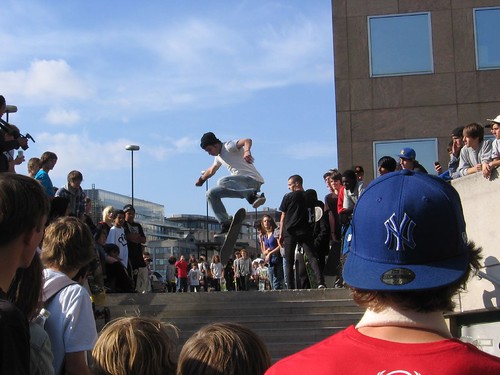
This may be old news for anyone more switched on or plugged in, but I was surprised to see a crowd gathered around the steps at the southern end of London Bridge this afternoon, watching skateboarders attempting a few manoeuvres as they jumped from the top. I've seen people trying to skateboard around the interestingly modern sloping feature at the top, but never an audience, as though it's an established event:


Saturday, 19 June 2010

Commemorating Mr Brunel's Great Eastern

We're rather proud, where I live, of being on top of a piece of maritime history, namely the site where the biggest ship of its day was built. There was quite a shipbuilding industry here, though it seems hard to believe nowadays, being so close to central London; but just across the water was the old Royal Naval Dockyard at Deptford, where Pepys came to check up on the builders, fitters and ships' captains (and their wives), Peter the Great came to learn shipbuilding (and like a modern rock star, trashed his host's home and garden), and Captain Cook set sail for Australia. Our side of the river was known for more mundane sorts of ships - until the Great Eastern.

This is a model of the construction site in the National Maritime Museum - the building with the tower still exists in the middle of our estate, and is something like four storeys high:

Part of the slipway from which the ship was finally - and with much difficulty - induced to slide into the river remains on display, though those parts that remain in the river are slowly disappearing, from the action of the tides, passing washes and a wartime V1 flying bomb.

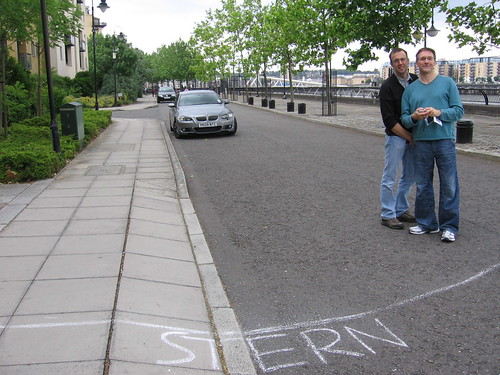
Today, the Thames Archaeology Group marked the 150th anniversary of the Great Eastern's first successful (technically, if not financially) voyage across the Atlantic by marking out on the ground the size of the ship and the position of its various important bits. It's hoped eventually to make something more permanently commemorative out of the site.


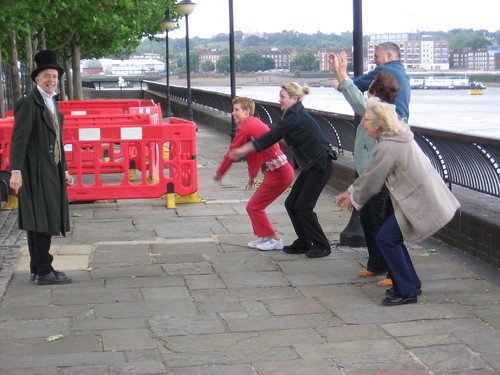
A small group of locals joined in to stand where the funnels stood, and to re-enact the turning of the paddles, under the direction of Mr IK Brunel himself, complete with his distinctive stovepipe hat.

The people in the middle of this photo show where the funnels - known by days of the week - would have been; in the distance, two groups of people to either side show the position of the turning paddle-wheels.
The cold and damp weather showed me up to be made of less solid and weatherproof stuff than the original builders. And just as I drifted away, so, sadly, did the shipbuilding business: and what killed it was Brunel's success in demonstrating here that you could make a huge ship out of cast iron. Until then, ships had been made of wood, which was easy to get into London; but cast iron and coal in quantity came from elsewhere, and it was easier and more profitable to build the ships nearer the supply of raw materials, along the sides of the Tyne, the Tees, the Mersey and the Clyde rather than Old Father Thames.

Sunday, 13 June 2010

Deciding what to do on one's last day away is never quite relaxed: this day's timetable has a fixed end point that must not be missed. But while there's time, what better to do than stroll along the Promenade Plantée - a lovely place for a quiet read, joggers permitting - and then the Sunday market on the nearby Boulevard Richard Lenoir, a classic general market.

In among all the usual market noises was a constant background of amplified announcements, the reason for which became clear at place de la Bastille, for once closed to traffic. There was an organised walk setting off around Paris, and maps, snacks and water were being handed out by the sponsors.

Thousands of people were putting their best foot forward for the next 18km or so, cheered on by some very jolly Savoyard cowbell-ringers:


(PS: the bald man in the video didn't have a heart attack, he was just taking a breather)

Saturday, 12 June 2010

Somehow, Saturday always seems to be shopping day, but when in Paris, it isn't stocking up at the supermarket that's compulsory, it's a gander at BHV.

The Bazar de l'Hotel de Ville is reminiscent of John Lewis, but is much bigger and, well, Parisian. It may sound a strange suggestion, but it's well worth starting in the basement DIY department. Of course, hammers and nails are just dull in any language, and others (like plumbing and electricals) too dependent on local rules and customs to be of any great interest to the passing visitor, but there are many other household items that are fascinatingly different. For example, on this trip, there was a large display of leather toolbags (or should I say, tool-satchels) in all the most fashionable citrus shades of lime and mandarin (a snip at €134, with a free can of WD40 thrown in). Somehow I think that's for the kind of DIY that requires the mysterious round tuit that too many people never seem to get. And did you know the French for a bungee-cord was "un sandow", presumably by extension (geddit?) from the old-fashioned chest-expander?

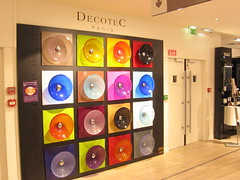
Upstairs, there is more to arouse the interest. Pictured here is a display of wash-basins. Wandering around the variety of styles in the different household and interiors departments (over 1000 different sorts of cupboard and drawer handles and knobs), it's easy to start re-imagining one's own home. Indeed, there were a couple of Australian ladies looking over the ready-made curtains and trying to remember between them the sizes of their windows at home. But looking at some of the more fanciful chandeliers, I could just hear my mother's voice snorting "It'd be a bugger to dust".

Around BHV, the crowds flock to the narrow streets of the Marais on a weekend to look at the more chi-chi, whimsical and extravagant products in what were once baker's and horse-butcher's shops.

In the middle of all this is an old building now converted to a community hall, which hosts all sorts of different events - on this weekend a fair devoted to crime novels. It isn't until you see the complete ranges of several publishing firms all together that you realise how much, and how odd it looks, that people like to have their crime stories attached to particular contexts. Here were regional and local publishers offering crime in association with cookery, or in different historical contexts, or set in every part of Paris, every region of France, indeed in what looked like every seaside resort in the country, no matter how tiny. Come for a relaxing holiday in our idyllic village (and imagine gruesome murder going on all around you)!

I'm not exempt. In my efforts to keep in touch with the language, I'd bought a detective story set in the Butte aux Cailles. As it turned out, among the authors corralled behind the displays were the two sisters who, as Claude Izner, had written it. So now I have a signed copy (so there are no excuses for not finishing it).

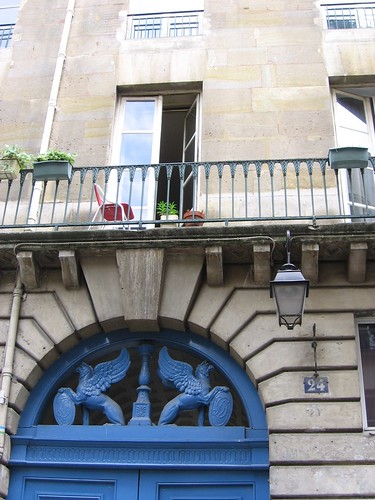
In my wanderings around the Marais, I was struck by some more examples of imposing doorways. I liked this contrast between the door and the informality of the chair on the balcony above:

while I simply have no idea what the architect of this office building was hoping to achieve:

"Hurry up, Glad, me arms are killing me"

"Well it was your idea to wallpaper the bloody thing"
An unexpectedly sunny and hot day (French weather forecasters are no more certain than ours) - so what else to do but get on a bike and wander?

Motor scooters seem to be much more in fashion than in previous years, silencers, sadly, rather less so, or my tolerance levels have gone down. A style note (a pity I couldn't get to my camera in time): a young man easing to the front of traffic queue on his scooter - the clothes and the beard said "earnest student revolutionary", but his scooter looked to have been styled by not so much a friend as a fanatical devotee of Dorothy, painted as it was in ruby red glitter, with the helmet to match, and a scruffy scrap of a dog to complete the ensemble. Definitely not in Kansas any more.

Eventually I arrived at the Grand Palais. The place was surrounded by police, as today was the grand opening of the Russian National Exhibition, and Vladimir Putin was in town. Crowds were gathering across the road at the Petit Palais, but it seemed most of those were waiting, somewhat impatiently, to get into the Yves St Laurent retrospective.

Through the glass doors of the Grand Palais, one could see some sort of skating show was in progress. Various flunkeys bustled in and out with the kind of self-importance only minor flunkeys display; gradually, they started to wave up cars from the long line outside. The stretch limousine with the flagpole oozed away around the back of the building. The police relaxed. To one side, a group of cops gathered round a van from which emerged trays of heated takeaway boxes. Show over.

At the side entrance of the Grand Palais, Russia had familiar neghbours and rivals: the exhibition of Chinese Taoism is in its last days, with no waiting queues, so I dropped in.

Taoism's longevity, the beauty and intricacy of the art it inspired and its influence on science and medicine all impress; but the complexity of the legends around the pursuit of immortality do confuse a little. The three pure breaths, eight immortals, five acred mountains, eight trigrams, five elements - museum fatigue begins to set in.

But I was quite taken by the Queen Mother of the West, keeper of the Peaches of Immortality: "dishevelled, with the tail of a leopard and the teeth of a tiger, she excelled at whistling."

Friday, 11 June 2010

I'm on another weekend home exchange in Paris. This time, my usual exchange partner is bringing a friend to London, and I've been offered the friend's flat.

It's in the 13th arrondissement, in south-eastern Paris. It's an ordinary residential district, and the immediate surroundings include the full complement of "proper shops" - bakers, patissiers, florists, as well as a wet fish shop (try finding one of those in London) and a surprising number of hairdressers. All the sort of thing that makes Paris so very much itself.

This particular area is also known for the Butte aux Cailles. Up the slope, you come to a sort of mini-Montmartre. Apparently (according to the helpful history notices the City authorities post around the place), this was the place where the first hot air balloon crash took place, hitting a windmill in the 1780s. Later, industrialisation saw the area sink into poverty, as it became known for ragmen and metal-bashing.

Nowadays, it still has little streets of two-storey cottages, some with gardens drenched in flowers.

As in so many other places, colonisation by the arty crowd has been followed by gentrification. Of an early evening, as rather older and more well-heeled folk peruse the menus outside distinctly upmarket restaurants, the earnest and scruffy-looking spill out of tiny bars down the side-streets.

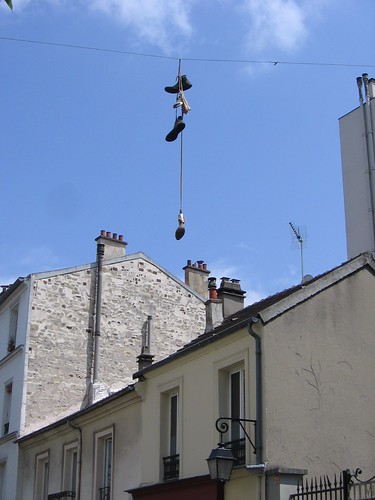
But the influence of the artists remains much in evidence. This - I suppose one has to call it an installation - hangs over the middle of the road.

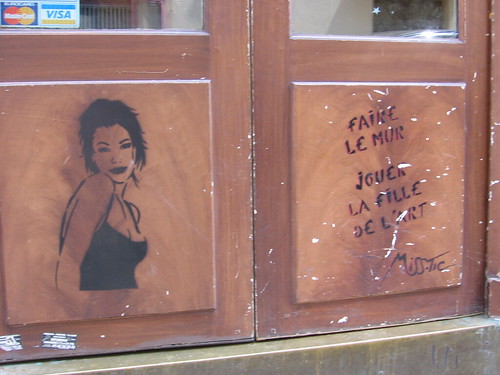
Elsewhere, Jeff Aerosol and Miss Tic compete to be the local version of Banksy:


Sunday, 6 June 2010

Tuesday, 1 June 2010

I am a guinea pig

I'm not allowed to give blood (some teenage jaundice), and I doubt there'll be many takers for my clapped out old organs by the time this cadaver is ready for disposal, so the invitation to contribute medical research data to the UK Biobank came as a rare chance to demonstrate a little altruism.

In one of those depressingly anonymous office blocks in Croydon, I joined a fair number of other people passing through a (very efficient) conveyor belt of assessments and tests.

Signing away all rights to my urine (the commercial possibilities of which escape me for the moment) and blood samples (no more than three teaspoons, they assure you, which neatly stops anyone making jokes about "very nearly an armful"), racking my brains trying to remember, amongst other distant history, just how many childhood episodes of sunburn I suffered (a lot, I think, but is that just the memory of the stories we tell ourselves?) and happily punching the screen through the computerised hearing and mental recall puzzles, I passed along the chain of technicians and their various physical assessments.

There were the familiar weight, lung volume (the lady in the next cubicle was having an operatic time of that), exercise and bodily fluid tests (blood comes next to last, no doubt in case of fainting fits, and the - ahem - other samples discreetly round the corner).

I see medical people so rarely, there is always some amazing new equipment, and for an operation like this, even more so: scary machines to photo my retinas, pocket-sized computers linked to a plastic clothes-peg on my thumb that between them graph out my blood circulation. And the output from everything is automatically stored on a simple pen-drive to carry on to the next technician.

After a last bout of confessing shaming truths to the computer about diet and physical activity (How many minutes a day do I actually walk anywhere, and does shuffling to and from the kettle count? What exactly was in that sandwich I ate yesterday?), I collected the only visible token of my contribution to science, a printout of the immediately available vital signs (no, not even tea and biscuits). Hardly surprising to be told I can afford to lose a bit of weight and need to watch my blood pressure, but reassuring that my heart and lungs are sound. I'll probably be bulking out their averages column for a few more years yet.