Custard...
Catastrophe...
And German rhubarb is tasteless.
That is the end of this newsflash.
Sunday, 28 March 2010


Saturday, 27 March 2010
British rhubarb
 "Right now, British rhubarb is in season and at its very best", says Waitrose as it urges us to try making the Blessed Delia's rhubarb and ginger brûlée. Well, that's as may be, but in my local branch, the rhubarb's come from............... Germany.
What new Brussels plot is this? Has the Daily Mail been told? As Yorkshire mourns (it doesn't take much), is the ghost of Captain Mainwaring adopting the appropriate shade of rhubarb-red fury?
Friday, 19 March 2010
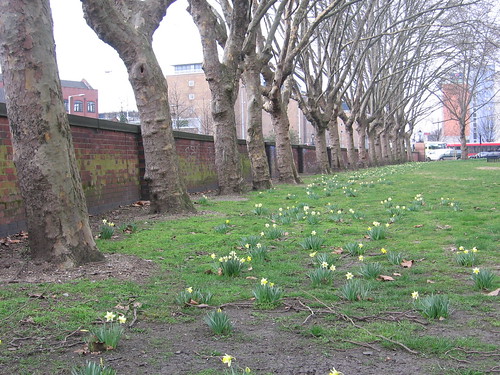
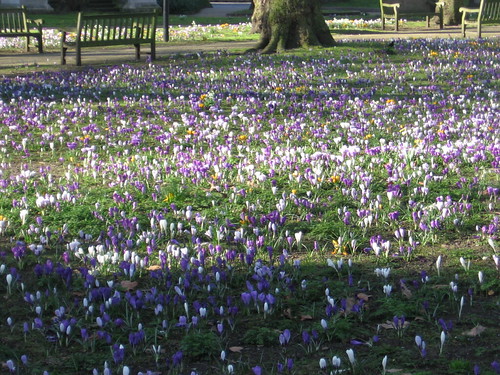
More signs of spring
It wasn't the sunniest of mornings, but there was some cheer on the way to work:


Monday, 15 March 2010
Friday, 12 March 2010
Underground
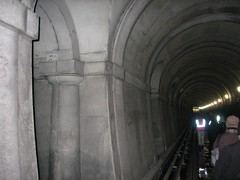 One doesn't expect to be asked to put on surgical gloves to enter a tube station, particularly not one that's just coming out of a long and expensive sprucing up.
But today, it wasn't the station that was the focus, rather the tunnel: between Rotherhithe and Wapping runs the world's first tunnel under a waterway, and today was the first chance in over 140 years (and the last for who knows when) for pedestrians to visit and walk through, before the East London Line is reopened after its refurbishment and extension. So health and safety required a degree of protection, in case any of us should happen to touch the grimier parts of the walls or any of the water than still drips into the tunnel; and there were cheery handouts about the symptoms of leptospirosis to explain, in excruciating detail, exactly why.
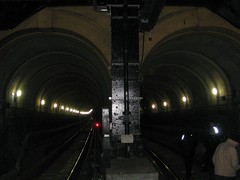 The tunnel took the best part of twenty years from original conception to its full opening, beset as it was by financial problems, lack of trust in the methods proposed by Brunel father and son for its construction, and the sheer difficulty of tunnelling, with the water breaking in on several occasions - and don't forget that in the early to mid-nineteenth century the Thames was an open sewer. As the tunnellers advanced, the air got worse; at times, if the water wasn't breaking in, pockets of methane were igniting - and sometimes both at the same time. Besides the deaths in accidents and flooding, many miners fell victim to the poisonous air underground, and disease; the strains of the job must have contributed to Marc Brunel's stroke and heart attack, and his son Isambard was nearly drowned more than once.
When it eventually opened, the tunnel was never the handy means of shifting cargo from one side of the river to the other that had been envisaged, and became instead a pedestrian walkway, with the arches you can see above used for shops and souvenir stalls. After twenty years it was taken over for a railway tunnel, which it has been ever since, and will soon be again.
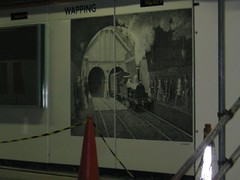 But for today, what took twenty years to build took us twenty minutes to walk through, however cautiously we might be watching our feet. Here and there the original render and brickwork have been left exposed, and make a sharp contrast with the shiny new station decorations.
There was just as great a contrast between the heroic efforts of construction, and the unheroic profiteers who occupied the tunnel after its opening (a million people visited in the first fifteen weeks of opening - at a penny a time). The guide regaled us with the tale of Queen Victoria's impromptu visit, a stallholder's gallant protection of her footwear from the mud with the handkerchiefs on his stall, and his subsequent success in selling off the handkerchiefs "as trod on by the Queen" - only, after the first few, the footprints got suspiciously bigger. And then there were the ladies of more doubtful reputation who were seen to take advantage of the gloomy gas light...
 As we came back to the station exit, it was hard to believe this otherwise prosaic-looking piece of track had taken so much to build - or that, as a PR stunt, the young Brunel had hosted in the tunnel a grand dinner for the great and good. No surgical gloves for them - and yet they survived.
Thursday, 11 March 2010
Sophistication
What stops the newspapers flapping away in the March breezes, outside the newsagents in the middle of a council estate in Elephant and Castle, where I stop to buy my daily fix?
Not an old-fashioned shop scales weight, nor a half-brick, a lump of abandoned concrete or a stone from someone's barren backyard: but a large knob of root ginger, in a suitably Esther-Rantzen-amusing shape.
Not an old-fashioned shop scales weight, nor a half-brick, a lump of abandoned concrete or a stone from someone's barren backyard: but a large knob of root ginger, in a suitably Esther-Rantzen-amusing shape.
Sunday, 7 March 2010
It must be spring
This is the first week I've done all my commuting on the bike since before Christmas. For once, the weather provided no excuses at all.
In the process, I seem to have become a bag-person. Various necessities are all kept in a bag, so that they can all be strapped down together in the basket. There's a pump, spanner and tube repair kit, a reflective waistcoat for after dark, the mirror and lights (you don't think those can be left on the bike in London, do you?), towel and shower-substitute spray (alcohol, witch-hazel and water), jumper to put on at the office. And the map. And the camera if I remember. And a pen. I think that's everything.
The trouble is, there are bags within bags. The mirror has its own little bag to protect the surface. The jumper has a bag to stop it getting dirty, or snagged on the spanner. The towel and spray have their own bag. There's a spare of the mirror bag for all the lights all go together (to make them easier to find, I thought).
But the start of most journeys is still dogged with desperate rummaging, accompanied by sighs and mutters, as the things I'm looking for hide in odd corners or disguise themselves to the touch as something else. It's just like all those people who hold up bus and supermarket queues looking for their purses and passes.
Ladies, I feel your pain (but all the same, passes and small change are what pockets are for, you know).
In the process, I seem to have become a bag-person. Various necessities are all kept in a bag, so that they can all be strapped down together in the basket. There's a pump, spanner and tube repair kit, a reflective waistcoat for after dark, the mirror and lights (you don't think those can be left on the bike in London, do you?), towel and shower-substitute spray (alcohol, witch-hazel and water), jumper to put on at the office. And the map. And the camera if I remember. And a pen. I think that's everything.
The trouble is, there are bags within bags. The mirror has its own little bag to protect the surface. The jumper has a bag to stop it getting dirty, or snagged on the spanner. The towel and spray have their own bag. There's a spare of the mirror bag for all the lights all go together (to make them easier to find, I thought).
But the start of most journeys is still dogged with desperate rummaging, accompanied by sighs and mutters, as the things I'm looking for hide in odd corners or disguise themselves to the touch as something else. It's just like all those people who hold up bus and supermarket queues looking for their purses and passes.
Ladies, I feel your pain (but all the same, passes and small change are what pockets are for, you know).
Sunday, 28 February 2010
From the sublime...
 What to do with an impromptu day off? Just lazing around with the newspaper seemed too much like any weekend, so eventually I took myself into town to look at the National Gallery, where I haven't been for years. It took a TV programme to alert me to this treasure in the Gallery, the Wilton Diptych. Just another reminder of how little one takes advantage of all the things available to Londoners.
 And when due respect had been paid to that, and Rembrandt and the Dutch painters, what then? I finally set about an idea I've had for some time, to get a turntable that will play 78s, with a view to digitising the shelves full of family inheritances and junkshop acquisitions from decades ago. I had it down for a retirement project, but who knows how long it will be before suitable turntables are no longer made?
So I spent most of a wet weekend getting to grips with records I'd almost forgotten about, and learning the limitations, not only of technology, but also of my patience in getting the best out of it. For some prized old recordings, I might make the effort to try to suppress the worst of the hiss and clicks (though come to think of it, the really great old performances have probably all been professionally done and put on CD years ago). For others, it seems only too appropriate to hear them as though they were ghosts dimly perceptible through the aural fog of decades. This, by the way, is from a record (possibly from 1910) of Maritana, in mid-Victorian times a hugely popular opera (be warned, I think I sense a theme coming on for future posts):
Sunday, 21 February 2010
A night at the opera
It's one of those commonplaces that people who live in a city too rarely take advantage of all the things it has to offer: it's too easy to follow the same old rat-runs to and from work and the couch in front of the telly.
But on a whim, from reading a rave review, I found it took only a handful of mouse-clicks to look up availability, choose a seat and pay for it. Which is how I came to spend Thursday evening in the over-the-top gilding of the Coliseum watching a drama of love across the chasm of family feuds, marriage by trickery, madness, murder and suicide. Just like EastEnders, but with better singing.
I could quibble about some of the production details: this style of opera tends to make everything stop for the Big Numbers, so in the wedding scene, the man who knows his bride has been offered for political reasons and suspects she might not be too willing, only to find the long-disappeared rival bursting in at the crucial moment, is given next to nothing to do for quite some time (I don't think that would happen down Walford way).
It can't be easy to find a suitably non-speaking way to have everyone else make "Corblimey, whatever next?" faces and movements through ten minutes or so of arias. To cover it, the principals seemed to be doing rather too much climbing on the furniture for no apparent reason; and at one point one of them was made to do the exact opposite of what the words said.
It was also over-egging it a bit to imply that Lucia's brother had some sort of suppressed incestuous passion for her, rather than just being the standard domestic tyrant. But I did like the way they managed to suggest that both the brother and the forbidden lover were, in their own way, not much further away from impetuous adolescence than the heroine. And there was a very impressive thunderstorm.
All that said, the heart of it all was Lucia's plight, and the beautifully convincing performance by Anna Christy. You can't but be moved at how, for once, the tour de force coloratura singing actually serves the psychology of Lucia's final fantasy. Here's Natalie Dessay, one of the current stars in the role:
But on a whim, from reading a rave review, I found it took only a handful of mouse-clicks to look up availability, choose a seat and pay for it. Which is how I came to spend Thursday evening in the over-the-top gilding of the Coliseum watching a drama of love across the chasm of family feuds, marriage by trickery, madness, murder and suicide. Just like EastEnders, but with better singing.
I could quibble about some of the production details: this style of opera tends to make everything stop for the Big Numbers, so in the wedding scene, the man who knows his bride has been offered for political reasons and suspects she might not be too willing, only to find the long-disappeared rival bursting in at the crucial moment, is given next to nothing to do for quite some time (I don't think that would happen down Walford way).
It can't be easy to find a suitably non-speaking way to have everyone else make "Corblimey, whatever next?" faces and movements through ten minutes or so of arias. To cover it, the principals seemed to be doing rather too much climbing on the furniture for no apparent reason; and at one point one of them was made to do the exact opposite of what the words said.
It was also over-egging it a bit to imply that Lucia's brother had some sort of suppressed incestuous passion for her, rather than just being the standard domestic tyrant. But I did like the way they managed to suggest that both the brother and the forbidden lover were, in their own way, not much further away from impetuous adolescence than the heroine. And there was a very impressive thunderstorm.
All that said, the heart of it all was Lucia's plight, and the beautifully convincing performance by Anna Christy. You can't but be moved at how, for once, the tour de force coloratura singing actually serves the psychology of Lucia's final fantasy. Here's Natalie Dessay, one of the current stars in the role:
Thursday, 18 February 2010
Surreal..
An email from "Mimetic Gillespie" (one of a silent order of Gillespies, I assume) offers me an "Often updated sugary original archive" - not something I encountered in my classes on records management, I have to say.
Reading (not much) further on, I discover that it is an archive of a lady from Port Stanley (who knew they could be so adventurous in the Falklands? You'd think the wind would make it inadvisable) displaying what are apparently now called (if I am to believe a rather shouty Chinese gentleman I've seen on the televisual apparatus) her "bangers".
Later in the day, there's something similar from "Objector Prescott" (surely not our former Deputy Prime Minister?!).
Ho-hum.
Reading (not much) further on, I discover that it is an archive of a lady from Port Stanley (who knew they could be so adventurous in the Falklands? You'd think the wind would make it inadvisable) displaying what are apparently now called (if I am to believe a rather shouty Chinese gentleman I've seen on the televisual apparatus) her "bangers".
Later in the day, there's something similar from "Objector Prescott" (surely not our former Deputy Prime Minister?!).
Ho-hum.
Thursday, 11 February 2010
Ive discovered a new gauge of temperature...
Cold enough to be glad there's some ironing to be done.
Tuesday, 9 February 2010
Move over, Maragarita Pracatan....
I've been reading through the blog of an old friend who's retired from the US to Mexico. Much of what he's experienced sounds familiar to anyone who's visited a Mediterranean country or watched one of those TV series following people who move to another country (though they seem to concentrate on people who make "good television" by being - totally the opposite of my friend - hopelessly unrealistic and unprepared). But it's always interesting to read about the cultural adaptations of such a big move.
And if I hadn't, I would never have found out about a lady who seems to be something of a Fanny Cradock of the castanets, and has managed to clack her way into decades of diva-dom.
Take it away, Sonia!
And if I hadn't, I would never have found out about a lady who seems to be something of a Fanny Cradock of the castanets, and has managed to clack her way into decades of diva-dom.
Take it away, Sonia!
Sunday, 7 February 2010
Back in the saddle
One good thing about cycling (as I'm rediscovering, the weather having turned a little more conducive recently) is that you don't (well, I don't) go so fast as to miss all sorts of quirks and curiosities, and (with due care and attention to other road users, of course) you can stop and investigate.
That's how, instead of sailing past All Hallows by the Tower, I came to put my head inside. The church may have been empty of visitors, but it's certainly full of memorabilia of its associations - mariners (a poignant memorial book listing people lost at sea, as recently as the last few years), famous Americans (Penn, and one of the Adamses married here) and Toc H, a community foundation growing out of a solder's rest and recuperation centre in World War I, founded by a former vicar) - and in the crypt, a room-size expanse of tesselated floor from a house that stood here in Roman times. It's that sense of sudden connection to generations past that is so beguiling: like uncovering old newspapers and photographs forgotten at the bottom of a cupboard, but on a millennial scale.
 The City of London is fertile ground for checking out curiosities, since it's still full of by-ways and semi-hidden alleys, and on a Saturday afternoon, it's possible to do a U-turn across Cannon Street or Ludgate Hill with barely a vehicle in sight. Items like this, tucked away by the Stationer's Hall, will make another contribution to a Facebook group I belong to, "The London You Don't Know".
The sun having decided at last to make a comeback, St Paul's (recently cleaned once again) was looking particularly imposing; but more striking still was the way the low late afternoon sun can make stained glass shine from the inside of a building out - here at St Mary's in the middle of the traffic in the Strand:

And the final quirk of the afternoon was that, as I passed All Hallows on the way home, the bells began to ring, not a peal, but a carillon, and, of all unlikely things, this tune I remember from childhood:
That's how, instead of sailing past All Hallows by the Tower, I came to put my head inside. The church may have been empty of visitors, but it's certainly full of memorabilia of its associations - mariners (a poignant memorial book listing people lost at sea, as recently as the last few years), famous Americans (Penn, and one of the Adamses married here) and Toc H, a community foundation growing out of a solder's rest and recuperation centre in World War I, founded by a former vicar) - and in the crypt, a room-size expanse of tesselated floor from a house that stood here in Roman times. It's that sense of sudden connection to generations past that is so beguiling: like uncovering old newspapers and photographs forgotten at the bottom of a cupboard, but on a millennial scale.
 The City of London is fertile ground for checking out curiosities, since it's still full of by-ways and semi-hidden alleys, and on a Saturday afternoon, it's possible to do a U-turn across Cannon Street or Ludgate Hill with barely a vehicle in sight. Items like this, tucked away by the Stationer's Hall, will make another contribution to a Facebook group I belong to, "The London You Don't Know".
The sun having decided at last to make a comeback, St Paul's (recently cleaned once again) was looking particularly imposing; but more striking still was the way the low late afternoon sun can make stained glass shine from the inside of a building out - here at St Mary's in the middle of the traffic in the Strand:

And the final quirk of the afternoon was that, as I passed All Hallows on the way home, the bells began to ring, not a peal, but a carillon, and, of all unlikely things, this tune I remember from childhood:
Monday, 1 February 2010
It's not about the toys, it's about the spin-off merchandising....
What a coincidence that my superficial thoughts on e-books and readers came just before the hooha about Apple's new iPad device. It all looks as slick as other Apple products, but if it is indeed the case that it won't multitask (no listening to music while you read?) it sounds like a first attempt rather than a finished product.
The meat of it seems to be not so much what the device will do as another attempt to set up a "walled garden" to supply content. On which topic, some recent goings-on at Amazon are of interest.
It all seems to add up to another good reason not to commit oneself (not that I ever need an excuse for that).
The meat of it seems to be not so much what the device will do as another attempt to set up a "walled garden" to supply content. On which topic, some recent goings-on at Amazon are of interest.
It all seems to add up to another good reason not to commit oneself (not that I ever need an excuse for that).
Saturday, 23 January 2010
Burning issue
 Monday being the traditional celebration of a certain Scottish poet, my local Waitrose has (oddly, perhaps, since there isn't a noticeable Scottish community in the area) put out a rather large special display of haggis. It looks like a national promotion, since it comes with a glossy poster proclaiming the day.
Only - someone obviously hasn't bothered to check the man's name, so they're suggesting we celebrate something called Burn's Night.
Does no-one care about apostrophes any more?
Gey few, and they're a' deid.
Thursday, 21 January 2010
Report
| Name: Cheapo Microwave | ||
| Subject | Mark | Comments |
| Porridge | Tick VG | The best results to date; care and attention needed to prevent natural exuberance from causing entirely avoidable explosions. |
| Frozen scones | Tick VG | Very pleasing presentation. |
| Buns and muffins | Satisfactory | Results acceptable, but a little more work needed to arrive at a happy medium between flabby and stodgy. |
| Scrambled eggs | Good | Results very acceptable, but seems to require close and repeated attention, showing little improvement over traditional methods. |
| Baked potato | Passable | Timidity tending to excess effort for less than optimum results. |
| Suet rolypoly | Passable | See Baked potato. |
| Curly kale | Good | Very acceptable results. |
General comments: A good start. | ||
Sunday, 17 January 2010
Intrigued by the mysteriously glowing yellow/orange thing in the sky (what do they call it again? I've forgotten), I dragged the bike out of the garage to see if I - and it - could actually move again.
 Where to go? A quiet ride up the Regent's Canal, with a coffee break at the Pavilion Café in Victoria Park (the Sunday clientele here very much the knit-your-own-bicycle antithesis of what you might see around Canary Wharf).
Not so quiet, as it turned out. The towpath was approaching congestion, what with family groups out for a stroll and endless runners - clearly training for the marathon is getting under way. At an emptied council housing block in Hackney, windows are boarded up with photos of former residents, in this installation.
After following the canal to Islington, it's downhill all the way through Clerkenwell to Bloomsbury, to pick up a new book about one of my heroes, what to do? Well, once in Bloomsbury, the British Museum always has something new, and for the moment, it's the "Staffordshire Hoard", a newly-found collection of battered and crumpled Anglo-Saxon gold artefacts found in a field. No-one yet knows what it was all about, though to me it looks distinctly like the quickly-stashed proceeds of looting.
As a relief from all this high-mindedness, just around the corner is the Cartoon Museum, whose current exhibition on the magazine Viz is for the easily amused, but not for the easily shocked.
And on the way home in Shadwell, in the late afternoon sun (ah yes, that's what it's called), a blackbird was singing.
 Where to go? A quiet ride up the Regent's Canal, with a coffee break at the Pavilion Café in Victoria Park (the Sunday clientele here very much the knit-your-own-bicycle antithesis of what you might see around Canary Wharf).
 Not so quiet, as it turned out. The towpath was approaching congestion, what with family groups out for a stroll and endless runners - clearly training for the marathon is getting under way. At an emptied council housing block in Hackney, windows are boarded up with photos of former residents, in this installation.
After following the canal to Islington, it's downhill all the way through Clerkenwell to Bloomsbury, to pick up a new book about one of my heroes, what to do? Well, once in Bloomsbury, the British Museum always has something new, and for the moment, it's the "Staffordshire Hoard", a newly-found collection of battered and crumpled Anglo-Saxon gold artefacts found in a field. No-one yet knows what it was all about, though to me it looks distinctly like the quickly-stashed proceeds of looting.
As a relief from all this high-mindedness, just around the corner is the Cartoon Museum, whose current exhibition on the magazine Viz is for the easily amused, but not for the easily shocked.
And on the way home in Shadwell, in the late afternoon sun (ah yes, that's what it's called), a blackbird was singing.
Saturday, 16 January 2010
Extraordinary
The temperature may not have been much above freezing for nearly a month, with barely a couple of hours of sunshine in all that time. But, in amongst the dead and wilting remains in my window-boxes, the pelargoniums and petunias are still putting out the odd floret, and I'm sure there's a new clump of nemesia - in full flower.
Wednesday, 13 January 2010
Toys
The best part of two weeks since I've been home, and next to nothing to write about. I blame the weather, of course: trudging through the slush encourages a sense of trudging through the days.
But there's been some fun playing with my Christmas toys. I've loaded up my spiffy new digital photo frame as far as I can. Once again, I contemplate the thought of digitising all my old photos, and then all the different forms of audio recording I have (hundreds of 78s, vinyl LPs, cassette tapes). After about five seconds of that, contemplation passes to procrastination - indefinitely.
I have another new (to me) toy, the penny finally having dropped that perhaps it would be more economical on electricity to use a microwave for the amount of stuff I freeze. So far, it works excellently on soups and scones, but not at all on crumpets (might as well put those straight into the toaster). I shall leave it to the weekend before I risk experimenting with (if the Internet is to be believed) exploding porridge.
For a while, e-book readers intrigued: Waterstone's have been pushing the latest model of the Sony, and the papers are full of Amazon's apparent success with the Kindle and the new business-oriented Que. Looking at an apparently ever-increasing collection of books (they breed, I tell you), the thought of having everything on one pocket-sized machine is immensely appealing.
But then, so much depends on how one actually uses books. Books are more than just the words on the page. For many, the physicality of paper, illustrations and layout is an important part of the experience. For others, books need to be read in context with others: researchers need to be able to cross-refer, so what would help them is the ability not just to make notes, but to link, and perhaps (assuming e-book files can have a standard set of bibliographic data) automatic construction of citations and bibliographies.
What we have here is the issue of convergence that makes so many new technology developments uncertain: which digital functions do you combine with which in a single device? I know someone who reads books on her i-Phone; the Que runs diary functions, spreadsheets and other office documents, and can download news updates; the Sony not only has an MP3 player built in, but it displays photographs (though the particular screen technology it uses renders them as a rather pale monochrome which soon loses its appeal). If there were a way a user could, on a single device, switch between the e-paper technology of e-book readers, and the backlit screen of a conventional computer (with, of course, full colour).......
And then there's the book-on-the-beach problem: a book can still be used even covered in suntan oil and ice-cream, and it can be left on the towel with far less worry than a £150 piece of electronic kit. And who wants to lose those stocks of abandoned books that some hotels accumulate, providing an opportunity on a rainy day for an in-depth study of the appeal of Netta Muskett?
But there's been some fun playing with my Christmas toys. I've loaded up my spiffy new digital photo frame as far as I can. Once again, I contemplate the thought of digitising all my old photos, and then all the different forms of audio recording I have (hundreds of 78s, vinyl LPs, cassette tapes). After about five seconds of that, contemplation passes to procrastination - indefinitely.
I have another new (to me) toy, the penny finally having dropped that perhaps it would be more economical on electricity to use a microwave for the amount of stuff I freeze. So far, it works excellently on soups and scones, but not at all on crumpets (might as well put those straight into the toaster). I shall leave it to the weekend before I risk experimenting with (if the Internet is to be believed) exploding porridge.
For a while, e-book readers intrigued: Waterstone's have been pushing the latest model of the Sony, and the papers are full of Amazon's apparent success with the Kindle and the new business-oriented Que. Looking at an apparently ever-increasing collection of books (they breed, I tell you), the thought of having everything on one pocket-sized machine is immensely appealing.
But then, so much depends on how one actually uses books. Books are more than just the words on the page. For many, the physicality of paper, illustrations and layout is an important part of the experience. For others, books need to be read in context with others: researchers need to be able to cross-refer, so what would help them is the ability not just to make notes, but to link, and perhaps (assuming e-book files can have a standard set of bibliographic data) automatic construction of citations and bibliographies.
What we have here is the issue of convergence that makes so many new technology developments uncertain: which digital functions do you combine with which in a single device? I know someone who reads books on her i-Phone; the Que runs diary functions, spreadsheets and other office documents, and can download news updates; the Sony not only has an MP3 player built in, but it displays photographs (though the particular screen technology it uses renders them as a rather pale monochrome which soon loses its appeal). If there were a way a user could, on a single device, switch between the e-paper technology of e-book readers, and the backlit screen of a conventional computer (with, of course, full colour).......
And then there's the book-on-the-beach problem: a book can still be used even covered in suntan oil and ice-cream, and it can be left on the towel with far less worry than a £150 piece of electronic kit. And who wants to lose those stocks of abandoned books that some hotels accumulate, providing an opportunity on a rainy day for an in-depth study of the appeal of Netta Muskett?
Saturday, 2 January 2010
One of my reasons for going to Krakow was that my father was, as a prisoner of war, working in a coal mine in the area in 1943/44. I'd been able to find in the National Archives a report from the Red Cross inspectors of the time that identified the place (Bory, near Jaworzno) from the camp number, and with a bit of digging on the internet I'd been able to link the German names of that time to the Polish ones.
 A bit more digging with Google maps and satellite views, and the local bus company's own online information made it possible to work out how to get there and back by train and bus, reasonably simply.
Jaworzno made a change from tourist Krakow, at the very least. An agglomeration of small villages into modern town planning and development, mixing little streets of one-storey cottages reminiscent of parts of Scotland (a few of the cottages appearing, where the dilapidated render is crumbling, to be built like crude drystone walls) with Soviet-era housing estates and half-hearted shopping centres along modern by-pass roads, and an attempt at a modern town centre. It's actually quite reminiscent of similar attempts in British industrial centres.
Eventually, the bus route ends outside the most likely candidate for Dad's mine. What can I say? I don't quite know what I hoped to find, or what he would have made of it. Had he wanted and been able to visit for himself, he would probably have said - more or less politely - that he recognised bits of it, whether he did or not. It's a mine like many another; the winding gear is spruced up and brightly painted, and most of the buildings are anonymous and undateable. Some of the outbuildings look old and crumbling, but the remains of slagheaps look more like ski-slopes in the morning's fresh fall of snow. The cold at least gives a sense of the desolation I'd have expected to feel in Dad's situation.

There doesn't appear to be anywhere to eat nearby, and if I don't get the bus that's coming, I'll have to wait an hour, since it's Saturday. The only thing to do is to run for the bus, head back to the train for Krakow - and be grateful I've got the option.
 A bit more digging with Google maps and satellite views, and the local bus company's own online information made it possible to work out how to get there and back by train and bus, reasonably simply.
Jaworzno made a change from tourist Krakow, at the very least. An agglomeration of small villages into modern town planning and development, mixing little streets of one-storey cottages reminiscent of parts of Scotland (a few of the cottages appearing, where the dilapidated render is crumbling, to be built like crude drystone walls) with Soviet-era housing estates and half-hearted shopping centres along modern by-pass roads, and an attempt at a modern town centre. It's actually quite reminiscent of similar attempts in British industrial centres.
Eventually, the bus route ends outside the most likely candidate for Dad's mine. What can I say? I don't quite know what I hoped to find, or what he would have made of it. Had he wanted and been able to visit for himself, he would probably have said - more or less politely - that he recognised bits of it, whether he did or not. It's a mine like many another; the winding gear is spruced up and brightly painted, and most of the buildings are anonymous and undateable. Some of the outbuildings look old and crumbling, but the remains of slagheaps look more like ski-slopes in the morning's fresh fall of snow. The cold at least gives a sense of the desolation I'd have expected to feel in Dad's situation.

There doesn't appear to be anywhere to eat nearby, and if I don't get the bus that's coming, I'll have to wait an hour, since it's Saturday. The only thing to do is to run for the bus, head back to the train for Krakow - and be grateful I've got the option.
Subscribe to:
Posts (Atom)