Heron Island, Great Barrier Reef, Australia

Saturday, 31 May 2008

How lucky we are to have so much open space in London: actually, luck has much less to do with it than a lot of hard work fighting off Victorian property developers and pressing local authorities to maintain parks - but the result is a blessing. Not so long ago, I went on a group walk that started at one of the less attractive stations in south-east London: but someone had cleverly worked out a route that snaked through local parks and woods, and although we were never more than a few hundred yards from main roads and suburban streets, it seemed we were in open country. Passing across one "village green", though, we came across a local kabbadi competition, which you wouldn't expect in Lower Dozing-on-the-Wold.

On a buckshee day off work this week, uncertain weather having encouraged my natural laziness against going for a walk in the country, I simply went out locally instead: there's a clear mile or so through Greenwich Park and across Blackheath.
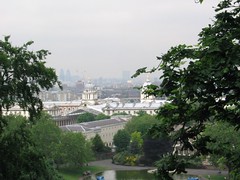
Avoiding the be-touristed paths up to the Royal Observatory, there's a slightly less kempt path up to One Tree Hill, with its own view, and a verse carved into the seats around the eponymous tree.

Carrying on, there's a rather Victorian flower garden, with some beautiful old trees and lots of island beds, and around the edges rhododendrons in full flower.

Through the high surrounding wall (this was once a palace, after all), you come to Blackheath, a wide open stretch of green with its own vivid history, criss-crossed by some of the busiest main roads in London, but still with plenty of space, not only for people to run around but for more rural touches - a little village pond over by Blackheath villages, and wild flower verges much visited by bees.

More remarkable still, to me, was how chatty people were. I'm not the world's most sociable person, but little incidents (a lost toy perched on the garden railings, a dog stalking a squirrel - clearly without quite knowing why) seemed to spark a series of jokey conversations with complete strangers.

Also in Greenwich Park, of course, is the National Maritime Museum, so I stopped there on the way home. I still think it's a rather bitty collection of seemingly unrelated themes (polar exploration, the Atlantic, how different peoples learnt to navigate, passenger ships, Nelson and Trafalgar, and a hands-on area for children to experiment with all sorts of nautical principles and practice - including, I'm pleased to say, Morse code), but there are plenty of boats, bits of ships and other nautical artefacts to look at and admire. They also have art installations, on this occasion Simon Patterson: he's most well known for his "Great Bear" application of the London tube map to various cultural luminaries, but a lot of what's here passes me by. I liked the sails, though, if only because I love Sterne's Tristram Shandy. They do a nice cream tea, too.

Last stop on the way home was a quick look at the Painted Hall, a celebration of the Glorious Revolution of 1689, the Hanoverian succession and the confounding of Louis XIV. For all the bombast of the decoration, the light of those huge Restoration windows seems very calm and austere.

And best of all, all this is on the doorstep: the trouble with country walks is that it takes such a time to get home afterwards.

Sunday, 25 May 2008

Hallo Belgrade

Last night we had our Eurovision party. I don't know what they do in other countries, but in the UK, we long ago gave up taking the song contest all that seriously - it seems as though even the BBC thinks the point is the party. In ours, we draw for who to "support", and we also run a "tatbola": three tickets a pound (for charidee, of course) and if you're really unlucky you win something. And we drink and eat a bit, of course.

I'm a traditionalist about these things and don't check out the competing songs in advance (life's too short, for heavens' sake), so my perceptions are (perhaps like however many others of the watching millions) based mostly on what I saw, since not that much was audible over the party chitchat, hoots of laughter and so on.

The range was much as usual. We had

- well-intentioned sentiments from the relative newcomers, seemingly delivered by a Desperate Housewife
- "all join in" party songs that might just be heard on coach trips and in Mediterranean holiday resorts this summer (Latvia, Denmark, Spain)
- big belter ballads, up a tone for the final chorus, surely the laziest gimmick ever: Serbia, Romania, Portugal, Poland
- cut-rate Kylie: Ukraine, Greece, Norway, Armenia
- eye-candy for the contest's core fanatics (you know who you are, boys): Israel, Russia, Turkey
- candidates for any drag act looking for an easy laugh: (Bosnia, Azerbaijan).

Sweden appeared to represented by Jocelyn Wildenstein, it looked to me as though the singer for Iceland had sweetly asked his mum to join in, and Finland stuck to the heavy metal style they won with a couple of years ago.

Our entry was competent enough, but came on second and ended up bottom (again). I still think we should have gone for this.

I have no idea what the French song was about, since the BBC has apparently still not learnt how to put pre-prepared English lyrics on its subtitles. In this case, I think he might have singing about "shivers", but from the subtitles I guessed it might have been meant to be Chivas (as in whisky), but the subtitling kept giving us "Chivers" (as in marmalade). But that's one of the incidental charms of the whole ludicrous gallimaufry.

How different it all is from the days of Pearl Carr and Teddy Johnson, Udo Jürgens and "Can you hear me, Zurich?"

Keen students of electoral processes might have wondered why the presenters in Belgrade seemed to know how the announcer from Azerbaijan had got her results in the wrong order, before she did....

But for all the chuntering about countries voting for their neighbours or on political affinity, is it so very different from the days when the French record companies got three or four entries, what with Monaco, Luxembourg, Belgium and Switzerland from time to time? It's something positive that - say - people in the former Yugoslav countries do show some solidarity with each other after all they've been through. More and more it's being treated as a self-parodying festival of frou-frou, a multinational Mornington Crescent - about as close as most heterosexual people get to camp: that's better than some other ways of expressing international rivalries, isn't it?

But I could wish it didn't go on quite so long. Perhaps there should be some more qualifying rounds done with videos to produce a final of about a dozen for the final live show. Or is that too prosaic?

Oh, Russia won, by the way. Expect a spate of anguished young men baring their midriffs next year.

And on the tatbola, I won some very dull posters for a computer game. So I know what I'm giving to it next year....

Wednesday, 21 May 2008

Da dit

Being the kind of person who hangs on to almost anything in case it comes in useful (I'm still giving houseroom to a massive turn-the-handle gramophone - one day I might get round to digitizing all my 78s), I was cheered (and I'm not the only one) to read that the author Alan Sillitoe still keeps his hand in at the Morse code he learned as a radio operator in 1944 - and there's a French poetry magazine that's broadcast in Morse, apparently.

I've never learnt more than a few dah-dits in Morse - enough to recognise the origins of the signature tune for the Inspector Morse series, and ro realise that text messaging on mobile was at least giving ...--... a new lease of life (SMS, if you hadn't worked it out, as the default ringtone for an incoming message). I couldn't see myself tapping away in the darkness, or waiting to see if the coded message would get through before the sinister knock on the door; but on the Joni Mitchell principle ("You don't know what you've got till it's gone"), I admire people who keep supposedly obsolete skills - and languages - alive.

Now, is there a celebrity that can do semaphore?

Thursday, 15 May 2008

Nothing to do with Samson or Philistines..

For some time now, I've been intrigued by this sign on a local building site.

Apart from the familiar meaning of "slew", I know it as a noun. My old Oxford dictionary has the meaning of a swampy pond, which explains why it conveys unpleasant or disparaging associations to me: but it seems there's also an American usage whose meaning may come from an Irish word simply meaning "many" (evidence, no doubt, that I don't know my Erse from my elbow).

A verb whose present tense is "slew" is something new to me. On checking, I find it means to turn on the spot, or on the same axis, and by extension to swing round (and as a metaphor, to get someone drunk or to exhaust them with beating). So I suppose in this context it's - prosaically - simply a warning to the crane and machine drivers to be careful not to swing round and risk bashing the existing structure the sign's attached to.

But it also seems to me like a perfect substitute for that old political metaphor the "u-turn". Obviously, one has to be careful to avoid inadvertent libel, but, if the appropriate circumstances arose, even the Evening Standard might be tempted by a headline like BORIS: I SLEW ON BENDY-BUSES.

Saturday, 10 May 2008

More trees

One good thing about going to work in all the fine weather we've been having recently is seeing from the top of the bus this line of chestnut trees in full bloom along the edge of a local park.

Already, though, the flowers are passing their best, as they do. Early to flower, they're early to set seed. In the height of summer, they turn one's thoughts to conkers and other autumn pastimes.

Oh dear. I've depressed myself now.

What did the trees say?

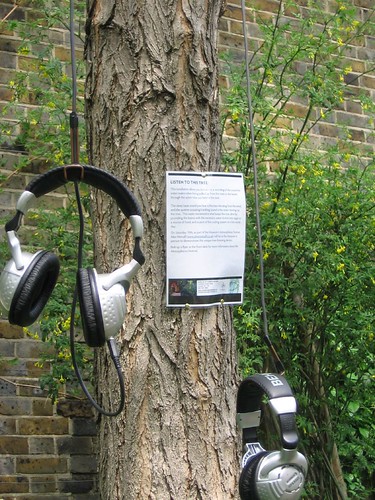
I misunderstood about listening to trees (now there's an opening line) - the installation is there all this weekend, so I went to the Museum of Garden History to hear it today.

Is there a particularly English attitude to trees? Attaching a mystical significance to forests and trees must be part of many different cultures, but it's hard to imagine a TV series called Meetings with Remarkable Trees anywhere else. But whatever emotional impact trees may have on us, I don't think we would expect sparkling repartee from them. And so it proved: what you hear is a low rumbling, like an irregular heartbeat or distant thunder, overlaid with a faint high-pitched crackling or ticking sound. The first is the sound of the internal strains in the tree as it moves with the wind; the second is the sound of water passing from cell to cell as it rises up the tree.

It's a reminder, in this instant makeover world, that trees and plants aren't just objects to be designed with, their life is on a different plane and timescale from ours.

The Museum itself is only a couple of bus stops away from Waterloo (or a walk past St Thomas's Hospital and through Archbishop's Park) in the former church of St Mary-at-Lambeth, nestled into the walls of Lambeth Palace, and home to the tombs of a number of Archbishops, as well as Captain Bligh (of the Bounty), as well as sundry memorial stones, including this one demonstrating the limits to eighteenth-century charity. Its connection to garden history is that the Tradescants, father and son, were buried there - great collectors whose name was given to various plants.

It's volunteer-run: you could tell from the slightly apologetic way the voluntary donation is asked for as you enter (£3 is hardly going to break the bank), and the slightly worn static panels that take you on a quick canter through the social and cultural significance of different styles of gardening from the Romans to the late Victorians. No-one seemed to mind the children scampering around and enjoying the church's echo. There were quiet marital disagreements over the plants for sale (I'm not sure if this is a regular thing or just because this was their open day for the National Garden Scheme).

There are display cases about great plant collectors and gardeners (the Tradescants, of course, Dampier, Banks, Paxton, Jekyll) as well as a selection of gardening tools and impedimenta, a strange plant called a vegetable lamb, and an "auricula theatre" - one of the more bizarre Victorian tastes, in my view.

It's a quirky , rather than comprehensive, collection, and the art and events it hosts look rather similar: talks on Guerrilla Gardening, alternative music, that sort of thing.

The churchyard contains a knot garden (complete with a panel explaining the problems their box hedges have had with an amorous fox - apparently box, to a fox, is like catnip to a, well, cat), and some panels explaining some principles like planting for the immediate environment, or for wildlife, and so on. But the Museum is not resourced to be like Wisley or Kew.

It has (of course) a café and bookshop. I bought Robert Macfarlane's Wild Places, all about mountains, cliffs, remote islands and more trees: just the thing to read while tucked up in bed with a cup of cocoa.

Wednesday, 7 May 2008

I think that I shall never see...

I'm rather sorry to be missing this event at the Museum of Garden History tomorrow.

The thought of listening to the internal workings of trees is intriguing.

It's a sort of payback for that soppy song the late, great Spike Milligan once parodied as

I talk to the trees
That's why they put me away....


After all, there are things the trees don't need to know:

Sunday, 4 May 2008

Won't you buy my pretty flowers?

For all its reputation for industrial grime, the East End has its green spaces - and since the 1850s the place to go for locals to indulge their green fingers has been Columbia Road market on a Sunday morning.

Squeezed into a tiny stretch of street about 10 minutes' walk from the other great Sunday markets (Spitalfields, Brick Lane, Petticoat Lane), Columbia Road is raucous, with a bit of banter to go with the gardening advice - and a bit overwhelming.

Stalls line both sides of the street, and the people inch along in between. Those who want to get by a little faster squeeze along the pavements along the outside (did you see what I did there?): definitely not a place for the claustrophobic (what on earth possesses people to imagine they could or should bring a child in a buggy into the crush between the stalls, I just don't know - but they do, and they survive).

Many of the plants are still the old favourite bedding and window-box plants, and plenty of cut flowers to sell to the sightseers who don't have a garden, but - even in the few years I've been visiting it - there seem to be more and more upmarket and exotic plants as the social composition of the area and gardening tastes in general have changed. There are trays of petunias and busy lizzies bobbing along as people hold them overhead, but palms, orchids, bottle-brush wattles and the occasional lemon, orange or olive tree stand out as they sail along above the crowds.

Similarly more and more of the shops round about cater for the quirky and more chi-chi artistic taste, as well the kind of ornaments you might expect people to put in a garden.

Pricing seems to aim at round sums to make the arithmetic easier - adjusting the quantity to the price rather than the other way around. Get there very early to avoid the crowds and see the best of what's on offer, hang around till lunchtime to see if there are any clearance bargains.

Stocking up my window boxes this morning, I got four upright fuschias for £6, four trailing fuschias for £5, six trailing ivies for £5 and a tray of lobelia for £4: in all, about the same as a very average restaurant dinner, a comfortable seat at the theatre, or three or four paperbacks. Not bad for (I hope) a summer's delight, is it?

You can understand the man I overheard saying "I'm the Imelda Marcos of plants".

Friday, 2 May 2008

Cripes!

At least you can't blame me.

And at least we're not in Rome.

Not quite.

Thursday, 1 May 2008

May Day

It's not just election day. In France it's a day for giving lily of the valley (muguet), so for readers in France:

X marks the spot

I've done it. I've been to do my democratic duty - and, as I always do, on my way to work (which is usually not busy, so I was in and out in five minutes).

From an outsider's point of view, it's been a rather quiet election. They usually are these days, as parties have fewer and fewer active members doing it the old-fashioned way (leafletting and canvassing door to door). Where I live, the old-fashioned way is close to impossible, since we're all behind gates or entryphones (and in my block somebody made off with the facing plates for our entryphone system a few weeks ago, since when nobody knows which wires go where, and any visitors have to telephone in advance to be let in - very handy).

We're used to one free delivery by the Post Office of a leaflet for each candidate (but they have to arrange for them to be individually addressed); but for an operation as huge as the city-wide election of the Mayor and Assembly, they now have a single booklet, with a statement from each mayoral candidate and a list of Assembly candidates. And that's pretty well all I've seen: apart from one leaflet for the Tories, who I suppose have a member living in my block. I never even knew about this comprehensive site until it was all over!

Voting itself is still a rather nineteenth-century operation: temporary plywood booths in the local school and tied-down pencils. I like it that way: it's straightforward and easy to understand not only what to do but also what happens afterwards.

Once upon a time, I was an active party member and saw quite a bit of the "afterwards", as an observer at several election counts.

First, all the ballot papers are tipped out of each box, unfolded, put the same way up and totalled to make sure there are no more papers in the box than were recorded as issued. This is the easiest bit for the tellers (who are usually bank staff since they're good at sorting and counting bits of paper quickly), but the most complicated for the observers. The individual ballot box represents the smallest geographical collection of voters, so the parties want to get any impressions they can of how their candidate's doing at this level. The observers are expected to count (silently) how many out of as many groups of ten ballot papers as they can count are going their way, and for as many as possible to do so for as many boxes as possible to get a good average.

Once the total is verified for a box, the ballot papers are all collected up and passed to another group of tellers to start sorting them into piles for each candidate. This is the serious stuff: the observers hover over the tellers alert for every mistake (every mistake against their candidate, that is - you'd be surprised how often new observers have to be told to keep quiet about possible mistakes in their favour). If I were trying to concentrate, as a teller, I'd hate having someone leaning over and pointing (no talking to the tellers, by the way, it all has to be done by pointing). Any disputed papers (from people who sign the paper - yes, some nitwits do, or people whose mark is all over the place or otherwise unclear) are put on one side to be dealt with specially by the senior returning officer.

Then the piles for each candidate are collected up and passed to a third group of tellers to start counting. This is the crucial bit for them, but the observers can (and do) relax, for they're in no position to second-guess the counting. They know by now roughly what proportion of the vote to expect. This is the time for them to banter with the opposition. In the 1997 general election landslide, I had my pocket TV with me, and I had the great privilege of telling my (loathed) MP that his counterpart in the next constituency had just lost his (even larger) majority.

Eventually, it's time, somewhere after midnight, for the announcement and speeches.

It's all bit different for this election, not least because one of our Borough councillors has resigned as well. So we had white, pink, yellow and peach ballot papers for each of the different categories: and where the white (Borough council) paper had to be folded (the usual way), the others for the London-wide elections were not to be folded.

And a little administrative detail like that tells me (I should have been a spy) that those ballot papers are going into a machine reader of some sort. And this is how it all works. But this is one area where I prefer to have humans, who can be checked by other humans.

Tuesday, 29 April 2008

Plus ça change (2)

Signs of the times?

Yesterday, on the way to work, I saw an art-studenty young woman with a bag made out of a souvenir tea-towel with bamboo sticks to hold the shape and a shoulder-strap; and when I opened the paper, there was a long piece about how to make your own clothes (for women) - apparently Youtube is full of instructional videos.

It's reminiscent of my postwar childhood: sweaters made of wool unravelled from old ones, cut-down hand-me-downs and so on (I'm not complaining). I thought I was going to be the last person in this country to turn a shirt collar - apparently not.

Saturday, 26 April 2008

Plus ça change...

I haven't been out and about the last few weekends, as I needed to move furniture in and out of the living room while the flooring was replaced; and I've also been dithering about some shiny new TV kit (and lugged a load of broken old stuff to the tip - thank goodness it's on a bus route).

But today I was up in town and saw - guess what - a couple of punks, Kings Road 1980s style. This was in Shoreditch High St (where else), so perhaps they were being ironic, or retro or something. I didn't think to take a photo - if I had I'd have been too timid to go through with it - but there may have been something post-modern about the way what would once have been a pink Mohican crest over the top of the skull was set along one side, while on the other side was a line of hair set like science-fiction eyes on stalks, or Björk's bunches on steroids.

But that wasn't what made them stand out, so much as how huffy they were getting at not being able to get a taxi to stop for them....

Friday, 25 April 2008

Stirring me stumps

I managed to miss Walk To Work Day: and taking the best part of two hours to get there would strain my goodwill, to put it mildly. However, checking out routes on www.walkit.com got me thinking: I could invest some of my unexpected early pension in a bike...

Not that that would put me any closer to biking Boris (I hope). I'm not surprised - but I am relieved - to find that the nifty issue-matching Votewatch finds me some way from his opinions on most things, and I shall trot off to the polling station on Thursday to vote accordingly.

The only thing that gives me pause about saying "on yer bike" to Boris is the way he does it:

Tuesday, 22 April 2008

Well, well...

Who'd have thunk it?

I thought one of the minor compensations for all the anguish about declining property markets would be no more begging letters from local estate agents ("We have recently sold a property in your building within days of its coming on the market, and we have a queue of clients anxious to buy..... please please PLEASE" and so on, and so on).

Hah. There were two more letters waiting for me tonight. Oh well, it's not a lot of extra weight in the recycling box, I suppose, beside the bulk of newspapers. It's just the waste of time that annoys me.

No time to go gallivanting round town the last couple of weekends, since I was moving eight bookcases and heaven knows how many books and records out of the living-room and back again to leave the workman space to get on with replacing the flooring. And, oh, what a difference it makes: hmm, I wonder what effect it has on the price of this place?

Friday, 18 April 2008

It's not called Twitter for nothing, is it?

Gordon Brown's office has set up a Twitter feed during his visit to the US.

Mind you, I was as >dismissive of blogging in my time: and I could post to this using my mobile, if entering text weren't quite so laborious.

Wednesday, 16 April 2008

Sock-sorting day

Isn't it amazing how many different shades of black a few washes can produce in half a dozen pairs you bought as identically-coloured?

Sunday, 13 April 2008

The London Marathon - sooner them than me

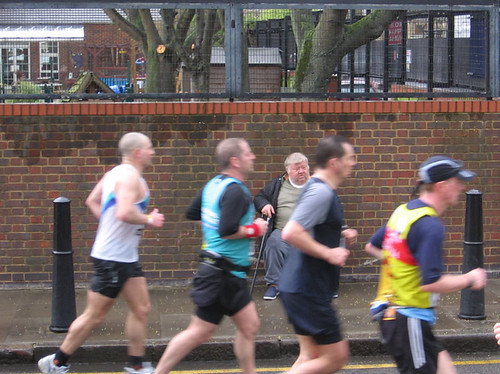
Where I live is right beside the route of the Marathon (near mile 16, if you really want to know), so it's a big event for people who live round here. For about three hours, we can't actually cross the main road, and more or less have to reconcile ourselves to being hemmed in here.

The day started fine and sunny for the wheelchair competitors and international elite runners, but by the time the fancy dress and what I've seen unkindly described as "village fete" runners got down to our part of East London, it was cold and showery (that might be rather better weather to run in than unexpected heat, of course).

As ever, people were out in force to cheer them on, especially the whole gallimaufry of the imaginatively dressed - Paddington bears, men and women in tutus and deely-boppers, Batmen, Supermen, policemen, firemen, cavemen, Wonderwomen, Pink Panthers, fluffy bunnies, Cornish pasties, a leafy branch in the backpack - you name it, it was there.

Mind you, some people showed more enthusiasm than others:

Last year, there was a woman in a cat outfit that wasn't much more than the whiskers. This year, a man in a Borat outfit - let's just say it demonstrated the effects of the weather...

By about four hours after the official start time, the runners are often mostly walkers, thinner on the ground and really starting to suffer as they battle on. It seems only right to slice up some oranges and break up a large block of chocolate to encourage them on.

By about five hours after the start, as I cross the road to go into town, the stragglers seem few and far between. One man, more or less ambling along, seemed so lost in his thoughts (or what was on his iPod) that he was quite startled when the policeman on duty said "Well done, young man!".

Here's a bit of video:

Thursday, 10 April 2008

Living it up

One more thing to separate people with more money than sense from their cash. I had heard tell of this stuff before (incidentally, the BBC's description of it is deplorably sloppy, since presumably the beans make their transit undigested), but I suppose PR must have its day pretending it's new and unheard-of, especially if it's for charidee.

My trouble is, fancy coffees are one of the things that turn me into Mr. Grumpy. Always - ALWAYS - when I'm lined up for my once-a-day plain black coffee, I seem to find myself behind someone (sometimes a committee of people) ordering the strange new combinations and flavours that take far too long to make. A cappucino's bad enough, but cat-poo-chino*...?!

*That's not original, I'm plagiarising.

Tuesday, 8 April 2008

Old city, open city

Once a month, there are free guided tours of Somerset House, the handsome eighteenth-century building beside Waterloo Bridge that used to house different government offices (registers of births, marriages, deaths, Inland Revenue, that sort of thing), and is now home to the Courtauld Institute Gallery and some fountains in the courtyard.

It's named for Thomas Seymour, Duke of Somerset, who was uncle and Protector of the child king Edward VI in the mid-16th century (and, rumour has it, a little too physically affectionate to the only slightly older Princess Elizabeth, which has been held to explain her attitudes as Queen to men and marriage). He decided a grand riverside palace was required for his status, and cleared local riverside properties (the Protestant reformation conveniently absolving him of any need to respect local church buildings). His ambitions leading his enemies to find a way of bringing him down and executing him for treason, his palace then became an all-purpose government building.

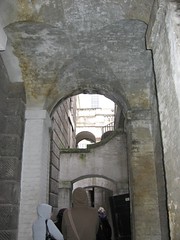
In those days, government offices tended to be squeezed into any available outhouses of the monarch's palace, so a grand building like this was quite useful for putting up foreign guests and international conferences. As a result, it quite quickly, and perhaps ironically, became a place where Catholic worship was tolerated for diplomatic reasons, a practice extended when it was used to house the Stuart queens and their attendants, who tended to come from Catholic countries. Part of the tour takes you round the Piranesi-like lightwells around the courtyard and into a service cellar where a few tombstones of French and Portuguese servants are preserved.

The present building was the first designed with government and public offices in mind, and squeezes a lot of space in. The point of the lightwells around the courtyard was to let light into offices set into the slope from the upper street-level down to the riverside (complete with river entrance for the naval officers who occupied part of the building). Down below, the space for the lower orders is utilitarian (imagine working here when every copy of every newspaper had to be physically stamped to show duty paid), but upstairs the space for the nobs is grand and light: this photo shows the Nelson staircase.

Not the most important building, or the most significant bits of information I've ever learnt, but it was something to do on a cold wet Saturday afternoon (pity the poor children who were dancing through the fountains on the snowy Sunday as part of the Olympic Torch hooha). When (if?) the summer comes, the courtyard is an impressive public space to sit - much better than the civil servants' car-park it used to be - but for now, there's a distinct air of not being quite sure what the bulk of the building is for, since the Gilbert Collection and the Hermitage Rooms moved out.

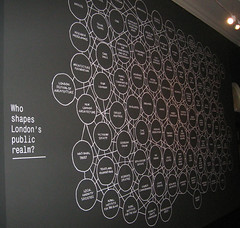
For the moment, it's housing Open City, an interesting and stimulating exhibition on some of the work being done by Design for London, the Mayor's design agency (can't you tell it's election year?), on the "public realm", the spaces and streetscapes under pressure from competing demands for security, safety, cars, buses, pedestrians, etc., etc. This wall shows the range of interests that have to be accommodated.

There's an interesting range of projects described in the exhibition, from improved access and use of the Victoria Embankment (30 years overdue, in my view), to the "Bankside Urban Forest" (not the new trees outside Tate Modern, but a scheme to open up dead spaces in the warren of streets and commercial/industrial premises behind it), to huge open space conservation and regeneration projects in the south and east of London (some kick-started by the Olympic park development, but much larger in scale and range).

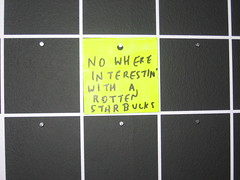
The public are invited for their comments: as you can see, there is a lot of disenchantment to be responded to...