Heron Island, Great Barrier Reef, Australia

Monday, 15 February 2021

A tale of two cities: Ely (3)

Outside, you might wonder why there's a cannon defending the Cathedral

It might have something to do with the fact that it's pointing straight at the house that Oliver Cromwell lived in during the 1630s and 1640s, as a rising farmer, country gentleman, Presbyterian (and no fan of bishops, cathedrals or stained glass), and MP.


Part of the ground floor doubles as the Tourist Information Office, but the rest is devoted to presenting the domestic interiors of the day.


Upstairs, there's an outline history of the causes and conduct of the Civil Wars, exploring Cromwell's record as he emerged as a leader in Parliament, army general and ultimately, as "Lord Protector", more or less military dictator and monarch in all but name. Visitors are invited to rate him Hero or Villain - it seemed it had been running around 65-35 in favour of "Hero", reinforcing (for those who remember their 1066 And All That) the view that the Roundheads were Right but Repulsive and the Cavaliers Wrong but Wromantic.

A few streets away there's a small local history museum, with plenty for school parties to get to grips with, from prehistoric finds to the draining of the Fens around about (Cromwell's first big local issue as an MP, standing up for displaced local farmers), eel-fishing (hence the town's name), the history of the assorted criminals and unfortunates who ended up in the building when it was the Bishop's Gaol, and Ely's experience in WW2 as a centre for both evacuees from London and massive numbers of airmen on bases nearby. 


Those apart, it's a pleasant, busy and reasonably well-serviced small town, though my photos don't capture much of that (I can never get over the habit of not taking pictures of the humdrum and everyday, even though that might be of most interest to others). The bland chainstore frontages of the main shopping streets somewhat conceal interesting side alleyways.


And on the way back to the station, it's worth a diversion to a well-pubbed waterside:


Sunday, 14 February 2021

A tale of two cities: Ely (2)

Arriving at the Cathedral, there are some impressive doors:

and the view of the interior, and particularly its roof, is equally impressive:

So are its stone, metal and wooden fixtures and fittings:

Some of the decoration, particularly the painted ceiling, is Victorian, part of the revival of interest in mediaeval styles previously dismissed as too papistical. The really distinctive thing about the Cathedral is, however, original: well, almost. The Octagon Tower was built in 1322 to replace an earlier Norman tower that had collapsed.


Victorian, too, are the stained glass windows; but upstairs in a side gallery, heralded by the play of coloured light from the windows on the floor, is the Stained Glass Museum, all about how it developed, and is made to this day, with plenty of examples, not only mediaeval but also early twentieth-century domestic and contemporary aesthetic (with plenty of Victorian stuff in between):


Saturday, 13 February 2021

A Tale of Two Cities: Ely (1)

Real-life travel being off the agenda for the foreseeable (no point trying to predict anything these days, it seems), time to do some armchair travel with old photos (surprising how little one actually looks at them, once taken and filed away). Back in the mists of pre-Covid time (2018, to be precise), one adventure was a day trip to Ely. Tidying up some old souvenirs had turned up a programme for a concert in the cathedral that I must have been to in my student days, but I have no recollection of it at all, so it seemed worth checking out again.

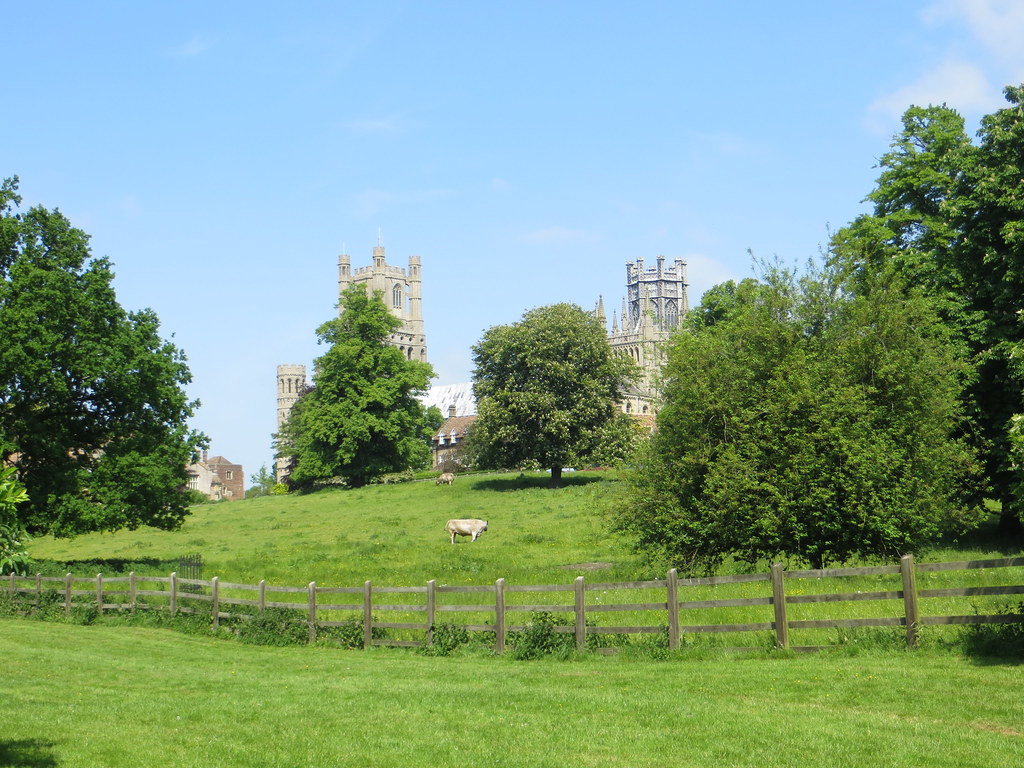
It's such a small place, on one of the few hills for miles around, that the Cathedral's domination of the town is visible from quite a way away. 

On leaving the station, there's a handy poster map of the centre to show the way to all the main attractions, but it's hardly necessary in the circumstances. Go round through the park, rather than the ordinary-looking streets, and the Cathedral (and with it the geography of the centre) is easily found.


It was originally the heart of a massive mediaeval monastery, whose purlieu took up most of where the modern town stands. On the Dissolution of the Monasteries, Henry VIII allowed the Cathedral to stand, and many of the surrounding buildings to become the King's School, which is there to this day, and mostly behind walls, off-limits to the passer-by. 


So even if you're welcome to use the park and pass through to the town centre, there's still a cloistered feel to it all.


But lest you think this place is entirely other-worldly, the old gate house to the Cathedral/School area contains a library which is keeping up with the times.

On to the Cathedral....


Thursday, 11 February 2021

I'm covered. Sort of.

On the left, my European Health Insurance Card, which allowed me access to local health services elsewhere in the EU, on the same terms as citizens of the country concerned (except that I notice - only now - that I didn't notice it expiring in 2018 and had a merry time not being covered at all in my European travels in 2019 - oops). 

On the right, my shiny new Global Health Insurance Card, which does much the same job, even after Brexit (except in the other EEA countries - Norway, Iceland, Switzerland and Liechtenstein) - not that there's much prospect of foreign travel any time soon (though let's hope there will be before this card expires in 2026).

The "Global" monicker is a nod to reciprocal health agreements with some other countries around the world. These have existed for years already, and to take advantage of them, existing documentation seems to have been enough:  the government makes no actual claim that the new card is proof of entitlement under those agreements (and even says it isn't proof that one's entitled to use our own NHS). 

So what we have is a distinction without much of a difference. Except that the distinction is having a Union Jack on it. And that makes all the difference, apparently. Cheers, Boris. 


Tuesday, 9 February 2021

Last weekend, tempted by a newspaper piece on making orange curd and spotting some Seville oranges in the supermarket, I had a bash at making both the curd and some marmalade (well it helps to pass the time).

The curd turned out fine, but the latter was a bit runny, so to get on with using it up, this weekend meant making a marmalade cake, with some of the curd as the middle layer.

It wouldn't win prizes (not exactly the lightest and fluffiest of sponges, and signs of the dreaded soggy bottom) - but it tastes good. And that'll do me. 

Sunday, 7 February 2021

It's on its way

It's sleeting outside today, but yesterday , the muddy grass in the park was brightened up by the first spring flowers.

Friday, 2 October 2020

Unexpected item in bagging area

 A word to the wise: put down shopping bags before attempting to put on your mask/face-covering.

Today was the second occasion on which I've found myself trying to hang my shopping bag on my ear.

Saturday, 29 August 2020

Autumn on the way

 Temperatures down from over 30C a couple of weeks ago to under 20, rain and wind, and bright orange hips on the wild roses on the Mudchute. It all points one way. 


Thursday, 27 August 2020

Thank you Facebook

If I needed any more encouragement to stay at home (and any more proof that algorithms are not to be trusted)......


Sunday, 23 August 2020

Passing the time

Among the little bits of life admin that nag at me are the accumulations of digital entertainment (that's recordings, not finger-puppets) in my video recorder and computer. I blame that "Series Record" button.

Slowly but surely I've been weeding out the recorder files, with some saved into a portable hard drive, for if and when travel abroad is possible again and the equivalent local services are - well, just not that entertaining. 

It can a be a tiresome slog waiting for the copying to be done and then renaming the files of some long-running series into some sort of comprehensible order (hence the slowness). And all too often some other little project suggests itself - this weekend, a cheerfully inconsequential piece of French swing music on the radio. I thought it would be something different to put into a video with the words. The wonders of the internet soon turned up a suitable photograph of the performers and the words, but experimenting with layouts, fonts and colours took a time: but stitched together it seems to work (well, it kept me amusedoccupied for a few hours):

Saturday, 1 August 2020

Ahem

"Beware all enterprises that require new clothes" - apparently these words of wisdom are from Henry David Thoreau. Whether he said anything about the clothes themselves, I don't know, but it would have been wise to bear in mind when buying a new dressing-gown.

The swimming pool here has re-opened, but on suitably distanced conditions, one of which is that we change and ablute in our own flats, hence the need for a dressing-gown (my old one turning out, on inspection, to be less than neighbour-worthy: blame it on clumsy attempts to bleach out tea stains). 

As it happens, I didn't notice the embroidered logo before I bought it. I do hope no-one thinks I'm boasting.


Wednesday, 29 July 2020

Mystery with a cherry on top

Not for the first time, a cycle ride home was interrupted by something going on in Trafalgar Square. The new commission for the Fourth Plinth has been installed, but until the unveiling the wrapping invites some speculation. Until you bother to look it up, in which case all is explained here.

To save the bother of clicking:

This sculpture attempts to address the specific physical context of the square, whilst considering a broader ideological one. How do we negotiate congregation, the intimacy of personal experience, broadcast and surveillance in one space? THE END represents exuberance and unease. Topped with a giant, unstable load, the plinth becomes a monument to hubris and impending collapse. The surrounding architecture and its population are participants in a mis-scaled landscape, one that magnifies the banal, and our cohabitation with other lifeforms, to apocalyptic proportions.

Well. if you say so.

And what will be revealed when all that fabric is removed? 

Tuesday, 14 July 2020

More daring adventures

Another Saturday visit to central London, only this time.... on public transport! On a boat, on a train, on a bus, for the first time in nearly four months. It almost felt like being a tourist in a strange city. I hadn't quite forgotten how it all works, fortunately: and there were few people on board, which left plenty of re-assuring distance between us.

A poor thing, but mine own
And, as required, I had a mask, home-made in an idle morning (there have been few others recently) from the leftovers of a home-made window blind some mumblety-odd years ago. 

The stripes give it a rather cheerful sea-sidey air, but to put it politely, I suspect using it is more performative than preventive. Still, it shows willing, and every little helps, I suppose.


Tuesday, 7 July 2020

Now it can be told

This was wobbling about mong the many and varied odds and ends blown down the steps to our communal garage in the weekend's high winds.

Perhaps I'm behind the times, but the news hadn't reached me that balloons for funerals are now A Thing - and a lot else besides.

Saturday, 4 July 2020

Hair today

..and gone today as well. It really was getting to be a nuisance trying to keep it all tidy (and that bald spot was a bit of a surprise).

It all felt rather adventurous to be going back to the mundane habits of months ago: a bike ride up to central London, a haircut, coffee and a bun sitting down at a café and lunch sitting down in another, and reading the paper over a pint in a pub. All suitably distanced, of course: waiting to be seated in solitary state, ordering up via a phone app, and registering the location (just in case someone else who was there bothered both to do likewise and to report symptoms of You Know What). And just to underline the occasion, there were a fair few reporters and cameramen recording reactions as some streets were pedestrianised to allow the restaurants to take over the roadway as well as the pavement.

But it wasn't all self-indulgence. Biking into a headwind that wasn't tempered to this shorn lamb must have worked off a few calories,

Saturday, 6 June 2020

Permitted exercise

Before the "stay at home" instructions I was just starting to put together a list of places to visit, up and down the country: the lockdown put that on hold, though it hasn't meant staying entirely behind locked doors. Fortunately there are places on the doorstep to walk to and around - along the riverside path, or through the local parks.

Entering Millwall Park from the south, it looks like a mixture of conventional city park and playing field, though the areas of play equipment for children and outdoor gym for adults is fenced off.

But on the other side of the playing fields, there's a rising slope covered in trees and bushes. 

That rising ground and greenery has the unglamorous name of the Mudchute - because that's what it is. The built-up berms or embankments formed settling ponds for the mud pumped out when the dock just the other side of the road and railway line was dredged out. Through the gate and up on to the pathways, and with a little imagination, that industrial beginning has now almost become countryside. With the near-disappearance of road and air traffic in the lockdown, it's certainly quiet enough. 
Apparently it took decades for the sludge to settle safely enough to be walked on, but settle it did, though there are clearly enough reserves of water to keep the trees and bushes green in the long dry sunny spell we've been having.


It looks as though someone has been setting up their home office here while the good weather was on - and the bees never stop working, of course:


Back in the First World War, allotments were set up here for local people to grown their own fruit and veg, and are still in productive use:


But allotments and open space are not the whole story, nor are bees the only livestock, for most of the space is devoted to the city farm, and those open spaces would normally have a range of animals out in the fields. With the lockdown making riding lessons and school group visits impossible,  most of the large animals seem to have been moved elsewhere, or confined to pens inaccessible to visitors, even from a pathway,  though there are sheep, goats and llamas in their usual pens (and the sheep put to work to replace expensive human mowers in different fields), and a pair of donkeys in the stables. The signs of the farm's educational mission are still everywhere, with plenty of warning notices about what to do and not do around or near the animals.


The café is of course closed, and one can only admire the roses from outside. The pigs don't much seem to care.

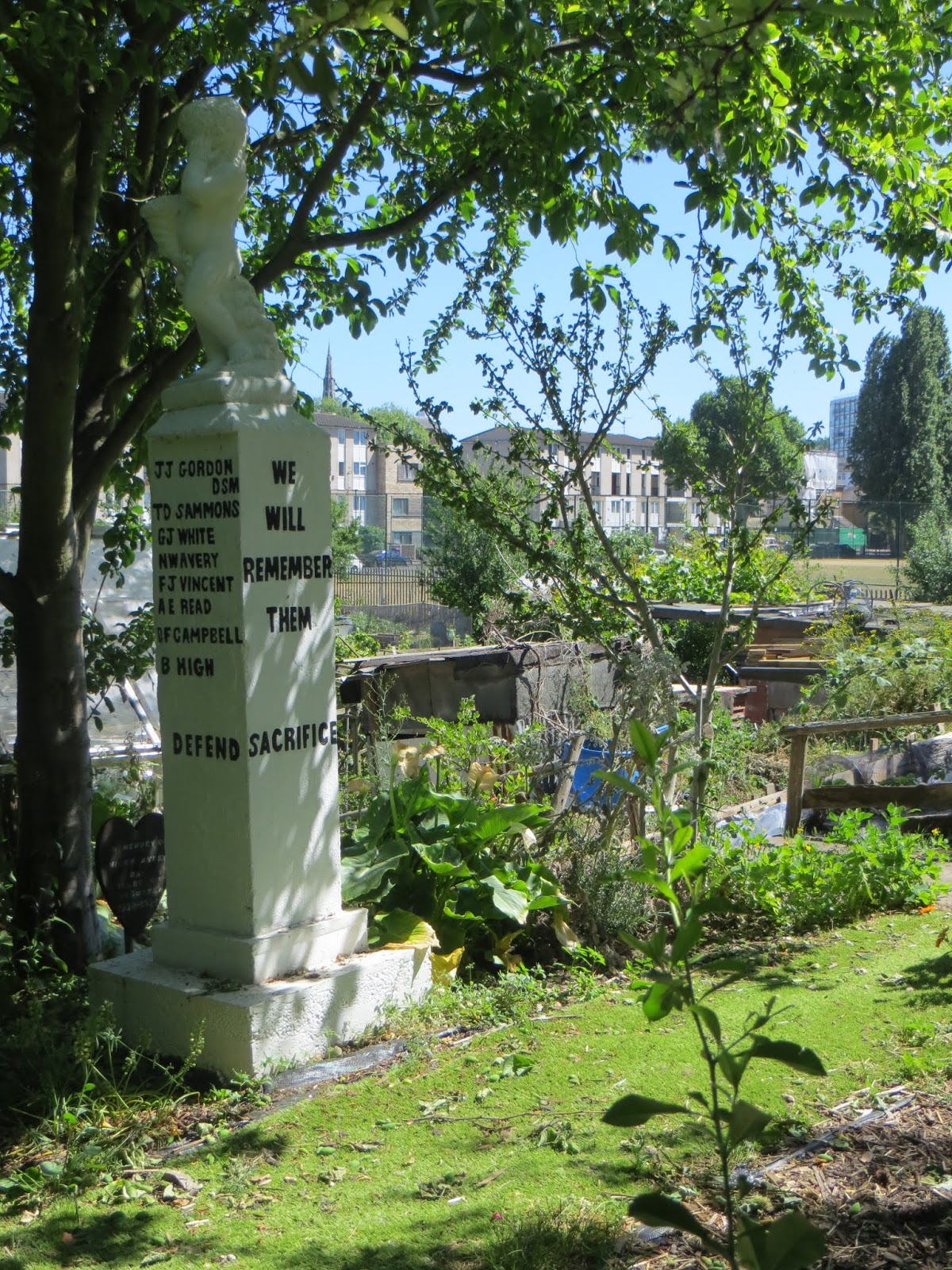
The pens for the pigs and some of the other animals are concrete structures that appear to be old emplacements for anti-aircraft guns from the World War II, and some years ago one was restored and an example of the original guns brought in as a historical display. This part of London was badly battered, though you wouldn't think it now.


Tuesday, 28 April 2020

What a difference a week makes


Last week was sunny and warm enough to encourage a bike ride up to central London and through the parks and back:


This morning - gray, chilly and rainy with enough wind to blow the raindrops sideways on to my window-boxes (usually shielded by the balcony above).


And so we plod on through the lockdown. But on the bright side, on Sunday one of our local convenience shops had...... bread flour!