 Well, all right, not exactly (OK, not a lot) like that, but interesting all the same. There were professionals from Africa, Hungary, France, the Netherlands and Portugal as well as the UK, doing some amazing things: the Africans had a lion and an elaborate carved archway sort of thing, the Netherlands had a collection of London icons (including the Dome, complete with its crown of support struts), the Hungarians had an intaglio screen of London "types" striding out, Abbey Road crossing style, and the French (surprise, surprise) offered a sculpture of a lady with a rather large bottom. Ordinary punters got a chance to have a crack at something less ambitious - no chain saws, but plenty of chances to work off some energy stabbing, prodding, sawing and scraping away:
Sunday, 16 January 2011
Just when we thought we'd seen enough ice
One of my colleagues is in China, aiming to visit the Harbin Ice Festival, practically on the opposite spot on the globe. How should I tell him when he comes back that the Canary Wharf bread and circuses events team have just organised something similar here in London?
 Well, all right, not exactly (OK, not a lot) like that, but interesting all the same. There were professionals from Africa, Hungary, France, the Netherlands and Portugal as well as the UK, doing some amazing things: the Africans had a lion and an elaborate carved archway sort of thing, the Netherlands had a collection of London icons (including the Dome, complete with its crown of support struts), the Hungarians had an intaglio screen of London "types" striding out, Abbey Road crossing style, and the French (surprise, surprise) offered a sculpture of a lady with a rather large bottom. Ordinary punters got a chance to have a crack at something less ambitious - no chain saws, but plenty of chances to work off some energy stabbing, prodding, sawing and scraping away:
Well, all right, not exactly (OK, not a lot) like that, but interesting all the same. There were professionals from Africa, Hungary, France, the Netherlands and Portugal as well as the UK, doing some amazing things: the Africans had a lion and an elaborate carved archway sort of thing, the Netherlands had a collection of London icons (including the Dome, complete with its crown of support struts), the Hungarians had an intaglio screen of London "types" striding out, Abbey Road crossing style, and the French (surprise, surprise) offered a sculpture of a lady with a rather large bottom. Ordinary punters got a chance to have a crack at something less ambitious - no chain saws, but plenty of chances to work off some energy stabbing, prodding, sawing and scraping away:

Monday, 10 January 2011
How musical are you?
 Yet another online test to play with, this time one set up by BBC Radio 3 and sundry serious researchers.
 I can't say my results surprise me much; if anything, I'd have thought my musical perceptiveness had dropped off a bit more over the decades than these results show. It turns out my "melody memory" is better than I'd have thought, and beat recognition about what I'd have expected. I'm dubious about the notion that one can really distinguish rock, pop, jazz and hiphop from each other on the basis of a one or two second beat - I certainly couldn't, but then, I haven't had the detailed exposure to what strike me as categories with fairly variable boundaries.
Sunday, 9 January 2011
Feeling chuffed
The sight of the first Seville oranges in the supermarket inspired me to have a go at making some - but something a bit out of the ordinary, some lemon and lime, for which the Blessed Delia came up trumps again.
 And it worked. However, I do notice that neither Ms Smith nor my trusty Marguerite Patten cookbook goes out of their way to reassure those of us who weren't listening in Chemistry that the mixture will stay liquid while hot, and that there's nothing wrong if it swirls around a bit even after you've started putting in the jar. No magic involved, provided the test sample was setting in the cold. The last time I tried something like this, you see, I didn't believe the test sample, and ended up with what I can only call gooseberry toffee: nice in its own way, but not easy to spread on toast. This time, however, trusting Delia worked a treat (but, my word, the lime makes it sharp).
All this domesticity set me off down memory lane, to my mother's proud efforts. There was a delicious three fruit marmalade, a large jar of which made it all the way to Paris to my school exchange family, and promptly fell off the kitchen table before anyone had a chance to try it. My mother swore by (and occasionally at) her pressure cooker for jobs like this (though a mechanical shredder would have saved more labour, if not cooking time). Hunting round to see if there's an image of the type she used, I find they have an example in the Science Museum, which adds a certain perspective. You can see why they used to talk about the Kitchen Front, can't you?

 And it worked. However, I do notice that neither Ms Smith nor my trusty Marguerite Patten cookbook goes out of their way to reassure those of us who weren't listening in Chemistry that the mixture will stay liquid while hot, and that there's nothing wrong if it swirls around a bit even after you've started putting in the jar. No magic involved, provided the test sample was setting in the cold. The last time I tried something like this, you see, I didn't believe the test sample, and ended up with what I can only call gooseberry toffee: nice in its own way, but not easy to spread on toast. This time, however, trusting Delia worked a treat (but, my word, the lime makes it sharp).
All this domesticity set me off down memory lane, to my mother's proud efforts. There was a delicious three fruit marmalade, a large jar of which made it all the way to Paris to my school exchange family, and promptly fell off the kitchen table before anyone had a chance to try it. My mother swore by (and occasionally at) her pressure cooker for jobs like this (though a mechanical shredder would have saved more labour, if not cooking time). Hunting round to see if there's an image of the type she used, I find they have an example in the Science Museum, which adds a certain perspective. You can see why they used to talk about the Kitchen Front, can't you?
Saturday, 8 January 2011
I thought it was getting warmer
Suddenly the winter layers of clothes seem too hot. And this morning, the bushes of broom around here were showing a first few tentative yellow flowers.
Wednesday, 5 January 2011
Eeyore-tastic
How fitting that the return to work should take place in all-encompassing gloom of cloud over the last few days; and that my new glasses should finally arrive to reveal a bright, sharp view of ... dreich drizzle.
On which note, I bring you this all-purpose weather prediction for the British Isles:
On which note, I bring you this all-purpose weather prediction for the British Isles:
Saturday, 1 January 2011
 What makes a good antidote to seasonal excess?
My eye was caught by a poster advertising the final days of the exhibition on the Second World War Ministry of Food, at the Imperial War Museum.
The Ministry led the drive to produce more food at home, to prevent waste and help people to make the best of what was available. In peacetime two-thirds of food had been imported: the consumption of meat and wheat had to be reduced, people had to be encouraged to eat vegetables rather than bread, to grow their own supplies wherever possible, using allotments, parks, gardens, back yards and the earth covering air raid shelters to raise not just vegetables but bees, rabbits, chickens.
It's often held that, overall, the rationing was so effective that the restricted diet of less meat, fat and sugar, and more fruit and vegetables, left the population healthier at the end of the war than in peacetime.
But, though the nutritional research underlying all that effort was the start of much of our modern knowledge about food and health, the exhibition focussed instead on the propaganda and promotional campaigns of the Ministry. There were plenty of the iconic posters, information films and snappy "Food Flash" announcements in the cinema, radio talks and recipe suggestions sent in by listeners (what on earth was in the pudding described as "Skinflint's Joy"? Probably something described, in a comedy sketch programme used to deliver nutritional advice and cookery hints, as "Another way to disguise parsnips"). There are recipes for lots of soups (so that people could use up the likes of pea pods and turnip tops), and ways to use hedgerow fruits (sloe and marrow jam, anyone?). A lot of this lasted well into my childhood - butter papers saved to grease baking tins, school mornings broken by free milk and fish oil capsules, and rose hip syrup to liven up boring milk puddings.
 It wasn't all worthy nagging. The constant reminders employed a range of approaches, sometimes congratulating the audience when, for example, huge savings in waste were being trumpeted.
The style and language can grate a bit on modern ears. Anything to do with food, cooking and home was shown as a matter for harassed housewives, and shopkeepers as authoritative older men. Information films reminded people about the massive contribution of the Commonwealth countries, but the voices supposedly expressing the enthusiasm for the cause of the different countries are all from the British upper crust (even for the Gold Coast - now Ghana). The jokiness can be clumsy and some of the advice is gratingly patronising, even to the point of stating the bleedin' obvious:

But I could only silently salute the resourcefulness of people coping with such restrictions - and realise that the snacks I went home to make for our local New Year's Eve party would have been unthinkable then. So easy for me to make some pizza tartlets (onions - almost unobtainable for about 18 months after the fall of France, olives and tomato puree - rarely, if ever, available as imported goods) and some cakes from a magazine recipe (two weeks' ration of eggs, half a week's sugar ration, almonds and stem ginger - likewise, rarely available imported luxuries). We take so much for granted.
Thursday, 30 December 2010
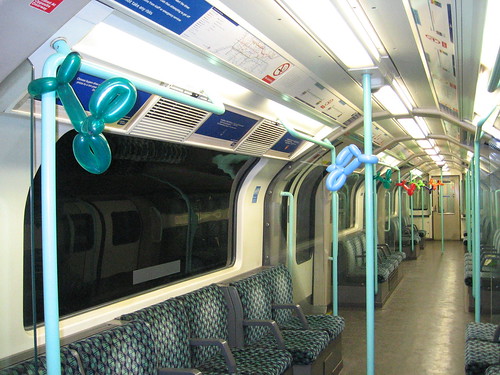
Getting home from central London on the day of the Big Snow (the Saturday before Christmas) required some variations in route. I ended up on the Waterloo and City Line, which (for various historical reasons) only links Waterloo and Bank for those who work in the City; so it was no surprise to find a completely empty carriage on a Saturday. But there was something even odder about it: the phantom balloon decorators had struck again:

Tuesday, 28 December 2010
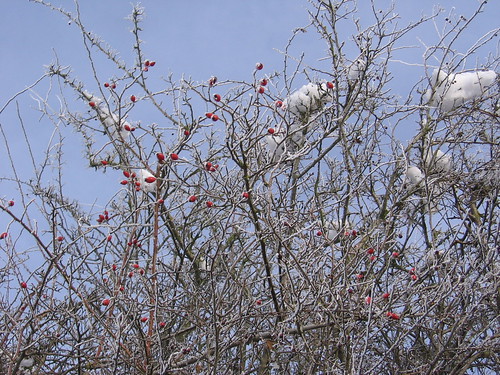
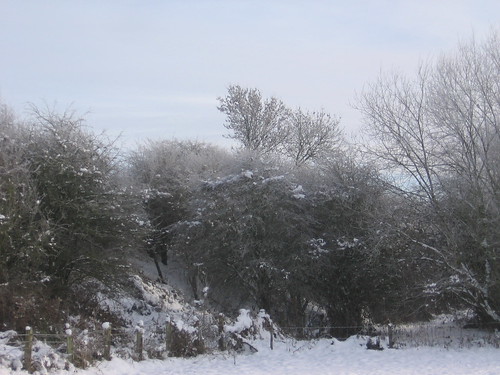
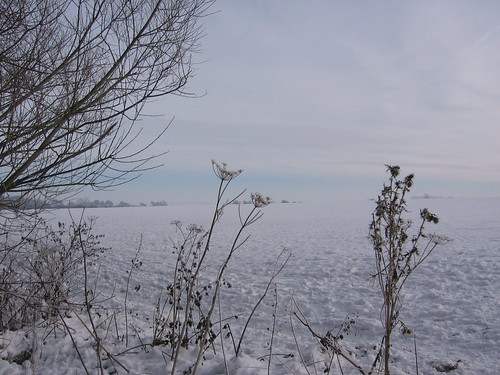
For whatever reason, I've felt bereft of inspiration and rather detached from blogs and blogging recently. Even the Big Snow caught me without my camera when it was worth photographing in London, before it vanished into slush. But where I've been spending Christmas - barely an hour away - it was still Christmas-card perfect:





Wednesday, 22 December 2010
Saturday, 18 December 2010
I've never claimed to be spectacular, but today I am completely unspectacled. Fatigue has finally overcome the frame of one of my lenses, which now has a tendency to dangle uselessly (I know how it feels).
Ah well, they had a good innings, and a new sight test was long overdue; but although my prescription hasn't changed much, it still involves varifocal lenses that will take a time to produce. Christmas will be viewed through more of a sentimental haze than usual.
Fortunately, I seem to have become a little more longsighted, which means managing without glasses isn't a great problem for immediate survival, reading or using the computer. However, once out of the house, I'm struck every now and again by a momentary panic, as my brain registers that something is missing, and that not everything in my field of vision is immediately comprehensible. Is this what old age will be like?
What's more, watching TV without my glasses is less than satisfactory, so in the comfort and privacy of home I shall be looking like a refugee from the 1940s, with the lenses held in approximate relationship to each other by an elaborate but precarious arrangement of sticky tape. Don't all laugh.
Ah well, they had a good innings, and a new sight test was long overdue; but although my prescription hasn't changed much, it still involves varifocal lenses that will take a time to produce. Christmas will be viewed through more of a sentimental haze than usual.
Fortunately, I seem to have become a little more longsighted, which means managing without glasses isn't a great problem for immediate survival, reading or using the computer. However, once out of the house, I'm struck every now and again by a momentary panic, as my brain registers that something is missing, and that not everything in my field of vision is immediately comprehensible. Is this what old age will be like?
What's more, watching TV without my glasses is less than satisfactory, so in the comfort and privacy of home I shall be looking like a refugee from the 1940s, with the lenses held in approximate relationship to each other by an elaborate but precarious arrangement of sticky tape. Don't all laugh.
Thursday, 16 December 2010
Party time
We may be having milder weather for a few days, but people are still dressing for winter on their way to work.
Just about.
On the tube this morning, there was a young woman with the regulation woolly teacosy hat, thick scarf and sensible wool coat - from which peeped out fingerless mittens covered in black sequins.
Just about.
On the tube this morning, there was a young woman with the regulation woolly teacosy hat, thick scarf and sensible wool coat - from which peeped out fingerless mittens covered in black sequins.
Saturday, 4 December 2010
Whether it's the hibernation instinct in all the cold weather, the generally gloomy news around the world or an irritatingly persistent cough, there hasn't been much to inspire a post recently.
But even my inner Scrooge had to crack a smile at this enthusiastic band, on Oxford St today (as did most of the audience - they really were there, even though my camera seemed to miss them almost entirely):
But even my inner Scrooge had to crack a smile at this enthusiastic band, on Oxford St today (as did most of the audience - they really were there, even though my camera seemed to miss them almost entirely):
Thursday, 25 November 2010
Sign of the times
Spotted in the café in Foyle's bookshop:
"Please finish your phone conversation before ordering".
And quite right too.
"Please finish your phone conversation before ordering".
And quite right too.
Friday, 19 November 2010
Let there be..
...lights.
Bike lights, to be precise. I've never been bothered about riding in the dark, probably because I learnt to drive in the winter and therefore mostly in the dark. The basic, regulation, one white, one red would be enough. Nothing fancy, just what you need to stay within the law and drivers' eyesight.
But then a pothole shook the rear light loose, and its red cover smashed. Only after I'd bought a replacement did I realise that the bulbs still showed red, as long as I held the batteries in with some clingfilm and sellotape: so now I had a spare to clip on to the back of my collar as a supplement.
Then I bought my Winkku, which also has front and rear lights. So now I could have one red light showing to one side as well as the original on my collar and the replacement on the saddle post.
And then my rear reflector cracked and fell off, and the only replacement I could find that fitted and helped hold the rear mudguard in place was yet another light with all sorts of sparkling and flashing options. How could I resist?
I'm almost a one-man mobile red light district.
But that was before I saw these:
Bike lights, to be precise. I've never been bothered about riding in the dark, probably because I learnt to drive in the winter and therefore mostly in the dark. The basic, regulation, one white, one red would be enough. Nothing fancy, just what you need to stay within the law and drivers' eyesight.
But then a pothole shook the rear light loose, and its red cover smashed. Only after I'd bought a replacement did I realise that the bulbs still showed red, as long as I held the batteries in with some clingfilm and sellotape: so now I had a spare to clip on to the back of my collar as a supplement.
Then I bought my Winkku, which also has front and rear lights. So now I could have one red light showing to one side as well as the original on my collar and the replacement on the saddle post.
And then my rear reflector cracked and fell off, and the only replacement I could find that fitted and helped hold the rear mudguard in place was yet another light with all sorts of sparkling and flashing options. How could I resist?
I'm almost a one-man mobile red light district.
But that was before I saw these:
Monday, 8 November 2010
Pootling and pottering
 One advantage of cycling is that you can stop and explore the byways - and in the City, there are more various and mysterious back alleys than might be expected. Behind the massive office facades along the main roads, there are passages and courtyards that look little changed since Victorian times or even before.
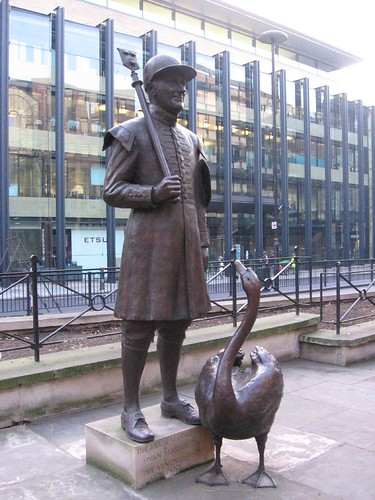
And that's how I came to find, among the Victorian survivals and postwar Georgian pastiche reconstructions, modern nods to local history. The church of St James Garlickhythe stands where once there would have been a riverside wharf, and now overlooks a flow of cars and lorries; outside it stands this acknowledgement of its links with the Vintners and Dyers companies, whose representatives row up river each spring to mark their share of the new season's swans, which for some ancient reason they share with the Crown.
 A little further on, this statue of a cordwainer (shoemaker) sits in Cordwainer Ward, on Watling Street. Like most of the City's streets and especially its back lanes, it's quiet, almost empty, at the weekends, the customers for its shops and cafés being the local office-workers; it might be a street in a sleepy village or country town. Hard to imagine that the high road between Roman London and the garrisons of the north west must have run along here; but at one end, the shiny new shopping centre opposite St Paul's seems to be drawing in weekend customers - perhaps the existing businesses will try to tempt them further down the street.
 A litle later, I came across thsi more convivial way of cycling around London, but it might be too large for those back lanes and alleys:

Thursday, 28 October 2010

Sunday, 24 October 2010

Not bad for £7
My window-boxes have sat indoors for far too long, while the exterior was being repainted and indecision about replacing the summer plants set in, but a sunny Sunday morning encouraged a re-stocking trip to Columbia Road.
I think I may have stumbled on the secret of shopping here (at least for someone impatient, like me) - approach from the eastern end. It's less crowded, and I suspect the eye-catching offers may appear a bit earlier at this end. Within about 15 minutes, five cyclamens, a dianthus and five violas were mine for £7. Now all I've got to do is clear out the casualties and make room for the new arrivals:

I think I may have stumbled on the secret of shopping here (at least for someone impatient, like me) - approach from the eastern end. It's less crowded, and I suspect the eye-catching offers may appear a bit earlier at this end. Within about 15 minutes, five cyclamens, a dianthus and five violas were mine for £7. Now all I've got to do is clear out the casualties and make room for the new arrivals:

Tuesday, 19 October 2010
More solutions
On my way back from the Post Office (why is the person in front of me in the queue always the angry one with the complicated grievance?), I noticed yet another "solutions" merchant: a van on a building site, advertising "progressive fenestration solutions" (=they put in the windows).
Just the sort of thing to make me contemplate a progressive defenestration solution of my own.
Just the sort of thing to make me contemplate a progressive defenestration solution of my own.
Friday, 15 October 2010
I have become a work of art..
..and I have a certificate to prove it.
 As part of this year's Frieze Art Fair, Gavin Turk brought his "Bikes de Bois Rond" to Regent's Park. The bikes are sturdy three-speed models, the frame wrapped in a decorative cladding in a style borrowed from a Polish artist. A brief escorted ride around the park's Outer Circle, past the Rose Garden and the back end of the Open Air Theatre, costs a mere penny charged to a credit card, though anyone absconding with one of these colourful machines would find a charge of £5000 appearing pretty soon. That you can indeed spend a penny and call it art these days may, no doubt, be an additional hommage, to Duchamp.
On return, a tear-off slip confirms that I am "to be considered an authentic work of art for all intents and purposes". Don't all genuflect at once.
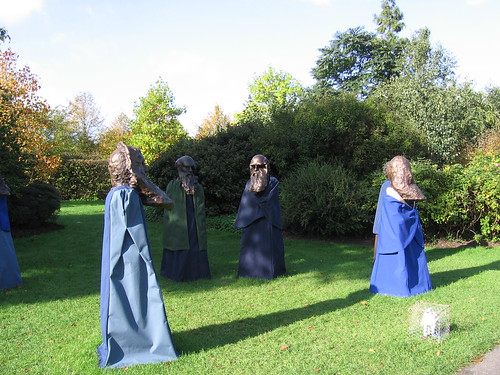
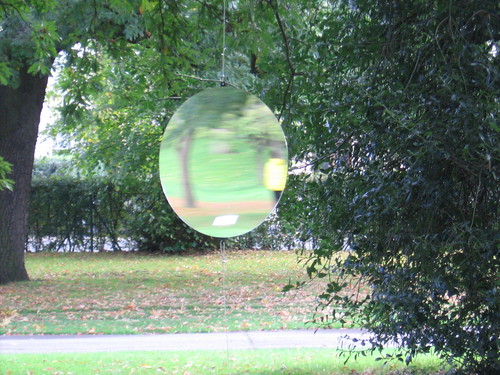
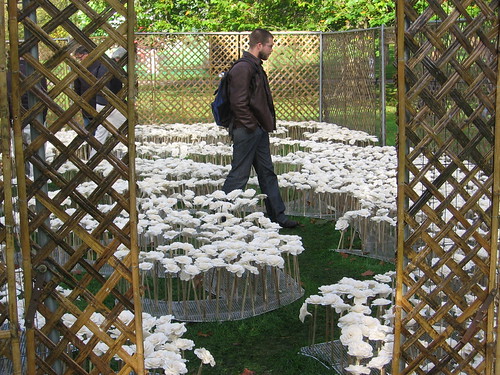
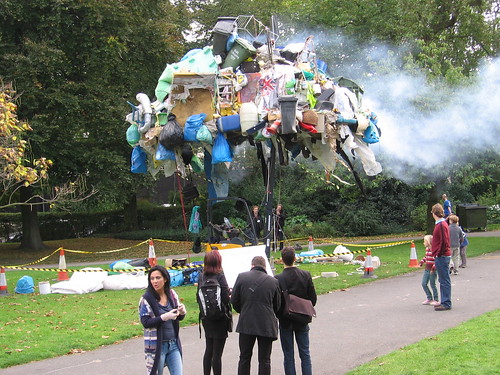
This was just one of the exhibits in the open air Sculpture Park, a scattering of sculptures and installations in the English Garden (looking splendid in the autumn sun). This part of the fair was at least free: I didn't bother with the exhibition marquee, which cost a cool £25 (I may have been certified, but I'm not that certifiable). It was enough to enjoy the return of the sunshine and wander through the collection, which included what looked like dilapidated statues of Darwin, a distorting mirror that swang this way and that in the breeze, a couple of stone eggs, a maze made of water hyacinth root, and an elevated pile of German rubbish (literally) complete with smoke and sound effects.


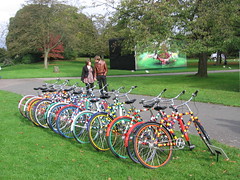 As part of this year's Frieze Art Fair, Gavin Turk brought his "Bikes de Bois Rond" to Regent's Park. The bikes are sturdy three-speed models, the frame wrapped in a decorative cladding in a style borrowed from a Polish artist. A brief escorted ride around the park's Outer Circle, past the Rose Garden and the back end of the Open Air Theatre, costs a mere penny charged to a credit card, though anyone absconding with one of these colourful machines would find a charge of £5000 appearing pretty soon. That you can indeed spend a penny and call it art these days may, no doubt, be an additional hommage, to Duchamp.
On return, a tear-off slip confirms that I am "to be considered an authentic work of art for all intents and purposes". Don't all genuflect at once.
This was just one of the exhibits in the open air Sculpture Park, a scattering of sculptures and installations in the English Garden (looking splendid in the autumn sun). This part of the fair was at least free: I didn't bother with the exhibition marquee, which cost a cool £25 (I may have been certified, but I'm not that certifiable). It was enough to enjoy the return of the sunshine and wander through the collection, which included what looked like dilapidated statues of Darwin, a distorting mirror that swang this way and that in the breeze, a couple of stone eggs, a maze made of water hyacinth root, and an elevated pile of German rubbish (literally) complete with smoke and sound effects.
Subscribe to:
Posts (Atom)