Heron Island, Great Barrier Reef, Australia

Monday, 2 November 2009

Chord

Not the most likely venue for an artwork, you might think; one of London's little seen spaces, the old Kingsway tram tunnel. Here, once upon a time, trams rattled between the Embankment and the top of Kingsway.

Ever since the trams were withdrawn in 1952, the space has been closed off to the public, part used for an underpass for cars, part set up for a control room for emergencies like the Great London Flood that we're still waiting for, part leading to mysterious offices for "other government functions". Of the rest, what isn't simply used for storing stuff has served for film sets, but most of us only know of the tunnel by reputation and odd glimpses through littered gratings and over the walls of the old entrance way.

So there's been a lot of interest in the opportunity to see it offered by Conrad Shawcross's Chord, an installation that takes advantage of the long straight tunnel.

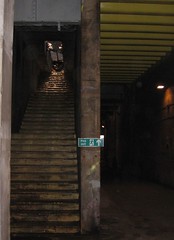
Entering down the surprisingly steep slope (imagine how the tram wheels must have squealed as they strained their way up), I was struck by the height and angularity of the tunnel. This isn't a tube, it's a straight cut down, made all the deeper for double-decker trams. We were ushered past still-surviving elements of the old tramway station: a narrow central platform and the kind of steep stairs that wouldn't pass a health and safety inspection nowadays, but the torn, stained and flapping station signs and maps on the wall are simply film props.

Skirting puddles and cables, we went on into the gloom, and came to two large contraptions, a good 4-5 metres high, set on a rack-and-pinion rail track. Three arms, each with three branches, and each of these with three sets of six spools of thick thread, each of a different colour (but related to the other five in the set). All these elements rotate independently, driven by intricate cogs from a single, modestly small, motor on each machine. Starting 10 metres apart, the machines move slowly apart, making a rope at a rate of 5cm an hour. After three days, the machines move back together and the process starts again.

Though the classically-minded might think of Ariadne, she made her thread at home (sensible girl) and for a labyrinth, not a straight tunnel. But here the floodlighting from the sides, keeping pace with the machines and the rope as they move, accentuated the gloom on the farther side. One might fancy that anything could be lurking in the dark, beyond the heaps of indeterminate shapes and the mysterious closed-off world of troglodytic securocrats. Appropriately perhaps, the machines let out an eery wail, like a modern jazz trumpet in a film noir soundtrack - or the squeal of a ghost tram grinding around a curve.

The enthusiasts for forgotten heritage, weeping concrete and the like had been flashing away with the cameras; we were asked not to photograph the artwork, but this doesn't seem to have been a universal rule, so you can get a better idea from these photos, or these.
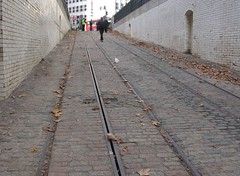
It takes less than half an hour, it seems, to contemplate the interchangeability and limitations of time and space; all too soon, we were being ushered up the surprisingly steep slope back to the street (imagine the noise of trams labouring up this!).

One last fact: when I asked the guide what the material for the rope was, he said the only material available in a sufficient range of colours for all those spools was "anorak cord".

Friday, 30 October 2009

Krispy Kreme, please note....

It isn't the most winning of sales techniques to greet a customer's order by adopting a Lady Bracknell tone of mildly outraged incredulity to say "Just the one?"

Friday, 23 October 2009

Sheer frivolity

I suppose I ought to have done my democratic duty and sat down to watch Question Time last night. But it's a long time since I gave up watching controversialists being controversial. What's the point if the only possible constructive contribution to the discussion is to throw something at the telly? Especially if, half the time, you could make a better fist of the arguments being put forward by someone you loathe in support of something you despise. And that's the last position I'd want to be in when the likes of Nick Griffin are on.

Anyway, it was nearly past my bedtime, and who wants to go to bed still chuntering away in high dudgeon? (By the way, what is low dudgeon?) Perhaps I might catch up in the daytime on the interweb - or maybe not.

Truth to tell - and I do hope this doesn't turn out to be some sort of historical parallel - there was a Astaire-Rogers musical on BBC4..........

Monday, 19 October 2009

Apple time

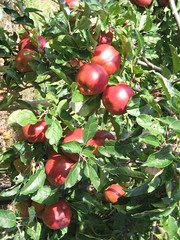
Tuesday is National Apple Day, apparently, and this weekend there was an Apple Festival at Brogdale Farm, the home of the National Fruit Collection.

Here over 2000 varieties of apples are grown, along with 500 varieties of pear, not to mention quinces and cherries, and the collection supports all sorts of serious research.

It's open to visit most of the year, but for the casual day-outer, the interest is either blossom or fruiting time.

For serious gardeners, there are opportunities to buy plants and seek expert (if rather brisk) advice:

"Is there anything I can do about the scab?"

"Yup. Spray".

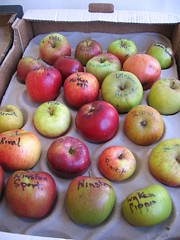
To save time, there was an ID parade of trays of different apples marked with their names, for all those people with an old tree but no idea what variety it is.

And there was a large pick'n'mix tent of apples and pears for £2 a bag, of varieties I'd never heard of - not just apples (Norfolk Orange, Blue Pearmain, Murfitt's Seedling) but pears (Bergamotte de Strycker, Beurre de Beugny).

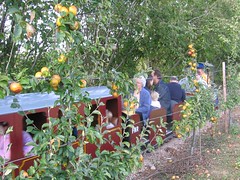
This being a Festival, the regular apple-focussed activities and tours of the fields were supplemented by talks and cookery demonstrations as well as other entertainments - food, fudge and craft stalls, a falconry display, a chance to try your hand at archery, the local classic car club display, and live bands while the miniature railway tootled back and forth behind the Egremont Russets.


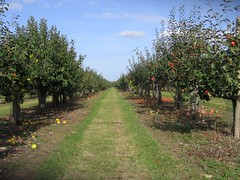
The guided walk took us past trees loaded with fruit which we were allowed to taste (and pick samples): perfect scarlet or crimson apples like the pictures in children's books (and every other possible colour too), historical varieties from what was claimed to be a Roman variety (small, green, not very tasty and fruiting only every other year), to the Elizabethan costard (large, crimson, delicious, but fruiting only at the tip of each stem, so not commercially economic), and a range of flavours too, with some apples (supposedly) tasting of aniseed, raspberry, lemon or coffee flavours.

It's the names that capture the imagination. The limited range of supermarket offerings simply doesn't prepare you for a world in which you might find D'Arcy Spice tempting the Lady of Wemyss to a Fondante d'Automne, or Mrs. Phillimore having Great Expectations of William Crump, while Leonard Lush calls Scotch Bridget "Sweetie" (and she calls him "Fairy"). (Yes, those are all names of apples and pears).

Anyway, here's my haul from the pick-and-mix (and a few windfalls besides):

Friday, 9 October 2009

Don't squeeze me till I'm yours

I didn't think of commenting on M. Giscard d'Estaing's venture into Cartlandland with his roman à wishful thinking about a tendresse between a tall and sophisticated French President and a beautiful young Princess. There comes a point when it's only polite not to draw attention to someone's onset of senility late flowering of erotic fantasy.

But seeing it referred to today, I suddenly remembered that he once affected to play the accordion, in an effort to show himself as just a regular guy (think David Cameron on the spoons, or Boris Johnson morris dancing). It occurred to me that he was perhaps re-imagining himself in one of Piaf's great hits. It seems he could have quite an effect on an impressionable blonde, with just a comb-over and a squeeze-box (even if, as she points out, a little one):

Monday, 5 October 2009

Dreich

Monday morning, lowering clouds and seeping drizzle: autumn setting in with not so much a vengeance, more a sigh and a sniff. Hard to imagine that less than two weeks ago we were still in a late summer, perfect weather for a stroll along the Ridgeway to Ivinghoe Beacon:

Sunday, 4 October 2009

Wet and wild

One last piece on what I did in my holidays: a pleasant walk along the Thames towpath from where I used to live, there are some forbidding railings and embankments which, in my childhood, looked mysterious and off-limits. And so they were, for these were reservoirs: we would see them on TV, once the Oxford and Cambridge Boat Race started to get aerial coverage, but otherwise not at all.

Since then, they have been converted into the London Wetlands Centre, a combination of educational facility and bird sanctuary.

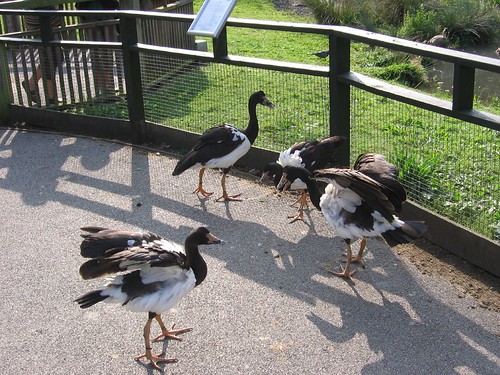
Around two sides of the site, a succession of areas shows different sorts of wetland habitat and the birds that live in them. I'm assuming that some of the birds populating the more exotic habitats (New Zealand ducks in the "white water" section, South American swans and blue-beaked teal in another) have clipped wings - wouldn't they get lost if they tried to migrate? But there are plenty of native mallards, moorhen and other Little Brown Jobs, as well as various sorts of different geese that seem to think they own the place:


These carefully managed spaces also include, with due acknowledgement to their relative artificiality as well as the principles of recycling, sculptures made of scrap materials

These outer areas are mostly focussed on school parties, with different sorts of buildings for groups to congregate, and a collection of fairground games to explain the water cycle and the maintenance of wetland biodiversity.

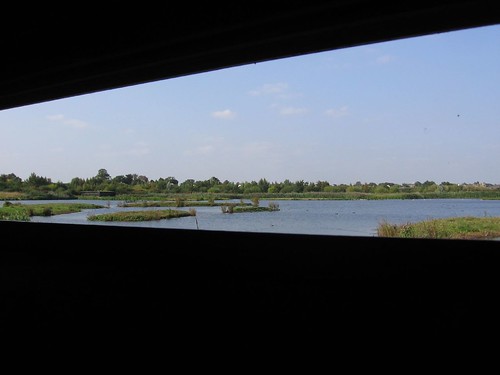
But as you walk around, there are vistas of apparently isolated wildness. Most of the site is left for non-human visitors. We humans can only look at them at a distance, from various hides:


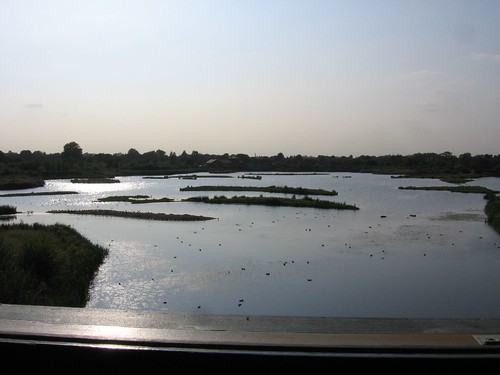
Choose your viewing angle right, and you could be miles away on the marshes of the Thames Estuary:


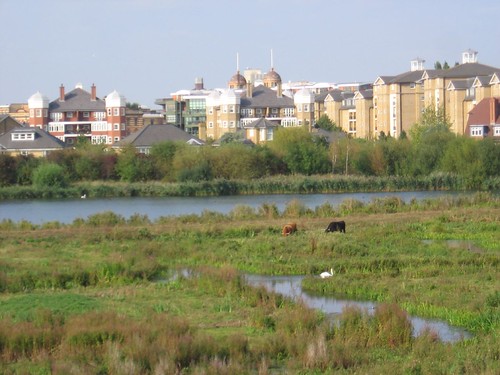
But if you look up, you see not only herons, swans and Highland cattle in the water-meadows - you see the expensive apartments whose development helped provide all this:


And you remember it's all within half an hour of central London.

Thursday, 1 October 2009

First of the month

For some reason I have never been able to understand, there is an old folk custom (occasionally honoured in my childhood by my mother) of saying "Rabbit" to mark a new month. So......:


Note for non-British viewers: In the song, "rabbit" is Cockney rhyming slang - rabbit (and pork) = talk.

Sunday, 27 September 2009

Underground in the sky

Don't be alarmed. This driver's-eye view isn't from a real rogue tube train poised to do a Thelma and Louise into Great Eastern St in Shoreditch.

It's from one of the redundant carriages now doing duty as artists' workshops and offices up a narrow spiral staircase on top of an old railway arch housing a massage parlour.

The collection of carriages is known as "Village Underground" (well, it is and it isn't, geddit?), and was welcoming visitors last weekend as part of the Open House event (I didn't really set out to see much this year, but this was on my route somewhere else, so I thought I might as well take a look).

The carriages mostly seem to house about half a dozen people each, with desks and all the usual office paraphernalia replacing most of the seats. I did ask one of the occupants if they found it got over hot in the sun, but apparently it's enough to leave a door open.

One of them, however, was being used for dress or costume-making, and was thickly festooned with cardboard pattern cutouts, swathes of fabric, and people ironing and pressing away - shades of the Shoreditch sweatshops of a century ago, perhaps.

Gingerly making my way down the stairs, who should be waiting to go up but Joan Bakewell - clearly this was the place to see. From the street, you can see why people want to find out what it's all about:

Monday, 21 September 2009

Awayday

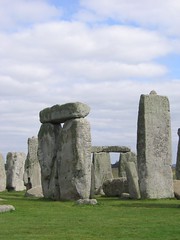
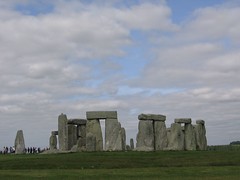
For once, trying to navigate through a herd of stampeding commuters at Waterloo offered something more exciting than another day at the office: I was going against the flow, for a train to Salisbury on a roundabout route to see Stonehenge.

A brisk walk to Salisbury bus station past some inventive gardening left me just enough time to savour the latest hot local news before the bus to Amesbury, the nearest town to Stonehenge. You can get a bus direct, but that just takes you to the car-park and the utilitarian sheds of the visitor centre: I was following a walking route that leads to Stonehenge through its context.

For the best part of a mile around the site, there are barrows (burial mounds) and supposedly ceremonial routes aligned around the stones. The route circles the edge of this gigantic piece of land art, offering distant glimpses of the stones as you climb up and down one set of barrows.

Eventually it leads to the Cursus, an expanse of open land believed to have been an area for ceremonial processions, but on this morning used by a solitary runner and a small group of butterflies, one of whom obligingly rested on a fence post. The land is owned and kept open by the National Trust with clearly marked paths and handy noticeboards explaining the features of the landscape.

At the lowest point of the Cursus, the lie of the land seems to have been used to emphasise a sense of awe when you look up to the stones. The tourist trappings of the final approach now seem a temporary distraction, rather than defining the experience of the stones themselves.

It's the sheer scale, not only of the size of the stones and the effort to erect them, but also of the timescale that impresses.

From the first wooden stakes to its final form, it seems to have taken as long as the timespan from the Romans to us; and it was finished and apparently abandoned almost as long before the Romans came.

All of its construction and use must have been in times when there was no writing, and no history but what was passed on by oral tradition, through a hundred generations - the longest chain of "Chinese whispers" one can imagine. The audio guide passes on some of the more entertaining myths as well as the best suppositions of archaeological investigation: but who knows what changes in concept and understanding, as well as use, of the site there might have been? There must, then as now, have been traditionalists and reformers, visionaries and functionaries, all leaving their mark on how the site was seen and used.

It escapes certainty: passing on, one last look back sees the site almost vanish into the landscape.

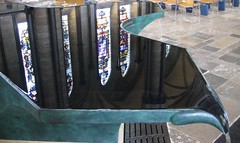
The return route leaves enough time for a quick exploration of Salisbury, where almost every corner seems to be stacked with baskets of flowers, and its Cathedral, which boasts a copy of Magna Carta, and a striking modern cruciform "infinity font". Here everything is defined and explained: would Stonehenge in its prime have had volunteer guides on hand and all the facilities to make the visitor feel welcome?

Monday, 14 September 2009

Artists Formerly Known as Plinth

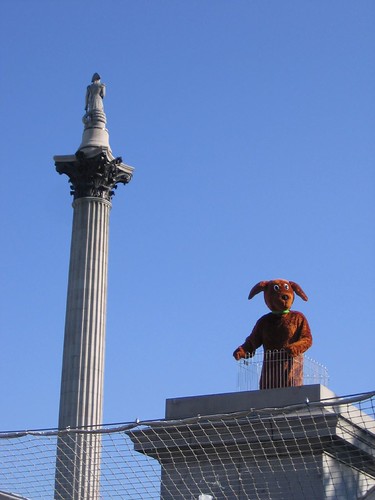
Passing through Trafalgar Square over the weekend reminded me that Antony Gormley's One And Other project for the Fourth Plinth is still going strong.

24 hours a day, people get an hour to do more or less what they like. There have been people sitting and drawing the view, or photographing people photographing them, blowing bubbles, throwing paper planes, presenting some sort of performance art, promoting themselves and their interests in all sorts of ways. The occupant in this photo was protesting about puppy-farming (the photo ought to inspire something about turning a blind eye, but at the moment I can't quite work out what).

You can see what's going on at any time on the project's live video feed, and plenty of people have been posting clips on Youtube. Back in July, one astute swing dance tutor led a large group of his students from the plinth - great publicity for his class, and great fun to watch (sound is a bit variable on this, but clearer in this ground-level view):

Saturday, 12 September 2009

Solutions

Got a Quavers quandary, a pretzel poser, a Twiglets teaser, a flapjack flummox? To get rid of those Cheesy Wotsit worries, you obviously need the people whose van I saw the other day, emblazoned with the strange device "Always Delivering - retail snacking solutions".

It's not new, this habit of advertising not plain vanilla products or services, but "solutions", usually for the most mundane sorts of business. I seem to remember that Private Eye, when I still bothered with it, would occasionally offer some of the more egregious examples. No doubt there's a chemical company somewhere thinking itself mighty witty for offering "solutions solutions".

This is not quite the same as one of the banes of my former life as a middle manager - the return of the bigwigs from some conference or other, fired up with enthusiasm for the latest technological wizardry, the classic solution looking for a problem, which, of course, we would be expected to waste time identifying and "solving" (fortunately, it only mattered for a month or two until the next fad came along).

Nor is it quite the same sort of grade inflation by which, in estate agencies and other bucket shops, hair-gelled spotty herberts and over-mascara-ed peroxide blondes cease to be clerks and sales staff and become "consultants".

This is a bid for power. No more are you an everyday wholesaler among many, trailing round the corner shops like all the rest, waiting for them to tell you what they think they need. As a purveyor of "solutions" you can imply that you are like some new age therapist, the keeper of the munchies mysteries, the shaman of sugar, the high priest of Hula Hoops.

And as for us ordinary customers, the only "retail snacking solution" we need is quite simple: step away from the starch - eat an apple instead.

Saturday, 5 September 2009

Nineteen to the dozen

Thanks to my PVR, I've got a backlog of the kind of old films they show on daytime TV. Recently, I caught up with His Girl Friday (which I don't recall ever having seen all the way through). It makes for an interesting comparison with today's Hollywood offerings: it's static and wordy, revealing its stage-play origins, but by today's standards almost unbelievably articulate.

A plot about an ace reporter trying in vain to settle down into dull domesticity, and enticed by her ex (as a cunning ploy to win her back) into rescuing a man from a politically-driven execution, becomes ever more voluble as the farce gets ever more convoluted. I'm guessing that too many producers nowadays judge that they have to appeal to the lowest common denominator to recoup their costs: the clearest modern comparator to this sort of production would be a TV sitcom, like Spin City.

There are a few moments of purely physical comedy - Rosalind Russell hitches up her skirts to chase a vital witness and (I assume) her stunt double rugby-tackles him to the ground. But as the complications of the farce get ever more frequent and various, there's as much enjoyment in the increasingly breakneck speed of the dialogue as in its content: and you know what? I could make out every word.

In memoriam

Sad news this morning, of the death of Keith Waterhouse, best known for Billy Liar, who also wrote various other unjustly forgotten novels (Office Life, Thinks, Mrs Pooter's Diary), and newspaper column after newspaper column. In the last couple of decades he was writing for the Daily Mail (boo), but once upon a time, he was in the Daily Mirror and wrote its style guide (when it was still a newspaper). I have an old copy of some of his columns from those days - you could read it as a blog before its time, full of incidental items of nostalgia and comic rant.

Take this, for instance:

I have been listening to the wireless again. Not the radio. Not that transistorised plastic matchbox which sings and burps and prattles all day long like a drunken mynah bird, but a real wireless set.

It's a mahogany cabinet the size of a small wardrobe, its loudspeaker is framed by a fretwork fleur-de-lis, and it has strange stations on the dial like Daventry, Hilversum, Zagreb and Paris (Eiffel Tower).


or

A somewhat bohemian character of my acquaintance was plucked out of his garret in deepest Soho and hurried to the suburban bedside of his father, who was gravely ill.

As he tiptoed into the sick-room the old man opened his eyes, beckoned his son closer, uttered these immortal last words:
'When are you going to get your bleeding hair cut?'

Then he sank back into the pillows and quietly expired. It was, my friend reports, a most moving farewell.

Monday, 31 August 2009

Meanderings

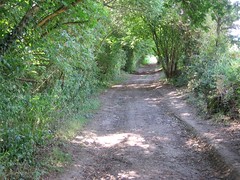
Inertia has a lot to answer for, in my case, not that it (or I) can usually be bothered to. I won't tell you how many cookery books and magazine recipes I have yet to put into practice; and it's much the same with me and guidebooks to walks within a commuter's train ride out of central London. I have a nice collection, of which I suppose I have done three or four walks.

Having some days off, and no plans, I thought I really ought to make some use of my boots. Arriving at Penshurst station, the clouds were looking more than a bit funereal, but I was brought up in the spirit of "I brought you all this way to enjoy yourself, now get on with it", so off I set.

It's amazing how, within a few yards of the railway station and a village centre clogged with cars, a few yards into a field took me into such quiet that all I could hear was my own breathing. Even a model plane performing acrobatics some fields away made no sound.

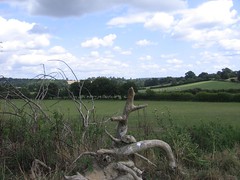
This is the gentle landscape of many a picture book, with undemanding ups and downs (nothing too strenuous for me) and docile cattle and sheep ignoring any passer-by, and even a fearsome-looking cockerel deciding I was no great threat to his plump and fluffy harem.

The route passed through Chiddingstone, a single street of Tudor cottages, the entire village now owned by the National Trust (and couldn't one tell: the backyard restaurant where I had a sandwich lunch had Radio 3 for its muzak), a church with a "vinegar bible" and plaques recording that one local family lost their elder son in the Boer War and the younger in the First World War. The village also has its "Chiding Stone", a rocky outcrop possibly - or possibly not - used as a place to reprimand local wrongdoers: someone had thrust a bouquet of flowers into the fence around it, like those impromptu shrines one sees at the site of road-accidents, so perhaps it has some special local significance still.

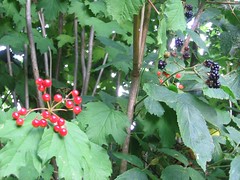
Along the way there were plenty of signs of the seasons about to turn, although the wetness of the summer has left everything lushly green.

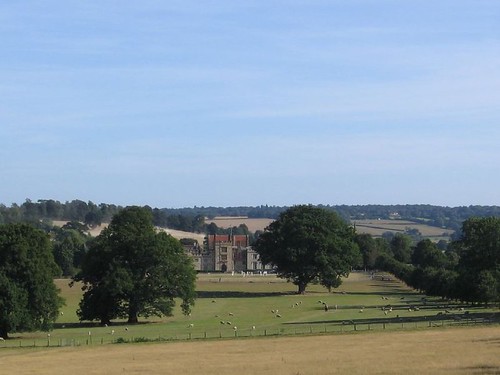
Eventually, the route arrives at Penshurst village, with more higgledy-piggledy Tudor houses round the church. Presumably it's miles from the station of the same name because the resident bigwigs didn't want the railway line too near their stately home: Penshurst Place.

This is a handsome old house, home to Sir Philip Sidney, one of the stars of Elizabeth I's court, but also much quoted as a moral example in the inherited Victorian books I grew up with. There's an impressive mediaeval hall and the usual complement of long gallery and ancestral portraits - many others in the family have been in court and public service over the generations, which is one reason why one of the gardens recreates the Union Flag in roses and lavender.

It is, of course, practically the law that a stately home sells cream teas, so that was some welcome extra fortification for the walk back to the station, past a reminder of more recent troubled times, and with one last, classic view - of a cricket match:

Tuesday, 25 August 2009

But which way will it crumble?

In among the chocolate chip, oatmeal and raisin, raspberry and white choc and other carbohydrate feasts at the refreshment stall was this monster.

Leaving aside the fact that it's not a Michelin-starred dinner or a romantic weekend in Venice, it's a big biscuit (and a broken one at that) - what on earth would you do with it if the answer was no?

Friday, 21 August 2009

The joy of ukelele

Every season of the Proms has its memorable concerts - and they're not all of the grand classical repertoire.

Topping the list of requests to BBC's i-Player replay service this week has been a late night concert by the Ukelele Orchestra of Great Britain. For 25 years, they have been exploring the humour in the sight of a line-up of people dressed like a rather formal 1920s concert party strumming (and singing) their way through a range of pop and rock classics, with some mix and match.
This must have been the first Prom to feature a Sex Pistols number, and a man who looks a bit like your bank manager performing Kate Bush's Wuthering Heights - with the audience shouting "Heathcliff!" at appropriate moments. One audience member stole a laugh by recalling (at some reference to rock) a folkie's famous rebuke to Bob Dylan for turning to an electric guitar 40 years ago, and shouting "Judas!".

But what caused the most stir was some more serious audience participation. Nigh on a thousand people brought their own ukeleles for a mass performance of Beethoven's Ode to Joy theme, with the UOGB providing harmonies and descants: and some audience members sang along (in German too). All very jolly, all the more remarkable that it was happening at nearly eleven on a sweltering night - and rather moving too. Joy indeed:


History - writ in sand

I've never been a fan of TV talent shows. Even if they're run in the kindest way possible (some hopes), there's a lot of ho-hum and why bother acts before you get to someone you would pay to see again.

I don't doubt the Ukraine's equivalent has its fair share of Whitney-wannabees, but they seem to let their cultural boundaries stretch that bit more. This is - well, judge for yourself:

Friday, 14 August 2009

And breathe......

This week, I've been both amused and amazed by the way the healthcare reform debate in the US seems to have branched out into absurd stories about the National Health Service.

This may be because the loonies don't need a dictionary to misunderstand the NHS, unlike other European systems that that provide universal care through insurance, at lower cost and higher efficiency and effectiveness.

Or it may suit the more machiavellian among them to face a furious blacklash from this side of the water, if it enables them to dismiss any reform proposals as being like the system defended by people with snooty accents, bad teeth and attitood (though, as it turns out, there are plenty of American expatriates willing to tell the truth).

As I understand it, there's little if anything in any of the proposals before Congress that approach the idea of a single payer, let alone a single delivery system, for healthcare in the US. I doubt if it would be possible in such a large, diverse and individualistic country. We tend to forget that the NHS is very much of its time, founded as it was at the high point of belief in community spirit and collective action through the state to achieve common ends. That, after all, was what was believed to have won the war. But the neocons' target audience wouldn't be aware that all this is not new: Churchill's first speech in the 1945 general election campaign claimed that a Labour government - people he'd worked in coalition with for the previous five years - would need a Gestapo to carry through policies like creating the NHS.

As the dust settles a little, what has really struck me is how so many of the comments from this side of the water see this as more than just a series of mistakes or political exaggerations: people are taking it as an insult both personal and national - our very sense of ourselves has been injured. It's as though the neocons have been taking pot-shots at Lassie and spitting at the Queen. In the long history of reciprocal misunderstanding, this feels like something of a watershed: perhaps de Gaulle had a point.

Friday, 7 August 2009

You couldn't make it up...

Ploughing seriously through the analysis of the Government's potential fiscal crisis, whither Iran? and the like in this month's Prospect, I am intrigued to learn that one of the more obscure cable TV channels that specialises in Things That Go Bump In The Night is apparently planning to bring us a programme from America about a short psychic.

It's called Small Medium At Large.

And she really exists.