There's a small flurry of excitement about the launch of the new series of the Danish crime series The Killing ("this time, she's got a new jumper!").
Apart from the whole question of why we enjoy watching so much misery played out, I'm struck by the commissioners' anxiety about the acceptability of subtitles. I'm wondering how many people have to use them even for English-language films and programmes, now that a naturalistic sound ambience and styles of acting and [in]articulation can make it difficult to make out what someone's saying. I had to use them all the time for The Wire, and even occasionally for homegrown drama. (And no, it's not my ears: try listening to any replays of old programmes made in dead studio sound, or to His Girl Friday, of 1939, and see how they still manage to get the dialogue across, the faster and more manic it gets towards the end).
If there's a problem with subtitles, it's when you do have some knowledge of the original language, but not quite enough to keep up, especially if it's full of slang delivered at speed - as for example in Spiral (Engrenages in the original French), which also filled the same "cult" slot on BBC4.
I'm forever trying to translate back from what I'm reading to what I've heard, which tends to distract from following the plot, even if it does add to my knowledge of French police procedure and criminal jargon (let's hope there's no need for that to come in handy next time I go). Even in other languages, there's a temptation to pick out odd bits and pieces: the way Sarah Lund referred to her CV left me wondering whether what we think of in English as "estuary" vowels might actually be a relic of the Angles and Vikings all those centuries ago.
Saturday, 19 November 2011


Wednesday, 16 November 2011
Reporting back
The gooseberry chutney I made in August is edible, indeed more than acceptable with a nice bit of cheese or cold chicken. There's definitely a tang of an acidity that isn't the vinegar, though my worn-out tastebuds couldn't confidently identify it as gooseberry flavour. It still looks an unfortunate colour and texture, and a punnet of gooseberries doesn't actually boil down to much finished product, so I'm not sure it was worth the effort. Or not as much as the jam. Perhaps it needed some apples to bulk it out.
Likewise, though the Blessed Delia's recipe for creme caramel comes up a treat, I had to wonder, when contemplating the washing up, if is it so much better than shop-bought.
Likewise, though the Blessed Delia's recipe for creme caramel comes up a treat, I had to wonder, when contemplating the washing up, if is it so much better than shop-bought.
Sunday, 13 November 2011
An hour and a half
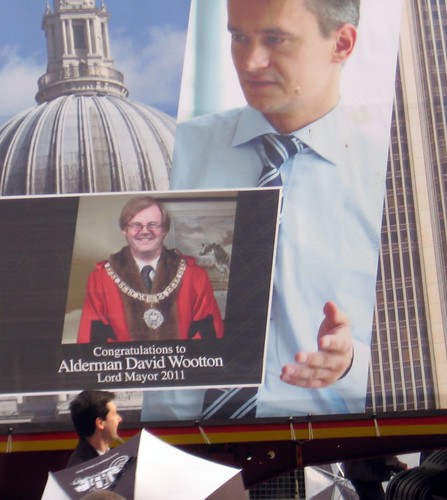 That's how long I was perched on a narrow, downward-sloping ledge with one arm hooked round the railings at the back of St Paul's Cathedral churchyard, to get the best view of the Lord Mayor's Show yesterday. That's how long it took for the procession to pass.
It was the usual mix of community carnival, commercial advertising opportunity, and civic pomp and heritage, to mark the inauguration of next year's Lord Mayor. The presence, round the other side of St Paul's, of the occupation protest didn't in the event have any effect, despite their raising some pertinent points about the City's status as part local authority, part private corporation controlled by business interests. A free show's a free show, and, as it has for centuries past, this Show provided a distraction from any awkward questions of that kind.
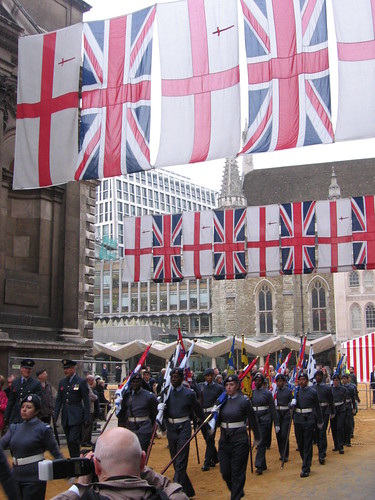 Every organisation the new Lord Mayor is connected to, along with the livery companies of the City, any military or community organisation that can claim a connection with the City, and commercial organisations that can pay to be represented, all put their floats and marching bands into the charivari. So slipped in alongside the various units of the Army, Navy and Air Force, every kind of youth and community organisation you can think of, there were striking displays from Hong Kong, the Philippines, Pimlico Plumbers ............. and Stoke-on-Trent.
Eventually we got to the civic dignitaries, with their attendant liveried watermen, and finally the cavalry, lent by the Queen, and the Lord Mayor's State Coach with a cheery wave from the man himself. They say you know you're getting old when the policemen look as though they're barely out of school; but when the Lord Mayor of London looks as though his mum should have packed him off for a proper haircut.........
The procession ends with the Trained Bands, a reminder of the days when London stood against the monarch in the Civil War, and clung (as it did from the days of Magna Carta onwards and symbolically at least still does) to its independence. The protesters will have their work cut out.
Endurance is the name of the game for the Show: having made the procession down to the Royal Courts of Justice for the formal ceremonies, and after a break for lunch, they have to process all the way back again (by another route, for maximum exposure). Coming out of the Museum of London a couple of hours later, I found bands and floats dispersing in all directions, with time to stop and chat, pose for photographs, tend to the horses and rest the weary feet. One young band was so relieved to be finished, their leader marched them smartly out of Guildhall yard, straight at a mounted policewoman who was - to judge by her language - rather more shocked than her horse.
Friday, 11 November 2011
It's all been said..
http://autolycus-london.blogspot.com/2008/08/lest-we-forget.html
There's a reason for two minutes' silence.
There's a reason for two minutes' silence.
Wednesday, 9 November 2011
Never a dull moment
With the Olympics on the way, Canary Wharf seems to developing a sporty theme this week: two book signings by sports personalities, and today (no doubt an awareness-raising event for the Paralympics - though the lunchtime throng looked to be more interested in setting new speed records for getting to their sandwiches and sushi), a demonstration of sitting volleyball:
Tuesday, 8 November 2011
More visitors
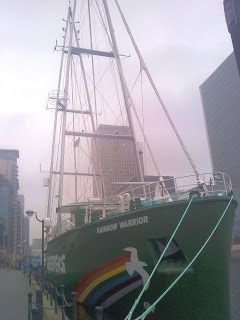
Not a day that would make you think of rainbows, but when my eye was caught by an unusual pair of masts at Canary Wharf, they turned out to belong to the Rainbow Warrior:

Saturday, 5 November 2011
It's that time of year again
Some might harrumph at council tax going up in smoke, but if it saves the cost of accidents at fireworks parties in homes, it'll be worth it. And it was a good show - and within walking distance.
Wednesday, 26 October 2011
Interior omphalomancy
Or... navel-gazing from the inside. Which is by way of explaining the fetching photos of my innards I was given yesterday afternoon, my doctor having decided that thorough investigation of my recent indigestion required an endoscopy.
Not an experience anyone would want to repeat (unless they're really peculiar), but not as bad it might have been - I was in and out within the hour. And the upshot appears to be that there's nothing that requires treatment beyond carrying on with the pills (or, in the words they've managed to avoid saying, just something one has to expect with increasing years).
I did think it might be a good omen that, when I arrived, the TV in the waiting room was showing Brief Encounter.
Less so, perhaps, the way someone in the waiting room tried to explain to a nurse that his daughter's sleepiness might not just be down to her sedative:
"She's got slight necrophilia".
Not an experience anyone would want to repeat (unless they're really peculiar), but not as bad it might have been - I was in and out within the hour. And the upshot appears to be that there's nothing that requires treatment beyond carrying on with the pills (or, in the words they've managed to avoid saying, just something one has to expect with increasing years).
I did think it might be a good omen that, when I arrived, the TV in the waiting room was showing Brief Encounter.
Less so, perhaps, the way someone in the waiting room tried to explain to a nurse that his daughter's sleepiness might not just be down to her sedative:
"She's got slight necrophilia".
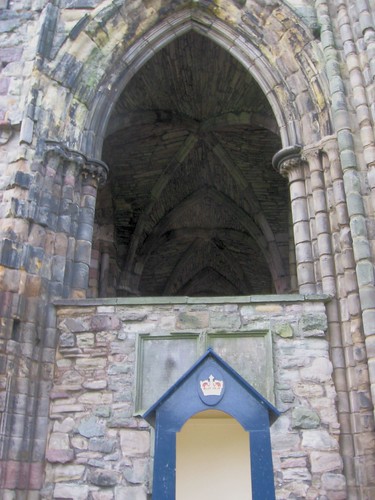
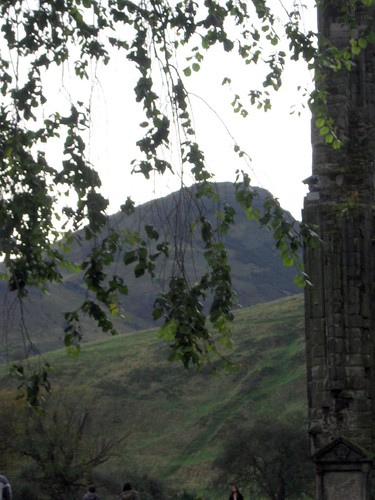
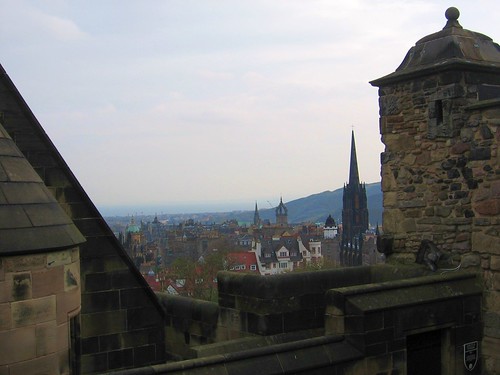
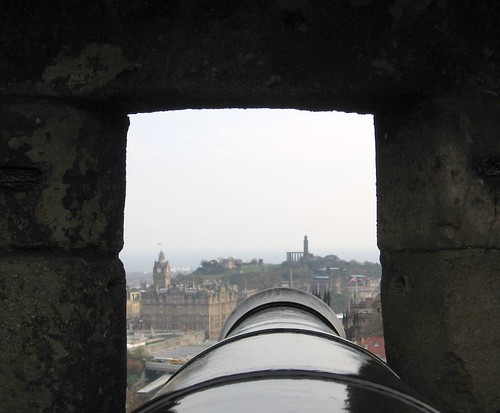
Edinburgh again

Saturday, 22 October 2011
Dundee
Dundee doesn't exactly spring to mind as a tourist destination, but the lure of family history drew my sister-in-law to investigate life in the jute industry, so there we went: and the trip turned out to be well worth while.
First to the Verdant Works, whose name belies the noise and unhealthy working conditions of Victorian jute processing, but whose contents outlined both the industrial processes and their social context and consequences.
One such was a sort of female emancipation (despite the demanding disciplines of the work), since it was women workers who, commanding less pay than adult men, predominated in the factories, and often the men who stayed at home and became "kettle-biler" househusbands.
 Another was the immense wealth of the "jute barons", fed back into examples of civic pride and improvement, amongst them the other surprise of this trip, the McManus Gallery. Here local history (back even to the prehistory of the Picts), improving tributes to the local great and good such as the missionary Mary Slessor, combine with art collections, not on a big scale, but with enough variety and welcome to draw in the visitor and stimulate the mind.
How many other such institutions start with a gallery asking the visitor to consider, with various examples of the things they work with, "What is a museum?".
 Passing on, by a statue commemorating yet another product for which Dundee is famous, we came down to the waterfront, where Captain Scott's Discovery is open to visit (we didn't), guarded by these unusual-looking bollards.
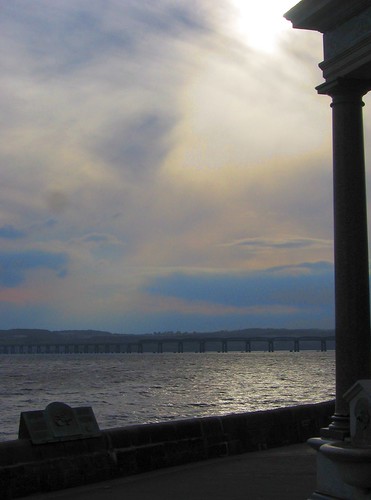
From here one can see the long expanse of the railway bridge, not perhaps as beautiful as the first such bridge here, but more longlasting as it straddles the Tay (which is still silvery):

First to the Verdant Works, whose name belies the noise and unhealthy working conditions of Victorian jute processing, but whose contents outlined both the industrial processes and their social context and consequences.
One such was a sort of female emancipation (despite the demanding disciplines of the work), since it was women workers who, commanding less pay than adult men, predominated in the factories, and often the men who stayed at home and became "kettle-biler" househusbands.
 Another was the immense wealth of the "jute barons", fed back into examples of civic pride and improvement, amongst them the other surprise of this trip, the McManus Gallery. Here local history (back even to the prehistory of the Picts), improving tributes to the local great and good such as the missionary Mary Slessor, combine with art collections, not on a big scale, but with enough variety and welcome to draw in the visitor and stimulate the mind.
 How many other such institutions start with a gallery asking the visitor to consider, with various examples of the things they work with, "What is a museum?".
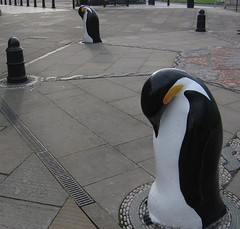 Passing on, by a statue commemorating yet another product for which Dundee is famous, we came down to the waterfront, where Captain Scott's Discovery is open to visit (we didn't), guarded by these unusual-looking bollards.
From here one can see the long expanse of the railway bridge, not perhaps as beautiful as the first such bridge here, but more longlasting as it straddles the Tay (which is still silvery):
Friday, 21 October 2011
A weekend in Edinburgh
 For a Londoner born and bred, it would be a bit hypocritical to make a great deal of my Scottish ancestors. I have been to Edinburgh plenty of times to find out more about them (and for what it's worth, as is no doubt statistically probable with most people, there is much more geographical and ethnic diversity the further back you go, of which more later); so while my sister-in-law looked up her family history this weekend, my brother and I went along just to visit.
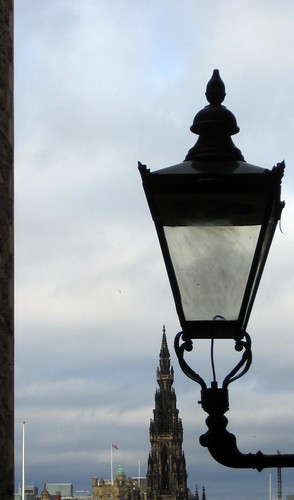
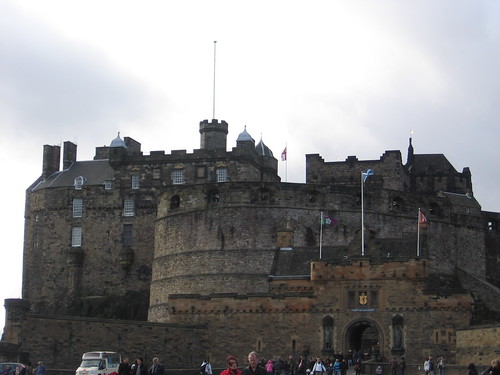
 After I arrived there was time for a lung-stretching stroll up, round and down a bleakly wet Calton Hill for its perspective over Edinburgh city centre before meeting their train, and an evening stroll to catch a view of the Castle by night:

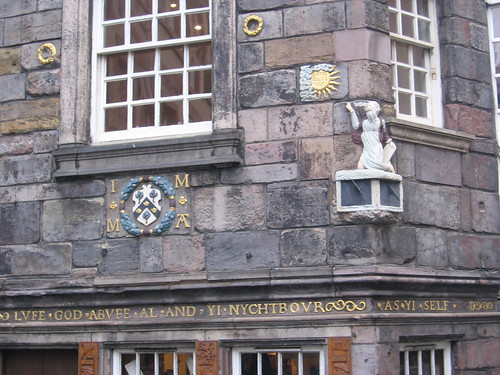
Friday saw us checking out the Surgeons' Hall museum: not just body parts in bottles, but an overview of the development of surgical techniques, with a detour to explore the origins of Sherlock Holmes, and a chance to test your skills at manipulating remotely-controlled instruments. Fortunately I already known I can never get the teddy bear in those things on seaside piers, so there'd be no chance of my killing someone trying to do a similar job in surgery. Then we stretched our leg muscles down the Royal Mile and up again, calling in at the Parliament for coffee (the Debating Chamber wasn't in use, so visitors could walk in, admire its light and functional interior - and note that, if debates become too heated, the Presiding Officer has a fire extinguisher within easy reach), peering down narrow closes (and discovering the charming Dunbars Close Garden), stopping off to visit St Giles's Cathedral, the Writers' Museum and a very windswept Castle Esplanade. A chance glance at the posters outside the Canongate church revealed a concert that night by the Kammerchor Chemnitz and an Edinburgh University choir, which turned out to be an unexpected treat.
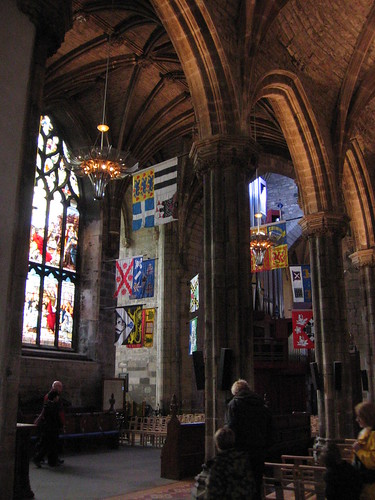
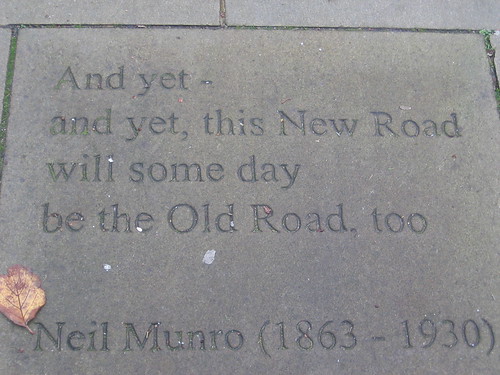
Tuesday, 11 October 2011
Not so recent history
 A week gone since the 75th anniversary of the Battle of Cable St, and more than that since Wilton's Music Hall had a weekend of commemorative events to mark the anniversary. [I've had a cold and the dog ate my blogging kit - well, that's my excuse].
Nowadays, Cable St is a quiet side-street, almost entirely lined with housing estates and best-known as one of the few cycle lanes that approaches continental standards: hardly a battleground. But in October 1936, a planned Fascist march into the heart of the East End was halted by crowds of residents, backed up by barricaded streets. In those days, it was still legal to dress up in military-style uniforms for a deliberate act of coat-trailing through an area with a strong Jewish and trade union population. So, even though the BUF was known to chant anti-Semitic slogans, and even gloried in violence against their opponents, the march had not been banned, despite requests from the local councils, and the police were deployed to try to clear the street. Hence the battle. The residents kept this up until late afternoon, at which point the Police Commissioner advised Oswald Mosley, the Fascist leader, to give up the attempt: so off they went to march along the Embankment while there was still some daylight. So much for Mosley's attempt to be a Man of Destiny, and the Great Leader like his continental models; if he'd ever represented anything significant, he didn't now.
There's a permanent commemoration in the mural on the side of St George's Town Hall, a little further down Cable St, which is reproduced on the poster above for the weekend's events. Wilton's air of slightly melancholic delapidation seemed to suit its nostalgic elements, with its exhibition on the British and Irish contribution to the International Brigade in the Spanish Civil War (in its opening stages in the autumn of 1936), reproduction posters from Spain to accompany the 19th century Indian dancers on its crumbling walls, historical documentary rehashing the old debates between the local and national left-wing parties about how to deal with the Fascists, talks on the literature and performances of the music of the period. Outside in the sudden late hot spell, the alleyway hosted a few stalls for various leftwing and community causes, with the compulsory jazz band. I'm assuming the man with the tray of "Fairly Fresh Fish" (that suddenly sprang into mechanical life when approached by the unwary) was there to entertain.
There were talks, films and exhibitions on present-day Cable St, and its challenges too, not least the latest incarnation of the resentments that fed the BUF. Are such bullies deterred, or encouraged in their pre-emptive sense of grievance and martyrdom that they direct against "the other", by being banned, or by being confronted and chased away?


Wednesday, 5 October 2011
Belgium invades!
Being a bit slow on the uptake this week (that hot weather managed to bring a cold with it, can you imagine), it's taken me until now to react to the startling news that Belgians have taken over British territory, albeit temporarily.
I can't think why (though I suppose the absence of a government in Belgium let them think they didn't need permission) It isn't as though there's a brewery or a chippy there. It's not called Rockall for nothing.
I can't think why (though I suppose the absence of a government in Belgium let them think they didn't need permission) It isn't as though there's a brewery or a chippy there. It's not called Rockall for nothing.
Sunday, 2 October 2011

Friday, 30 September 2011


Tuesday, 27 September 2011
Moving Planet
 This is a picture of one of many eye-catching stunts dreamed up around the world last Saturday for Moving Planet. Rehearsals for the "bike" were well under way by the time I got away from my Saturday chores to make my way up to Haggerston Park, but eventually we latecomers made up the numbers, lining up along the banner.
That left me time to wander around taking photos of all the action (and, as is the way of such events, inaction, since the organisers had been efficient enough to get all their photos taken before the press arrived, and everyone had to wait a while before doing it all again).
The end result may not have been as spectacular as Melbourne's; and one has to admit that, actually, bikes do need a bit of oil to keep moving (not to mention the fossil fuels involved in manufacturing them and getting them to market, since so many like mine were made in Asia); but people got to make a bit of noise and a point, of sorts. The odd thing is, there don't seem to be any aerial videos of the "wheels" going round, so you'll have to imagine it from mine.
Oh, and I got a puncture on the way home. Heigh ho.
Tuesday, 20 September 2011
Serendipity
Or, things that happen by chance. One sunny day last week invited a bike ride, so off I set to the Victoria and Albert Museum (of which more later), through the parks wherever possible - a route that I had quite forgotten goes past the Serpentine Gallery and its pavilion, which had still been building last time I was that way.

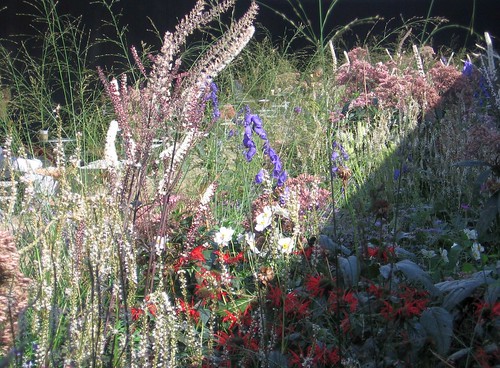
 A forbidding and closed-looking exterior takes you into a dark and even more depressing corridor, from which there is access to a cloistered garden that might have been there for a thousand, or even two thousand, years (such is its mediaeval, or even Roman, feel), instead of barely few months. This is "Hortus conclusus" by Peter Zumthor. Nothing remarkable about the plants or layout, perhaps, but all the more peaceful a sanctuary for the dramatic contrast of the fact of its enclosure - and of the fact that, like all the previous pavilions, it's purely temporary:


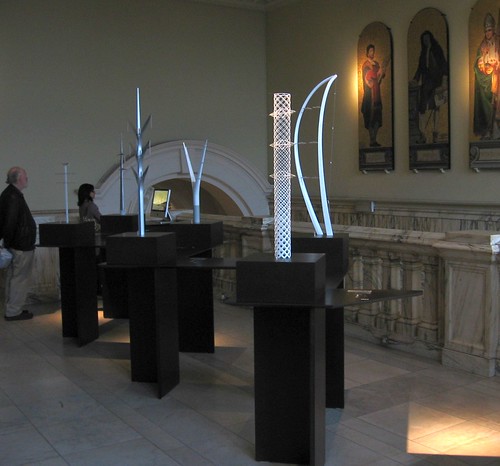
Back to modernity and industry for the visit to the V&A, which was prompted by a news piece about a competition to find a new standard design of electricity pylon. The shortlisted proposals were rather tucked away on a landing upstairs. You might, by the way, think that anything would be better than the great Stalinist robots that currently march across the countryside, but the glumness of the people watching a computer simulation of those that didn't make the shortlist tells you they could be much, much worse. No doubt there are all sorts of technical and cost considerations that outweigh the aesthetic, but I thought the "Y pylon" was a clear winner, for sheer simplicity. You can make your own mind up.

Serendipity might as well be the V&A's alternative title. It was the place to come for surprises on a wet day in the school holidays: you might think you wanted to look at one thing, but it's so easy to take a wrong turning and find yourself moving from stained glass to metalwork to Buddhist sculpture to musical instruments. This time, the pylon competition turned out to be a minor part of the Museum's contribution to London Design Week. On the ground floor is "Power of Making", all about new developments in craft and skill as new technologies and markets develop. Here there were bicycles in mahogany, or nylon, or covered in Swarovski crystals, a surfboard based a cardboard frame, a Polish lace manufacturer's sideline (to its usual Church vestments) in skimpy undies (presumably for a different market), various sorts of wacky furniture and a thought-provoking demonstration of 3D printers. These can create any computer-based design in plastic: as they get cheaper and more sophisticated, how soon will it be before you can have customised designs of whatever you can imagine run up in a local high street printshop?.
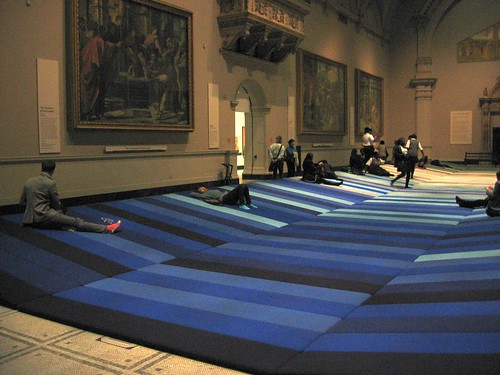
After all that, what better than a relaxing new way to contemplate the Raphael Cartoons, courtesy of this installation for Design Week:

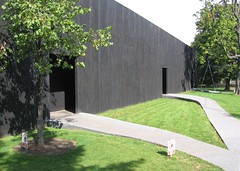
 A forbidding and closed-looking exterior takes you into a dark and even more depressing corridor, from which there is access to a cloistered garden that might have been there for a thousand, or even two thousand, years (such is its mediaeval, or even Roman, feel), instead of barely few months. This is "Hortus conclusus" by Peter Zumthor. Nothing remarkable about the plants or layout, perhaps, but all the more peaceful a sanctuary for the dramatic contrast of the fact of its enclosure - and of the fact that, like all the previous pavilions, it's purely temporary:
Back to modernity and industry for the visit to the V&A, which was prompted by a news piece about a competition to find a new standard design of electricity pylon. The shortlisted proposals were rather tucked away on a landing upstairs. You might, by the way, think that anything would be better than the great Stalinist robots that currently march across the countryside, but the glumness of the people watching a computer simulation of those that didn't make the shortlist tells you they could be much, much worse. No doubt there are all sorts of technical and cost considerations that outweigh the aesthetic, but I thought the "Y pylon" was a clear winner, for sheer simplicity. You can make your own mind up.
Serendipity might as well be the V&A's alternative title. It was the place to come for surprises on a wet day in the school holidays: you might think you wanted to look at one thing, but it's so easy to take a wrong turning and find yourself moving from stained glass to metalwork to Buddhist sculpture to musical instruments. This time, the pylon competition turned out to be a minor part of the Museum's contribution to London Design Week. On the ground floor is "Power of Making", all about new developments in craft and skill as new technologies and markets develop. Here there were bicycles in mahogany, or nylon, or covered in Swarovski crystals, a surfboard based a cardboard frame, a Polish lace manufacturer's sideline (to its usual Church vestments) in skimpy undies (presumably for a different market), various sorts of wacky furniture and a thought-provoking demonstration of 3D printers. These can create any computer-based design in plastic: as they get cheaper and more sophisticated, how soon will it be before you can have customised designs of whatever you can imagine run up in a local high street printshop?.
After all that, what better than a relaxing new way to contemplate the Raphael Cartoons, courtesy of this installation for Design Week:
Saturday, 17 September 2011
Another of life's little embarrassments
What is the world coming to, when you remember the name of your neighbour's dog but not of the neighbour?
Thursday, 15 September 2011
What a gent
 Mildly narked by the presentational changes to Radio 3 this week, I emailed their Breakfast programme to suggest that reminding us of the news headlines barely fifteen minutes after the half-hourly bulletin was a bit too like the doom-and-gloom of a Radio 4 morning for a predominantly music and arts channel. Within minutes (even before their auto-reply), Petroc Trelawny himself emailed, promising to make sure the producers considered it.
 Now, how do we get them to drop the "classical charts" stuff?
Monday, 12 September 2011

Subscribe to:
Posts (Atom)