There, that's got your attention hasn't it?
This morning, I woke to find the carpet outside my airing cupboard completely sodden, and water leaking from somewhere: and then I found my insurance policy didn't cover emergency call-outs.
Boo.
But then, having bitten the bullet and called out an emergency plumber, I found the water was coming from the flat next door, so I could claim the cost against someone else's insurance policy.
Hooray.
But it still cost £183, just for the plumber to come and check it all out.
So I must remember in future to check the details on the insurance policy before I renew it; and instead of writing about interesting things happening in London this weekend, I shall be laundering towels.
Sunday, 25 November 2007


Saturday, 24 November 2007
Conundrums
 1: Why do ducks sleep on one leg?
To have one still functioning if anything happens to the one they're standing on?
2. Why am I always taken by surprise when the Christmas shopping season starts?
 This was the queue for Santa's first day at Canary Wharf this morning.
So far, so enlivening. But in the afternoon, I went up to town, planning to visit the reopened Transport Museum, and with a couple of mundane items to buy.
So why was I surprised to find as long a queue waiting to get into the museum? Why was I surprised not to find around Covent Garden a place selling simple clip frames (because there's nowhere within half an hour's travel to buy a bit of glass to replace something broken - much easier to buy a whole new frame that's come all the way from China: this is called progress) and a bit of Blu-tak?
And why is it that walking through all those crowds turns me into an exhausted combination of Scrooge and Eeyore?
And why does a cup of tea make all the difference?
Friday, 23 November 2007
Words, words, words...
Apparently, some words of mine sent Claude to her dictionary.
As it happens, I've been trying to read some Fred Vargas that I bought on a previous trip to France. No chance of reading it on the train*, I'm afraid, as I find almost every page contains something to send me off to my huge Robert - accastillage, baffe, mettre en boule, plastron, bousiller (she likes that word, does our Ms Vargas), crânement.......
Proof once more that when it comes to languages, there really is no substitute for just doing it, over and over again.
The book's just introduced the idea of a Breton village crier - Ar Bannour - whose voice can carry from the church to the wash-house. The first is an obvious title for a blog: but then the second might better reflect the reality of a lot....
*There was a man on the tube this morning reading a book by an author with a Turkish-looking name, and a title that looked like no language I could recognise; I guessed Albanian - but then he pulled out of his bag a Kurdish dictionary. That's London for you.
As it happens, I've been trying to read some Fred Vargas that I bought on a previous trip to France. No chance of reading it on the train*, I'm afraid, as I find almost every page contains something to send me off to my huge Robert - accastillage, baffe, mettre en boule, plastron, bousiller (she likes that word, does our Ms Vargas), crânement.......
Proof once more that when it comes to languages, there really is no substitute for just doing it, over and over again.
The book's just introduced the idea of a Breton village crier - Ar Bannour - whose voice can carry from the church to the wash-house. The first is an obvious title for a blog: but then the second might better reflect the reality of a lot....
*There was a man on the tube this morning reading a book by an author with a Turkish-looking name, and a title that looked like no language I could recognise; I guessed Albanian - but then he pulled out of his bag a Kurdish dictionary. That's London for you.
Tuesday, 20 November 2007
Reading a book?
Hearing someone say (I hope as a joke) that they haven't read a book in a year reminded me of one of my favourite comic film moments, from Dinner at Eight, where a gangster's moll (Jean Harlow) accompanies him to a society dinner and makes polite conversation with a "stately galleon" of a hostess (Marie Dressler) about a book she's been reading.
I remember still the delight with which, twenty-odd years ago, a very camp friend of mine acted out the comedic exaggeration of Marie Dressler's reaction. Trying to describe it in words, at third hand, would be one of those "you had to be there" moments. It was months before I got an opportunity to see the original - but now, thanks to the wonders of YouTube, I can save you a tortuous description with just a finger-click:
I remember still the delight with which, twenty-odd years ago, a very camp friend of mine acted out the comedic exaggeration of Marie Dressler's reaction. Trying to describe it in words, at third hand, would be one of those "you had to be there" moments. It was months before I got an opportunity to see the original - but now, thanks to the wonders of YouTube, I can save you a tortuous description with just a finger-click:
Saturday, 17 November 2007
Where I'm from
I've been wondering whether this blog really has a "voice", or any sort of online personality. A bit of digging suggests people visit because they're interested in the individual events and places I write about; it doesn't look as though visitors feel they require any comment - apart from Daphne (who was obviously brought up proper, and kindly acknowledges my all-too-feeble comments on her blog).
It comes of years of bureaucratic writing. I occasionally slipped a sly joke into para 34 of some committee paper or report (one way of checking whether anyone read it), but on the whole, anything I wrote had to get to the point and summarise facts and arguments as concisely and non-controversially as possible.
So when it comes to writing anything really personal, I welcome the idea of filling in this form - the link to which I picked up from Claude's English blog (now there's discipline - to be able to write blogs in two languages, and make them both interesting, as she does).
Forms I can do. Forms I understand. Heaven knows, I had to construct enough in my time. You wouldn't believe, for example, how difficult it is to collect people's names, given all the different naming conventions and systems. "Christian name" is obviously meaningless in large parts of the world, "surname" seems to be a particularly British usage, "first name" and "last name" have completely different significances in Anglo-Saxon and Chinese cultures, some people still have purely patronymic systems, some people simply use one name, and so on. I felt like giving up when I tried "family name" one year and an American student put in "Bud".
But that's by the by.
Here goes:
I am from mincers, mangles and apple-coring gadgets, from Bemax (ugh) and extract of malt (yum).
I am from a tall, narrow Victorian house, where every move from room to room taught me to plan (never go up or downstairs empty-handed; take what you'll need for the next few hours, or you'll be dashing up and down those cold stairs and landings).
I am from the candle-flowered chestnut tree and a resident blackbird, its summer afternoon song and evening alarm call; from the smell of the flowers on the lime-tree several gardens away; and from the rolling Thames.
I am from fossicking in junk-shops, from music, shouting and sulking.
I am from make-do and mend, never throwing away something that "might come in useful", be it string, brown paper, clothes or the remains of the air-raid shelter.
From learning not to fear the wasps with yellow stripes on black, only those with black stripes on yellow, and concentrating on telling the difference.
I am from somewhere between Congregationalists, Baptists and the low Church of England: conscience comes before pings and pongs; and now I'm the kind of atheist that most irritates the faithful, that tuts over the modern prayer book and watches "Songs of Praise" shouting "Wrong tune! Wrong tune!".
I'm from London, via Edinburgh, South Shields, Kent, Cornwall and Suffolk; from my mother's Queen of Puddings, and my father's beloved pease pudding (once he made it in a pressure-cooker and took off the lid before the pressure).
From the stories of my father's time working as a prisoner of war in German railway yards and a Polish coalmine (which records suggest may have been a much darker experience than he ever told); from a father who barely remembered his father or brother who died in the First World War, and grew up in a household of forceful women, and a mother who, as the only child of the oldest daughter, kept up with cousins and aunts in every continent.
I am from five red ring-binders, full of photocopied certificates and register entries that help identify photographs from the 1860s onwards - and a box full of the unidentified, mysteries to be pursued.
It comes of years of bureaucratic writing. I occasionally slipped a sly joke into para 34 of some committee paper or report (one way of checking whether anyone read it), but on the whole, anything I wrote had to get to the point and summarise facts and arguments as concisely and non-controversially as possible.
So when it comes to writing anything really personal, I welcome the idea of filling in this form - the link to which I picked up from Claude's English blog (now there's discipline - to be able to write blogs in two languages, and make them both interesting, as she does).
Forms I can do. Forms I understand. Heaven knows, I had to construct enough in my time. You wouldn't believe, for example, how difficult it is to collect people's names, given all the different naming conventions and systems. "Christian name" is obviously meaningless in large parts of the world, "surname" seems to be a particularly British usage, "first name" and "last name" have completely different significances in Anglo-Saxon and Chinese cultures, some people still have purely patronymic systems, some people simply use one name, and so on. I felt like giving up when I tried "family name" one year and an American student put in "Bud".
But that's by the by.
Here goes:
I am from mincers, mangles and apple-coring gadgets, from Bemax (ugh) and extract of malt (yum).
I am from a tall, narrow Victorian house, where every move from room to room taught me to plan (never go up or downstairs empty-handed; take what you'll need for the next few hours, or you'll be dashing up and down those cold stairs and landings).
I am from the candle-flowered chestnut tree and a resident blackbird, its summer afternoon song and evening alarm call; from the smell of the flowers on the lime-tree several gardens away; and from the rolling Thames.
I am from fossicking in junk-shops, from music, shouting and sulking.
I am from make-do and mend, never throwing away something that "might come in useful", be it string, brown paper, clothes or the remains of the air-raid shelter.
From learning not to fear the wasps with yellow stripes on black, only those with black stripes on yellow, and concentrating on telling the difference.
I am from somewhere between Congregationalists, Baptists and the low Church of England: conscience comes before pings and pongs; and now I'm the kind of atheist that most irritates the faithful, that tuts over the modern prayer book and watches "Songs of Praise" shouting "Wrong tune! Wrong tune!".
I'm from London, via Edinburgh, South Shields, Kent, Cornwall and Suffolk; from my mother's Queen of Puddings, and my father's beloved pease pudding (once he made it in a pressure-cooker and took off the lid before the pressure).
From the stories of my father's time working as a prisoner of war in German railway yards and a Polish coalmine (which records suggest may have been a much darker experience than he ever told); from a father who barely remembered his father or brother who died in the First World War, and grew up in a household of forceful women, and a mother who, as the only child of the oldest daughter, kept up with cousins and aunts in every continent.
I am from five red ring-binders, full of photocopied certificates and register entries that help identify photographs from the 1860s onwards - and a box full of the unidentified, mysteries to be pursued.
Friday, 16 November 2007
Fun with Sonia
Here are some diverting alternative tube announcements, recorded by the genuine article - as listed by Going Underground.
They'd have made a nice change from the cacophony at Canary Wharf this morning. Mr Growser's Do NOTs were being broadcast every ten seconds, on top of an overly self-important platform attendant, and a busker who seemed to think he was auditioning for Spinal Tap.
Perhaps I should invest in an MP3 player after all, if only to cocoon myself still more.
They'd have made a nice change from the cacophony at Canary Wharf this morning. Mr Growser's Do NOTs were being broadcast every ten seconds, on top of an overly self-important platform attendant, and a busker who seemed to think he was auditioning for Spinal Tap.
Perhaps I should invest in an MP3 player after all, if only to cocoon myself still more.
Thursday, 15 November 2007
It's That Man Again (not)
I see there are mutterings in Conservative ranks about Boris's perceived low profile. Well, what did they expect? Being opinionated is not the same thing as campaigning (let alone actually running public services); and did they seriously expect a man with his record to be a team player?
His notion that the Stockwell shooting was all the fault of "healthandsafetyism is quixotically off the point. There was a management shambles - something, perhaps, his experience doesn't equip him to recognise: far easier to rail at something the Mayor of London is not empowered to change than to think about the things the Mayor could and should be doing.
On which topic, why on earth is Ken Livingstone so adamantly hitching his star to a dead duck?
His notion that the Stockwell shooting was all the fault of "healthandsafetyism is quixotically off the point. There was a management shambles - something, perhaps, his experience doesn't equip him to recognise: far easier to rail at something the Mayor of London is not empowered to change than to think about the things the Mayor could and should be doing.
On which topic, why on earth is Ken Livingstone so adamantly hitching his star to a dead duck?
Sunday, 11 November 2007
Now I know I'm getting old
There's a slightly creepy advertisement on daytime TV, all about putting elderly minds at rest by encouraging them to park some money with an insurance company "for your loved ones' peace of mind". Until recently, the presenter was June Whitfield, opening with a clip from one of her films from the 50s. Now we have Cilla Black (Cilla Black!) telling us she loved the 60s.
Who's next? Toyah Willcox?
Who's next? Toyah Willcox?
Lord Mayor's Show
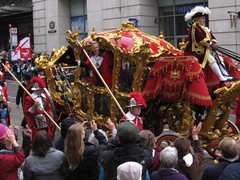 It must be 50 years or more since I was taken to see the Lord Mayor's Show. I remember standing about halfway up Ludgate Hill, not far from the railway bridge that ran acrss the foot of the Hill in those days. The cellars of the bombed-out buildings behind us were serving as carparks (as they did until the City Thameslink station was built not that long ago).
The Show itself hasn't changed that much. The City of London has always taken its status seriously. This is hardly surprising - for centuries it was the one power in the land independent of both Church and King. The Lord Mayor (not to be confused with the new arrival, the executive Mayor of London) may only be a ceremonial figurehead and ambassador for the City, chosen on Buggin's Turn, but the City Corporation, once made up of the trade guilds (livery companies) is still dominated by business votes and safeguards the interests of the financial and business establishment gathered in the enclave of the City, just as it always has.
But the civic pomp is shown in a light-hearted atmosphere. I can remember, all those decades ago, the policeman smiling as a group of teenage boys chanted:
"I'll sing you a song,
And it's not very long -
All coppers are bastards".
This time, I arrived on Ludgate Hill to see a line of coaches with various dignitaries in their robes - waving glove puppets: a Mickey Mouse, a Mr Punch, a Gromit, a lion, a badger, sundry fluffy puppies and a pink inflatable hand.
Then the Household Cavalry led the really grand part of the procession, with the Lord Mayor's ceremonial coach (liberated for the day from the Museum of London); if he was preceded by the royal Life Guards, he was followed by sternly Cromwellian-looking pikemen.
I'd missed the first part of the procession, but caught up with it on its return. Here any and every organisation connected with the City and the new Lord Mayor gets its chance to put itself on show (and some seizing the opportunity for purely commercial advertising). There's a strong representation of all sorts of military units, community and charitable organisations, vintage machinery and bands galore (I never knew there was a St John Ambulance band, but apparently so), flags and bunting, and many floats carrying their own music, with plenty of spectators blowing whistles (which seems to be the thing to do at any public event these days).
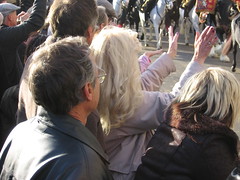 At times the people on the floats were calling out to us to smile and wave, but there was plenty of banter from the onlookers as well: "Where's your boat?" to the watermen marching along with their oars.
But as the pikemen came past for the last time - no band for them, just the repeated click of the musketeers' staves on the tarmac - the procession came to an end with a small group of elderly men, one in a wheelchair, all with medals and banners from the units they'd served in. The whistles and shouts died away, and instead, on the eve of Remembrance Day, there was a soft and gentle wave of clapping.
Wednesday, 7 November 2007
Great Expectations
 It's an odd thing about Dickens - or me - but I tend not to think of him as particularly attracted to railways. You'd have thought his imagination would run wild at the thought of fire, steam and speed; what would he make about the various odd personalities and goings-on that you can see on Mr. Livingstone's Stupendous Tubular Railway - and surely there's nothing more "Dickensian" than the looming pinnacles and turrets of St Pancras?
But what most of us remember is the mythologised pre-railway world of his childhood, all carts and stage-coaches; and, as part of that, the mysterious marshes where Pip meets Magwitch, the convict escaped from the hulks. Dickens names no specific location, but what he had in mind can't have been that far from Eurostar's spanking new Ebbsfleet station. It's all concrete, steel and glass, and - frankly - without any sense of place at all. It might as well have been in Paris, as it has been pretending to be for the purposes of Eurostar's testing of systems on the new high-speed line into St Pancras. Thanks to a tip-off from diamondgeezer (a Stakhanovite of blogging about all sorts of London lore), I was able to get to be one of today's guinea-pigs.
The new line replaces a leisurely tour of the back-garden sheds and washing-lines of south London to Waterloo with a swoosh through anonymous concrete tunnels and cuttings and much briefer glimpses of lines of pylons marching across the warehouses and containers of Rainham and Dagenham. A fine welcome to London: whereas on the approach to Waterloo you see the Houses of Parliament and the London Eye (for quite a long time if there's a queue to get into the station), on the run-in to St Pancras you see nothing of note, and only the briefest glimpse of the towers of St Pancras Chambers at the last minute.
 That said, the new St Pancras is every bit as imposing as the rave reviews say it is.
The "undercroft" space where the freight used to be stored is now converted into the Eurostar check-in and departure lounges, combining exposed brickwork and cast-iron columns with woodblock floors, glass and steel and slate in the fashionable Docklands warehouse look, with plenty of seating, some in an interesting "spine and spur" shape of backless purple leather bench.
This allows masses of space. Even allowing for the jolly, "we're all just acting the part" atmosphere of the test runs, the check-in areas, circulation and waiting spaces are handsomely spacious and airy.
One of the disappointments of Waterloo is that you don't really get to appreciate the ingenuity and scale of the sweep of Grimshaw's roof curling around the rest of the station, because (if you're leaving) you're underground until you need to board or (if you're arriving) you're going back underground within a relatively few paces of leaving the train - and let's face it, the platforms at Waterloo aren't that wide, either, so you feel you have to keep an eye on where your feet are.
 But at St Pancras, you can at one point see the magnificent arch from the lounge area; and on arrival, you have the time (well, admit it, you have a rather long walk) to look up.
Waterloo seems cramped and tired in retrospect - not to mention the Gare du Nord or Brussels Midi. Let's hope St Pancras continues to convey this sense of adventure and comfort.
Friday, 2 November 2007
Oh dear oh dear
Oh Stephen, Stephen, Stephen....
I was so impressed by the lightness with which The Ode Less Travelled delivered some serious learning.
But if Twining's ads were bad enough, what sort of judgment is that jumps on the Christmas commercial bandwagon with voiceovers for Argos..?!
I was so impressed by the lightness with which The Ode Less Travelled delivered some serious learning.
But if Twining's ads were bad enough, what sort of judgment is that jumps on the Christmas commercial bandwagon with voiceovers for Argos..?!
Sunday, 28 October 2007
In my last post I mentioned in the context of the constitutional consultation the idea - that the soldiers of 1647 would have seized on - that the House of Commons ought not just to be a replacement monarch with monarchical powers. Catching up on a book of Leveller texts I bought at the Putney Debates exhibition, what do I find?
In A Remonstrance 0f Many Thousand Citizens - what a title! - (July 1646) the authors complain:
They may not be sending people to prison for having the wrong opinions, or engaging in "fishing expedition" interrogations any more: but there are precious few legal brakes on what the House of Commons might be able to do if a sufficient majority thought they could get away with it, even if at the moment we only face minor nonsenses about priority in queues at Westminster or some eyebrow-raising expenses claims.
In A Remonstrance 0f Many Thousand Citizens - what a title! - (July 1646) the authors complain:
For we must deal plainly with you: you have long time acted more like the House of Peers than the House of Commons. We can scarcely approach your door with a request or motion, though by way of petition, but you hold long debates whether we break not your privileges. The king's or the Lords' pretended prerogatives never made a greater noise nor was made more dreadful than the name of privilege of the House of Commons.
They may not be sending people to prison for having the wrong opinions, or engaging in "fishing expedition" interrogations any more: but there are precious few legal brakes on what the House of Commons might be able to do if a sufficient majority thought they could get away with it, even if at the moment we only face minor nonsenses about priority in queues at Westminster or some eyebrow-raising expenses claims.
Saturday, 27 October 2007
The poorest he and the richest he
 I was brought up in Putney, and on the fact that it has one proud claim to historical fame: its parish church housed the debates, between the soldiers and the leaders of the Parliamentary army against Charles I, that most clearly articulated the issues that dominated debate (in the Anglo-Saxon world at least) about the principles of representation in government for the next few centuries.
 Last night I went to a staging of the key moments in the debates, and the opening of a commemorative exhibition in the church. Actually, given the constraints on space - it is still, after all, a functioning church - it's more of a commemorative cupboard, with half a dozen explanatory panels of text and pictures, and an audio-visual display of extracts from the record of the debates and of various talking heads on their significance. And there's an elegant engraved slate plaque as well.
That's not to minimize the importance of what happened here. In 1647, the Army had presented Parliament with a victory over the King in the first Civil War, but also with a challenge. Soldiers were claiming a say in that great issue that confronts all revolutions: where next? To borrow a phrase from Milton "Progressive, retrograde, or standing still?"
A contemporary shorthand record allows us, uniquely, to eavesdrop on the (more or less?) exact words with which ordinary soldiers argued their fears over the compromises the Parliament was planning to make with the King, for the sake of peace and property, and their belief that God's grant of a victory over the King created a right for all men to a say in government.
Eventually, and perhaps not surprisingly, the process of debate collapsed into repression, as the Parliamentary revolution faced its Kronstadt. As tends to happen to revolutions that require a particular kind of perfection in the people, it fell even further into a military dictatorship which could not long outlast the death of Cromwell.
The issues raised at Putney never went away. If the revolution of 1689 finally settled the primacy of parliament over the monarch, equal suffrage finally arrived in 1832, and universal suffrage in 1928, we still argue over how democratic our system really is.
How appropriate that this has happened at the end of a summer in which The Broon launched a consultation on at least some of these issues. However, if you look at what was proposed in July, it focusses on incremental changes, with a great deal of "could" and "might" about the possibility of a proper written constitution - and absolutely no recognition of the idea - that the soldiers of 1647 would have seized on - that the House of Commons ought not just to be a replacement monarch with monarchical powers.
Thursday, 25 October 2007
More announcement nonsense
As I career down the escalator, it's clear there's a train at the platform: but the crowds aren't pushing to get in, they're just standing waiting. Some of the doors are open, some aren't; the train is quite empty.
Something Is Not Right.
Eventually the platform attendant announces that someone is ill on a train two stations along, and she'll let us know when the trains will be moving again, and whether this train is to be boarded or not. Before she can do so, the doors close and the train moves off empty, leaving a full trainload of passengers, and the new arrivals, puzzled and bemused.
At this point, a cheery message tells us there's a good service on all London Underground lines this morning. Once again, the PR tells us something that is not only not the case, but even if it were true would be of no informational value at all.
Does no-one at LUL have any common sense?
Something Is Not Right.
Eventually the platform attendant announces that someone is ill on a train two stations along, and she'll let us know when the trains will be moving again, and whether this train is to be boarded or not. Before she can do so, the doors close and the train moves off empty, leaving a full trainload of passengers, and the new arrivals, puzzled and bemused.
At this point, a cheery message tells us there's a good service on all London Underground lines this morning. Once again, the PR tells us something that is not only not the case, but even if it were true would be of no informational value at all.
Does no-one at LUL have any common sense?
Saturday, 20 October 2007
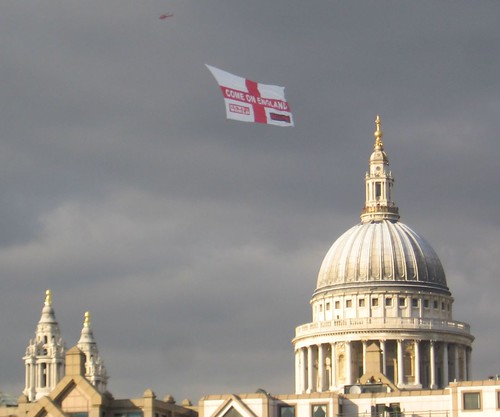 I had thought about going to see the Camouflage exhibition at the Imperial War Museum this weekend. I'd like to say I couldn't find it; but the truth of it is, when it came to it I just couldn't be bothered.
It's the weather. I feel like one of those late wasps that sometimes stumble around in a sudden warmth of the sun in the first chills of autumn, not quite knowing what they're trying to do.
So after doing my chores for the day, I thought I'd see the waxwork of Jonny Wilkinson that replaced Alison Lapper in Trafalgar Square, with some pertinent thoughts about the symbolism. But though the giant St George's Cross flew all round central London, the waxwork seems to have made way for the celebrations of Eid. I couldn't hear much of what the rappers were saying (I rarely can), and I don't like feeling hemmed in by crowds, so instead I settled for home, and the first Marmite crumpets of the autumn.
Tuesday, 16 October 2007
Saturday, 13 October 2007
Shibboleth
 If a nickname is the mark of an impact, then Doris Salcedo's Shibboleth at Tate Modern has made it, and very soon after opening.
A shibboleth is a means of dividing people to identify those you fear or mean to harm. This "division" is an artificial crack in the floor of the main Turbine Hall. The official description points you to the divisiveness of the very concept of "modernity". But if you arrive thinking that the crack suggests that the cultural constructs this massive building houses are unstable (even if its foundations aren't), the experience of it suggests otherwise.
 Despite much discussion over the supposed "mystery" of how it was built, there's no great secret or puzzle to it. The artifice isn't exactly hidden. A section of floor has been replaced by one in which cement render forms the "crack", on a deliberately visible framework of chicken-wire fence-netting: what divides also contains and supports (Good fences make good neighbours, or so I was taught).
I don't think many of the people who came for the spectacle were feeling their foundations rocked, their cultural assumptions challenged, or any particular concern to reconsider their own shibboleths.
Children played their unselfconscious games with it. Tourists assumed their standard "We were here" poses for photographs, as they must have done across the meridian line at Greenwich and outside Westminster Abbey or the Tower, recording their individual presence in the same sort of pose as millions of others. Others were putting their cameras right inside the widest parts for that God-like canyon effect.
 People straddled and probed what must very soon be appearing on the souvenir T-shirts. They were imposing their presence without any visible cracks in their foundations: the consumption of modernity as spectacle went on its merry way.
Tuesday, 9 October 2007
Tubespeak..contd.
Use all the available doors along the platform edge
As opposed to which doors, where?
As opposed to which doors, where?
Thursday, 4 October 2007
Hubble bubble.....
I'm in print. Or, to be precise, one remark I made on a messageboard has been used in a guide book to London. The producers kindly offered to send me a free copy from the US, which arrived today.
A roughly A5-size book, 1" thick, came in a box 14"x11"x5", complete with enough bubble-wrap to fill the space and sixteen (count 'em) sheets of documentation. Among them, just to reassure, is a written confirmation that the package contained no unauthorized explosives, destructive devices or hazardous materials [unauthorized?] - complete with a photo of the person signing and a sticker to say that Random House authorized the rather fed-up looking woman in question to sign.
And I have to wonder - is any of this remotely likely to prevent anything - apart from unemployment in the packaging and bureaucratic nonsense industries?
If I let it get to me, I might need to start popping bubble-wrap as therapy. I've got plenty of it, after all.
A roughly A5-size book, 1" thick, came in a box 14"x11"x5", complete with enough bubble-wrap to fill the space and sixteen (count 'em) sheets of documentation. Among them, just to reassure, is a written confirmation that the package contained no unauthorized explosives, destructive devices or hazardous materials [unauthorized?] - complete with a photo of the person signing and a sticker to say that Random House authorized the rather fed-up looking woman in question to sign.
And I have to wonder - is any of this remotely likely to prevent anything - apart from unemployment in the packaging and bureaucratic nonsense industries?
If I let it get to me, I might need to start popping bubble-wrap as therapy. I've got plenty of it, after all.
Tuesday, 2 October 2007
Not even bronze
I have to hand it to TfL, they replied within 48 hours to my email about station announcements, along the same lines as my rant here.
However, despite my asking for a reply that didn't just seek to soothe my irritation, but actually answered the point I made, they went for the standard "customer management" response:
Well, I did get in touch. Two weeks ago - and not a dicky-bird in reply to my basic point: that using the PA too often switches people off and they don't listen. Only use it when something out of the ordinary is happening, and they will - unless LUL has evidence to the contrary, but this reply rather suggests no-one's collected any.
I've often thought there ought to be a Society for Halting Unnecessary Transport Undertaking Pronouncements (geddit?), but I don't really have the energy to do more than whinge, like most commuters. Until now. I'm really thinking about it.
However, despite my asking for a reply that didn't just seek to soothe my irritation, but actually answered the point I made, they went for the standard "customer management" response:
Thanks for your recent feedback for about the use of PA messages at Canary Wharf station on 18 September.
We've been reviewing the type and frequency of messages that are broadcast at our stations and have developed a new set of guidelines for staff when making announcements. These guidelines will be disseminated to front line staff over the next few weeks and should result in a reduction in the frequency of announcements.
The changes are focused on giving customers the information they are most interested in - factors affecting their journey - without overloading them with information. Service information - to tell customers if there is a good service, delays or a suspension - will still be the most frequent type of message, but will in most cases be no more than once every five minutes.
Non-service announcements will also be reduced in frequency, with announcements from each category to be made no more than once an hour. The categories are:
* Housekeeping (no smoking, no photography etc)
* Marketing (Oyster pay as you go )
* Safety & security (CCTV, personal belongings etc).
We have also emphasized that consideration should be given to residents and note that these guidelines are not to override any local agreements with residents, for example the quiet period at Earl's Court.
While there may be times when more frequent announcements become necessary for safety reasons, these new guidelines should ensure that customers get the information they need while reducing any impact on residents.
I hope you notice a positive difference to our announcements in due course.
Do get in touch if I can be of any further help.
Well, I did get in touch. Two weeks ago - and not a dicky-bird in reply to my basic point: that using the PA too often switches people off and they don't listen. Only use it when something out of the ordinary is happening, and they will - unless LUL has evidence to the contrary, but this reply rather suggests no-one's collected any.
I've often thought there ought to be a Society for Halting Unnecessary Transport Undertaking Pronouncements (geddit?), but I don't really have the energy to do more than whinge, like most commuters. Until now. I'm really thinking about it.
Subscribe to:
Posts (Atom)