This must be my week for being prompted by other people's blogs. Way back in January, Urspo referred to the idea floating around the internet about men's thoughts on the Roman Empire. I can't say I have many, although I went to the kind of grammar school that gave you plenty of Latin (and a low tolerance level for bloody Caesar throwing yet another bridge across yet another river), but seeing that the British Museum had an exhibition on life in the Roman army, it would be foolish not to see it.
Another daunting queue to get up to the security check, though having a timed ticket for the special exhibition got me priority (and when I came out - around noon - there was no queue at all, for whatever that tells you). Once inside, though there was plenty of room for everyone, and separate children's activities which kept the visiting primary school party busy away from the rest of us.
There were a few items I have actusally seen before on a visit to Vindolanda - leather shoes and sandals, and some writing tablets (what sounded like the equivalent of the "Colonel's lady" inviting a friend to a birthday party, and a list of supplies to be ordered) but so much more, about recruitment (pretty selective, and it helped to have contacts: also, soldiers had to provide their own arms and armour), training (tough), living conditions (also pretty tough if you were on campaign), health (tricky - disease and poor food were all too common), leisure, and the prospects of survival into retirement rewards (citizenship and pensions). Some of that might not be too different from almost any military, though presumably the Romams were the first that we can see how they systematised it all.
Not the kind of shield the ordinary soldier could afford
Not Mussolini but a military standard featuring the Emperor Galba - until he met the same fate as Il Duce
Another standard - the "dragon" which also made what was supposed to be a fearsome sound
On campaign: constantly pitching and striking camp with tents made of goatskin and wooden tent pegs
On campaign, poor hygiene and disease were a recurrent problem - here's a portable medicine box
No qualms about enslaving their prisoners (if they took any), or about glorying in booty
Leisure time - gambling (of course) but to prevent cheating the black box is designed to randomise the casting of dice
Opportunities for fun for kids of all ages
Wednesday 24 April 2024
Mr Mago asks, à propos my last, what happened to the organ of Notre Dame in the fire. By coincidence, I've had a good insight into that, from finding a reference to Westminster Abbey hosting a virtual reality exhibition from Paris about cathedral's place in history, the fire and its consequences.
The good news is that the organ escaped the fire, but not the lead-contaminated dust from the collapse of the roof, nor the water. So there's been a complete dismantling, cleaning, re-assembly and re-voicing. So it will resound again.
Not doing touristy things that often around London, I was a bit surprised by the long queues to enter the Abbey, and by how crowded it felt inside. But then, the last time I was there I was a child, so of course it all felt smaller and - dare I say it - somewhat cluttered.
In fact, they've made room in the roof spaces for more clutter, in the Diamond Jubilee Gallery of incidental artefacts - among them the funeral effigies of a number of monarchs (probably the nearest we'll get to an unprettified portrait of some of them).
As for the Notre Dame display - ingenious (well, it's French, after all): a tablet computer that picks up the code for a particular display and presents you with relevant images and 3D animations from various points in the Cathedral. So you're not all crowding round the same display case, or tied to a particular route or speed through the exhibition.
And I don't need to make a trip to Paris to see it!
so to mark the occasion, here's a very grand organ - and the Toccata from Widor's 5th Organ Symphony
Sunday 14 April 2024
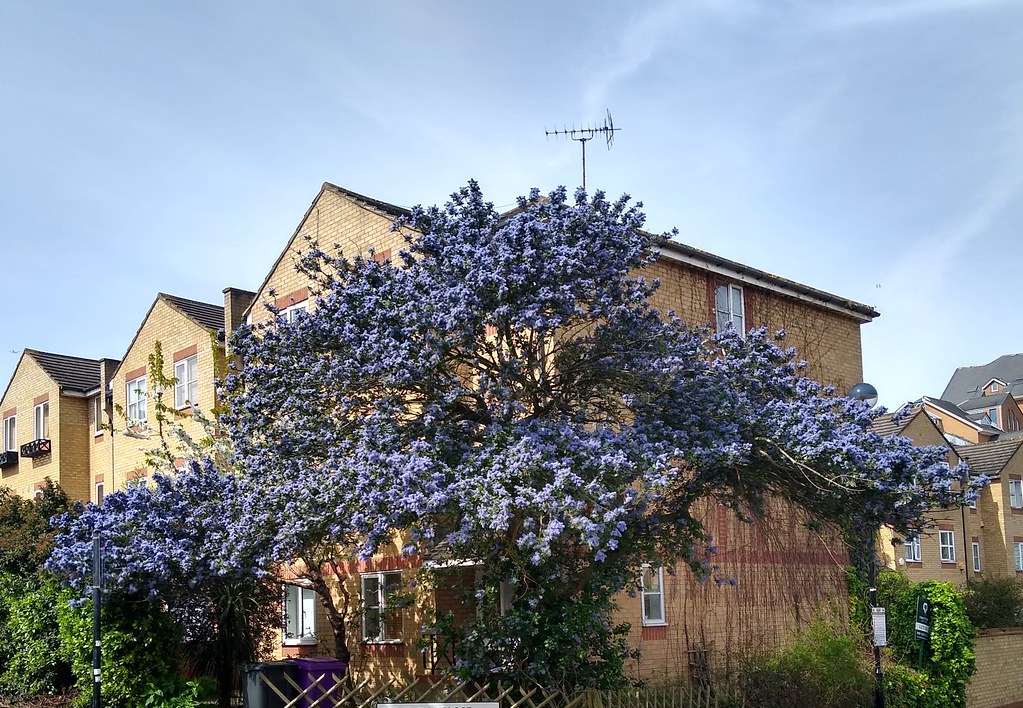
It only takes a day or two of warmth and sunshine and suddenly all the trees in the neighbourhood seem to have woken up together. This ceanothus has been there as long as I can remember, and has obviously had a tidy-up there used to be branches hanging down a lot lower.
Monday 8 April 2024
Click to see the what, when and where - and what one must and mustn't do
It's election time again, this time for local government in London and a bunch of other cities, though since there must be a general election by next January, this will inevitably be taken as an indicator of whether the government really is staring into the abyss the opinion polls suggest.
As ever, we get this handy formal notification of when and where to go, and the essential rules.
But this year there was also a colourful leaflet reminding us that we now have to take photo ID with us to the polling station. There's a long list of suitable documents, of which I have at least three, so it won't be a problem for most people who don't forget to take it, but one does have to wonder whether it's really necessary.
I can't recall any cases where people have been prosecuted for impersonating someone else, let alone where it would have made any difference to the overall result. If you think about it, the effort of identifying people on the register who could be plausibly impersonated and then recruiting other people to pretend to be them just doesn't look remotely likely. These days, getting enough people to go out canvassing and leafleting seems to be more and more difficult for the parties.
This rule was applied to last year's local elections in other parts of the country, and it looks as though at most 10,000 people across the country were turned away and didn't come back, or in effect a handful of votes in any one election.
As it happens, my polling station is in the primary school just over the road, so voting just requires a slight diversion from my normal route to buy my morning paper.
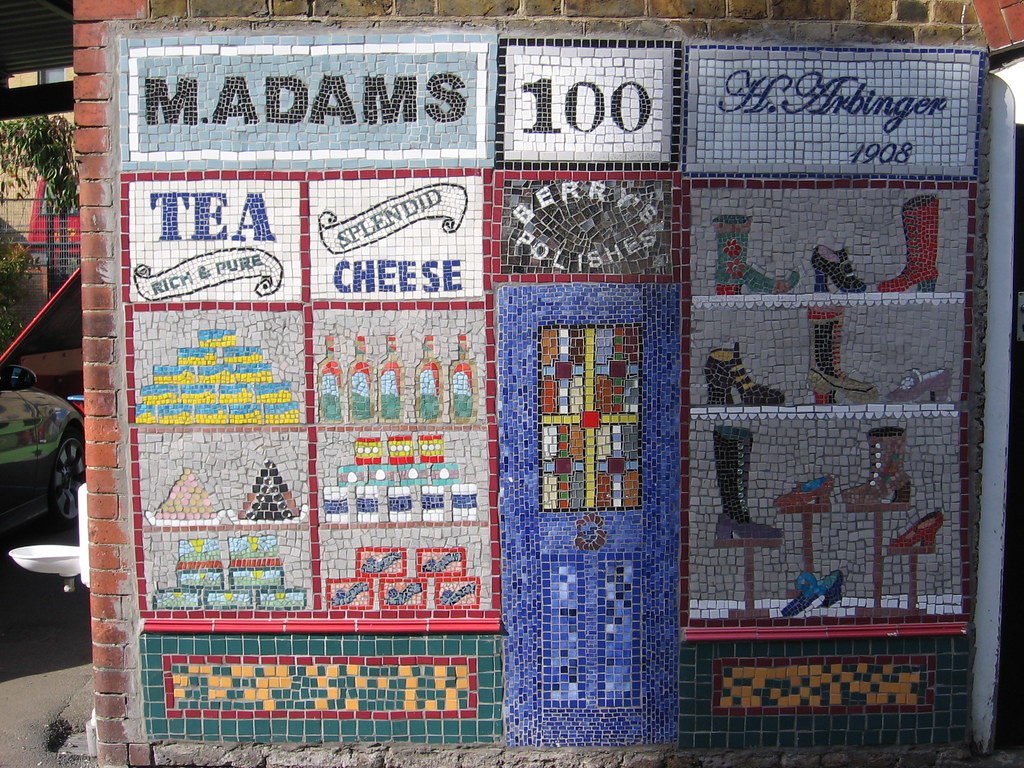
It's also a chance to admire this mosaic in the playground, and the children's artwork on the walls once inside (briefly, given how quick the actual process is).
And then it's back home for breakfast, civic duty done.
Monday 1 April 2024
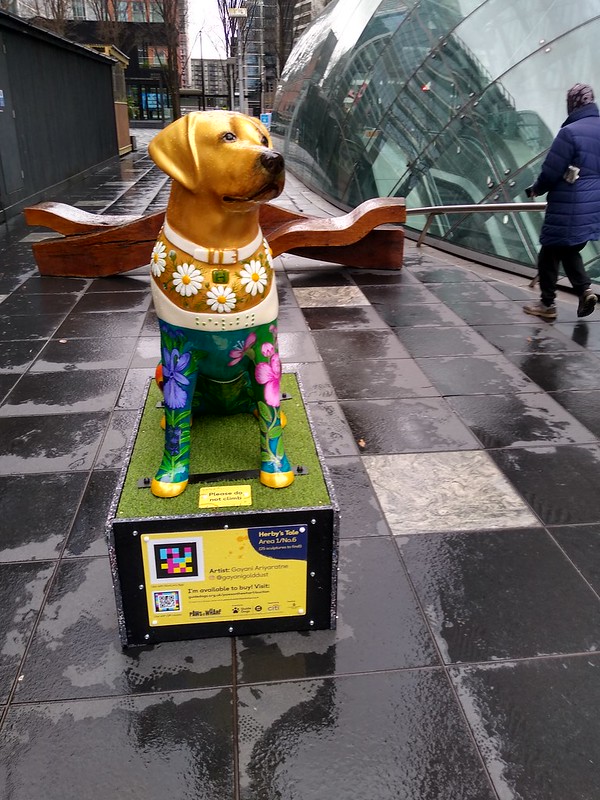
Always something new to look at up at Canary Wharf - currently a promotion for Guide Dogs for the Blind
My trainspotting days are long gone, but they were in the age of steam, and something remains of the appeal of the steam engine which quiet, efficient electric trains just don't seem to have. Our group had a strong contingent of serious anoraks, who knew a great deal about all that sort of thing and enthusiastically took up the option to explore as much as possible of the Harz network, with the rest of us tagging along for a couple of rides with the better views. (It wasn't just the engines that were old - the carriages were, I suspect, old third-class stock from East German railways - wooden seats and not much in the way of suspension, while the toilet facilities were the old-style trap that simply opened on to the track beneath).
The high point (literally) of the trip was to go up the Brocken mountain. Old legend has it that on Walpurgisnacht, witches would gather on the mountain for a "witches' sabbath" (sort of a springtime Halloween, but no doubt used in its time for the periodic persecution of supposed witches, as elsewhere). More recently, being such a handy high point so close to the border between East and West Germany, it became a listening post for surveillance and spying on Western transmissions, but also housed (as it still does) a TV transmission tower.
The train winds its way up through forests (sadly depleted since a blight struck much of it a few years ago, as did some wildfires) to the - frankly rather bleak - plateau on top. Perhaps not surprisingly, the views from the top were almost entirely of enclosing clouds, so nobody wanted to linger.
Another day, we had more sunshine and a gentle ride through a river valley, to a quiet spa town and back.
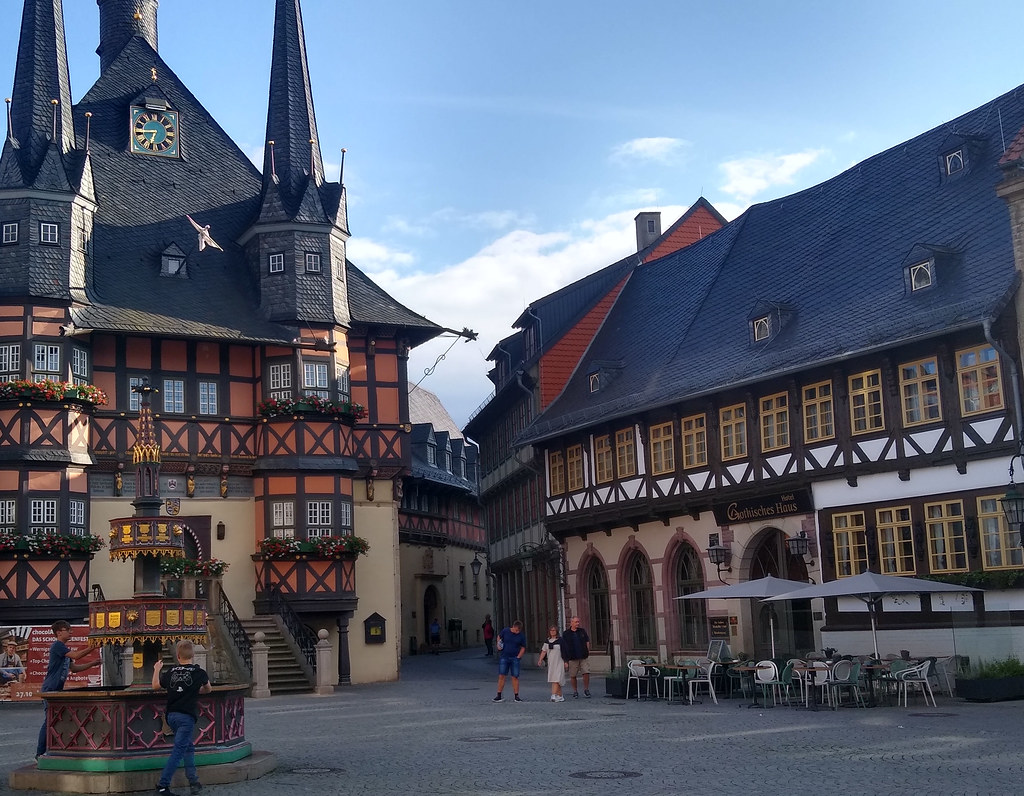
As if Wernigerode weren't picturesque enough, our itinerary took us to Quedlinburg, an ancient town seemingly undisturbed (at least in its historic centre) by the ups and downs of much of Germany's history.
Half-timbered houses lining narrow winding streets (all remarkably uncluttered by modern street furniture and signage) and ornate doorways - we didn't get to see the castle, but it's easy to see why it's a tourist magnet.
After our brief stop to ride the Schwebebahn, the trains took us to our base for the week, in Wernigerod: in the heart of the Harz, so to speak.
It's picturesque and traditional-looking, with plenty of half-timbered houses and flowers (it even has a floral clock, just as one used to see in the posher British seaside holiday resorts).
Is it a bird? Is it a plane? It's outside the library, at least
Wien! Wien! Nur Du allein...
And there's a castle (of course). The local aristocrats had a long history, but their castle reflects a rebuild in the ponderous taste of the late 19th century - all dark wood and stuffed hunting trophies outside, and touches of pseudo-mediaeval fairytale outside:
The castle courtyard
One thing I couldn't help noticing was that in at least one place they had retained the old East German Ampelmann for the pedestrian crossing lights. Somehow he looks rather jollier than one would expect from a Communist dictatorship, which is no doubt why he was held in such affection:
But they also maintain a nod to the area's association with legends of witches and the like:
Last year wasn't all lethargy. I'd been playing with ideas of training it deeper into Germany than I have so far, tempted by a new night sleeper service from Brussels all the way round to Prague, stopping en route at, among others, Bad Schandau in the "Saxon Switzerland". As a student in 1969, unexpectedly given grant to travel, I planned to stay there as part of a trip around the then East Germany, only to find that the authorities wouldn't allow it, for no specified reason: that hadn't stopped me taking a day trip there from Dresden, but the opportunity to stay there now looked attractive.
However, that sleeper service wouldn't start until this year, and looked expensive; while dithering about whether and where to stop overnight en route by day trains, somehow F*ceb**k kept serving up adverts for (you'd be surprised how many) companies offering train-based guided trips.
One that caught the eye was to the Harz in the dead centre of Germany (but once divided between East and West), where there's a network of steam trains, one going up to the Brocken mountain, famous in literature for witches and the like. The itinerary had us stopping for a night in Wuppertal, not the most scenic of the Ruhr's industrial towns, but among transport enthusiasts, Wuppertal is famous for its "Schwebebahn" (floating railway) - suspended from a monorail high above the river and streets below.
Once on board, it's as prosaic as any surface tram ride, bar a little tilting, and it's not as though there's much to see, but it's a useful way of whisking people along without taking up road-space:
Just recently, thanks to the wonders of the internet, I found a commercial I saw just the once decades ago, but which really stuck in the memory. It turns out that it dates from 1989, and it's been judged worthy enough for the British Film Institute to archive it.
Over lethargy, lassitude and can't-be-botheredness, that is. A couple of cupboard doors coming off their hinges (and built into a corner where each makes the other only approachable at an awkward angle), and a collection of old pillows and other things to take to the recycling centre: classic "round tuit" jobs louring in the background of whatever else has been on my mind. For months, I must admit.
But finally grasping the nettle, I find that those cupboard doors weren't that much of a problem - less flimsy screws fixed them firm again in half an hour. And a rare sunny day today was just right for getting out the bike to take those pillows and other things to their next destination.
Quite why such things created such a fantigue - well, that's another question.
Most of the developments round here have plenty of hardy shrubs along the street frontage. One was getting particularly overgrown, and had a radical, even brutal haircut in the autumn (on the principle, no doubt, that managing plants means sometimes being cruel to be kind). Most of them are rather dull, but this one has bounced back with one of the earliest spring flowers (already!):
Meanwhile, a few streets away, on an equally blank spot that gets full sun (when there is any), there's a snowdrop out. Spring is on its way.
It being a dank and rainy evening for Guy Fawkes night, cocooning with the curtains drawn, and the TV on - as it happens, a documentary all about those barrels of gunpowder underneath the House of Lords, and all the rest. The distant whooshes and booms of fireworks some brave souls were letting off despite the weather seemed a good long way away. Until some came very loud and seemingly very near. I wondered if it was someone on their balcony upstairs. but this morning, it appears that some bright (?) sparks (see what I did there) had decided to look for somewhere dry for their fireworks - like the garage on the ground floor of this block.
Yes, the garage. Containing a fair number of cars - with petrol tanks.
Luckily we're all still here. And they probably didn't realise they were on CCTV.
Whether we'll hear any more about it, who knows? I'd better check my insurance, but in the meantime here are some much safer fireworks from, well, some years ago