Heron Island, Great Barrier Reef, Australia

Saturday, 4 February 2012

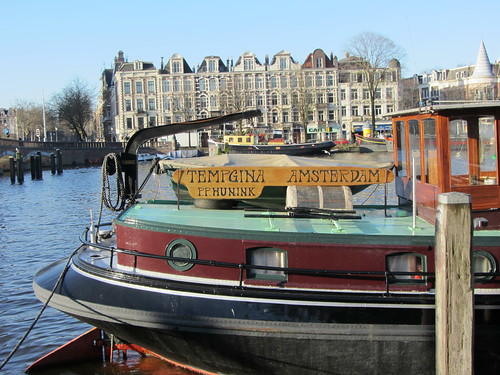
A weekend in Amsterdam (5)

Some last incidental details that caught my eye:

It pays to look up: as Amsterdammers of the Golden Age found it more tax-efficient to build up rather than sideways, the tops of their houses repay study, not just for the hooks on the gables to hoist up goods and furniture (I once spent a quarter-hour or so engrossed in watching a committee get a fridge up to an attic), but also for some "statement" gable decorations. Is that, I wonder, why even a low-rise modern suburban house may have a decorative figure attached almost to the eaves rather than nearer eye-level?

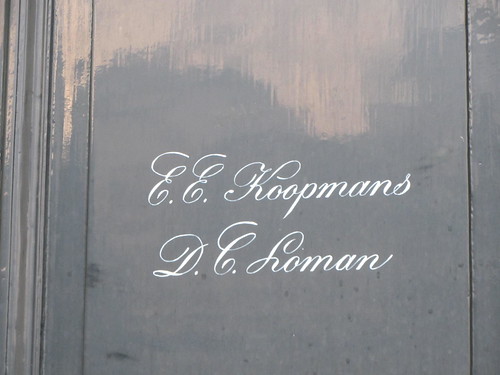
But it also pays to look nearer ground level, at the front doors. Even security can be decorative, in a restrained sort of way - so a grille includes the figure of an inquisitive doorkeeper, and a spy-hole has its own little lace curtain. And, much more impressive than any nameplate or little bit of paper next to the bell is the custom of having the residents' names beautifully signwritten on the front door - a sign of commitment to stay. I seem to remember seeing more of these in the past - perhaps it's a dying skill or it's too expensive now, or perhaps people move around more.

And here are some other impressions in movement and sound:

Friday, 3 February 2012

A weekend in Amsterdam (4)

I wouldn't want you to think I totally neglected kulcher on this trip. There were a couple of museums I've not visited in the thirty years or so that I've been going to Amsterdam.

One was the Tropenmuseum, originally devoted to the wonders of the Netherlands' overseas empire in Indonesia and the West Indies, but now expanded to include the cultures and environment of the tropics generally, in Africa, Latin America and South Asia, focussing on changes resulting from development and interaction with new ways of living. Alongside that are regular art installations and events on similar themes. Even though the content is more contained than its equivalent in Paris, the Quai Branly, it could be just as exhausting - it would repay an early start and a leisurely tour.

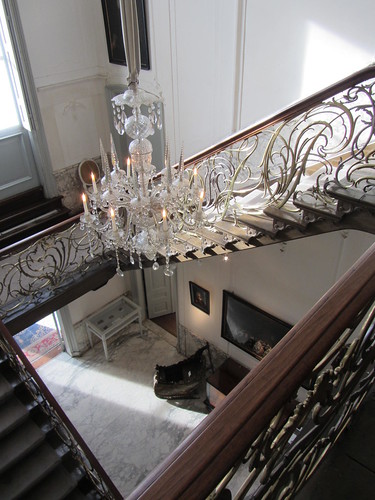
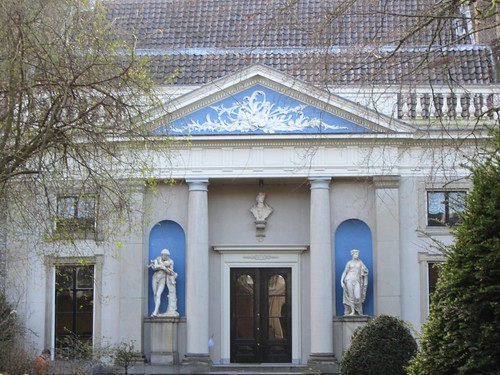
Another is the Museum Van Loon, an imposing canalside residence restored to something like the style of its wealthy 18th century owners, but full of mementoes of successive families living there. It's a slightly odd mix of a very Dutch worthy restraint and the opulent, as the pictures below would suggest. The grand staircase is in largely unadorned marble; but the very last picture shows not the main residence but - the coach house and stables.

Thursday, 2 February 2012

A weekend in Amsterdam (3)

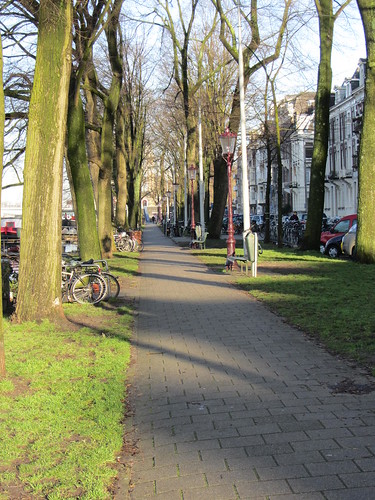
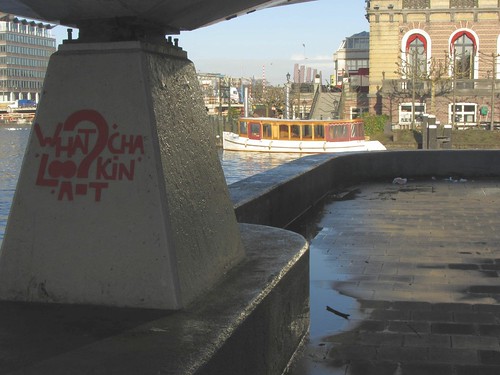
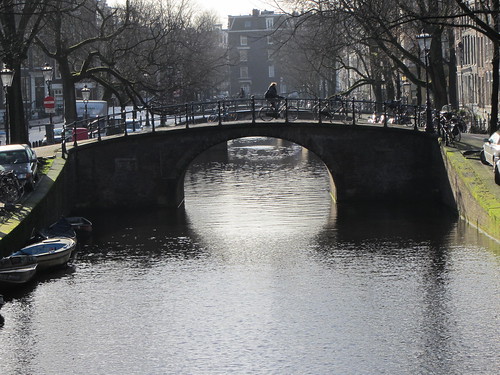
Though the weather was cold, it was occasionally sunny enough to encourage walking, something Amsterdam's waterways are ideally suited to.


Wednesday, 1 February 2012

A weekend in Amsterdam (2)

A trip to Amsterdam isn't complete without a visit to the Tuschinski Cinema.

Its domes dominate an otherwise unremarkable small street, and inside the decor is... well, unique. I suppose one could summarise the style as Ballets Russes meets Scandinavian Gothic. Or possibly not.

It is possible to take a guided tour of the architecture and the restored decor, but it is an experience in itself just going to a film in the ordinary way, especially in the main auditorium, or even just to have a coffee in the foyer, watching the ceiling lights cast changing colours over the already over-the-top painted patterns on the ceiling.

Nor is the uniqueness of the experience confined to the decor. For one thing, I have known the main evening performance to include an interval halfway through the film at what seemed to be a somewhat randomly chosen moment. For another, there's the stereophonic experience of watching an English-language film in a city where so many people are virtually bilingual - half of them getting the joke as it's delivered on screen, the other half catching up as they read the subtitles.

Neither of these quite applied on this occasion. The film was an early showing in one of the smaller modern rooms, and it was (largely) silent. It seemed only appropriate to the spirit of the building to see that hommage to the Hollywood of the 1920s, The Artist.

Thursday, 26 January 2012

A weekend in Amsterdam (1)

If postings have been a bit sparse recently, one of the reasons why has been a burst of early spring-cleaning, to get the flat ready for a weekend exchange with someone in Amsterdam. There's nothing like trying to see your own space with someone else's eyes for spotting scuff-marks and wonky cupboard doors that you've taken for granted for too long: and sorting all that out needed an extended plan of campaign.

Well, that's my excuse.

I've been to Amsterdam often enough not to be rushing around the regular sights; this time I was noticing more interesting details.

Take the cycle culture, for example. Bikes are used everywhere, and accumulate in drifts wherever there's a railing to chain one to (you've only to look at the 2500 place - count 'em - multistorey bike park at Central Station to imagine what Amsterdam would be like if cars were used as widely).

But these are mostly rather different bikes from what we see in this country or elsewhere. It's easy to spot the specialised work-bikes, with a handy box (at the front, rather than behind) for small children (once they're past being perched on a extra seat in front or behind the rider) or quite substantial freight; but it also dawns on the observer that very few are anything like racing bikes or mountain bikes (nor does anyone attempt to dress up in special cycling gear, let alone a helmet). On closer inspection, "city bikes" or "grandma bikes" turn out often to have only the one gear (it may be a flat country, but there are some impressive hump-back bridges), which makes it easier to instal a complete enclosure around the chain (that must save on the cleaning - I'd want one, only it wouldn't fit on my bike).

But, lest you think the cyclists have it all their own way in Amsterdam, here's a sign of the times, just outside where I was staying: a recharging point for electric cars.

Sunday, 22 January 2012

Mysteries

As it happens, my flat is over the entrance to our communal garage, so there are plenty of people passing under my window, which has an exposed cast iron lintel to which my window-railings are attached. I wonder who decided - and why - it would be a good idea to jump up and attach this particular fridge magnet (cute but not my style).

Then again, there's the ongoing mystery of the thought processes behind packaging, audit trails and security. I've just received a free guidebook (handy for the incoming home exchange partners next weekend) , as a reward for providing some quotable information on the publisher's travel messageboard. Just an ordinary A5-sized guidebook to London - and packed in
- a box measuring 14"x11"x5"
with
- 13 (count 'em - thirteen) sheets of documentation
and
- 5 square feet of jumbo-size bubble wrap (enough to keep a fetishist in ecstasy for, ooh, an hour or two):

Saturday, 21 January 2012

Petard-hoisting time

I see that the proprietors of the Daily Mail and other fishwrap have lost their claim to the courts that the current judicial enquiry into press ethics, phone-hacking and the like should not allow for anonymous evidence from journalists. Apparently they claimed that newspapers risked being "reputationally damaged" by "untested" claims from journalists. What business do they think they and their like have been in for decades past?

Tuesday, 10 January 2012

Mr. Latif

What with email, Facebook and such, postal deliveries are a sad disappointment these days. Some bills still come on paper, as do begging letters from estate agents (not quite so frequent at the moment, but where I live is still, as they say, sought-after) and flyers for takeaway pizza and curries from implausible distances away (somehow I doubt there's much measuring of cost-effective performance in their marketing: as the old saying has it, half the advertising budget is a waste of money, but it's impossible to tell which half).

But among the dross this week was a bit of a novelty. I'm not surprised, in the more African-influenced parts of Paris, to have a flyer shoved into my hands advertising the services of some miracle-working marabout (no, not a marabou, that's to do with frou-frou feathers): but not here. Though there are people from Francophone Africa round about here, they stand out by their relative rarity. Perhaps whoever left this particular flyer assumed that everyone who lives within sight of Canary Wharf works in the kind of bank that needs a miracle, or suffers from the kind of magical thinking that believes everything they're told by some chancer waving a shiny derivative.

Howsomever, Mr. Latif has kindly arranged for us all to be informed that
Your entire problem will be fulfilled in SEVEN DAYS. For example: business, financial, career, depression, separated from the person you love, domestic problems regarding husband, wife, children, health, exams, court cases, immigration, studies and sexual impotency or any other problems. Physical sport improvement, to be high rank, to be a winner. JUST ASK?...........Latif's work is 100% guaranteed, breaking black magic and evil spirits in 48 hours.
And in case there's the faintest smidgeon of scepticism left in anybody's mind, he reassures us with the signoff
THE RESULT: Believable
But here's the thing: somehow his miracle-working hasn't extended as far as getting himself out of Canning Town.

Saturday, 7 January 2012

Oh yes it is!

Cinderella, Sleeping Beauty, Jack and the Beanstalk, Dick Whittington - but a panto based on, of all things, Beowulf?

Well, yes. Over a pub in the canalside no man's land between Islington, De Beauvoir Town and Haggerston*, half a dozen singer-actors, a couple of pianists and a drummer delivered an evening complete with all the usual cross-dressing, corny gags, double entendres, sweet-chucking, custard pies and audience participation, interlarding a collection of songs stretching from Eminem to Singin' in the Rain, via Sondheim and Les Miserables (and the faintest dash of Wagner) - and not forgetting a chorus of muppets.

After all, if Jack and the Beanstalk can include a man-eating giant, why not a panto with the fearsome monster Grendel (especially once Beowulf has rendered him 'armless)? And one has to admit, as Grendel's mother, Angelina Jolie didn't offer the prospect of as many laughs (well, not intentional ones) as does a pantomime Dame (and this was a very good one - though how many Dames are lined up for a Wigmore Hall recital, I wonder?).

And, by the way, this particular outing was chosen by some American visitors I know through an online forum, who'd been persuaded that they ought to see a panto while they're in London. None of the Londoners in the group knew anything about it.

*Come to think of it, that's just about where this sort of thing's to be expected.

Tuesday, 3 January 2012

Signs of progress

It's a while since I walked over to Greenwich. Yesterday's visit showed the riverside building works still going on: some permanent terminal-style buildings for the ferry pier and, of course, the restoration of the Cutty Sark. She, at least, is ever more visibly on the road to re-opening; the protective boarding around the site now replaced by mesh fencing, the roof of the new exhibition space underneath her now in place like a solid bow-wave, and the first stage of reinstallation of masts and rigging:

It seems to be taking forever to finish the work on the foot tunnel however. The lift/staircase shafts are boarded over as they have been for months, and little or no sign of whatever they plan to do with the wall surfaces in the tunnel itself. Instead, everywhere is covered in warning signs:

Saturday, 24 December 2011

A rather quieter reminder of snow: some photos of last year's white Christmas with a bell-like version of something seasonable, by an uncharacteristically restrained (and all the better for it) Liszt:

Friday, 23 December 2011

Just to make sure of a little show of snow this Christmas, here's a video card from a remote Inuit village in Alaska (it was all the rage some time ago, but I've only recently become aware of it - and yes, they have been told about the apostrophes):

Thursday, 15 December 2011

It's no good: there just doesn't seem to be a way of shaking off the idea that, whatever I'm doing, I ought to be doing something else. Never mind the reminders in my phone diary (what? use it to talk to people? how very last century), there's a nagging feeling that there is something else, planned or promised, that I've somehow forgotten to do, and that there will shortly be some sort of "Oh heck!" moment, or a puzzled "Where are you?" phone call. Or worse.

Of course, there are always odd chores awaiting the acquisition of A Round Tuit, things that could be a bit cleaner or tidier or neater, the cupboard that threatens to brain me with an avalanche of clutter, the buttons that look a bit loose, the accumulation of half-read magazines and books, not to mention the computer that's running out of memory (dare I risk deleting stuff off it and relying on the external hard drive?).

But those I know about; and almost everything Christmas-related is sorted out. This is something much more nebulous: a common feeling when I was a middle manager, and you never knew what Damn-fool Wizard Wheeze from top management, or crass error from an underling, might land in the in-tray - but now, when there's no particular reason to do any particular thing on a particular day?

Perhaps I just don't have enough to do.

Thursday, 1 December 2011

More old friends

The regular return of an old friend featured in a post last Easter.

Now that the seasons have turned again, it's the Christmas cactus that has put out its improbably neon-coloured flowers, as it has done without any special attention for decades, first in my parents' house, now with me. The container it's in is also a hand-me-down, probably from a generation further back: in my memory, that deep, rich blue was always somewhere in the background or a corner of the view.

Time for it to take centre stage, for a change.

Wednesday, 30 November 2011

It being St Andrew's Day, today is the time to dust off one's distant Scottish ancestry. In the true spirit of parsimony (and soft Southern laziness), I offer you someone else's creations to mark the day.

From the symphonic (I hear pre-echoes of Sibelius in this, but maybe that's just me):

to the traditional (at least for Gaelic-speakers, which I am not) - the band is Capercaillie, the singer Karen Matheson, and to mark the Auld Alliance, the photos are taken by some really skillful French people (how come it never rains in other people's photos?):

Monday, 28 November 2011

Autumn colour (2)


No self-respecting bird has any excuse for missing the invitation of these blazing red berries. I assume we can expect to see plenty of seedlings from this tree in the future.

Whether it's a measure of the late warmth we've been having, I don't know, but the tree's immediate neighbour, a ceanothus which flowers profusely for a couple of weeks in May, seems to have decided to compete, however feebly, with a few tufts of blue flower:


Sometimes autumn can be just too abundant:

Sunday, 27 November 2011

Perhaps she didn't intend to comment on the weather, but as I came out of Canary Wharf underground station into this afternoon's cloudless sky and balmy sunshine, the perky jazz singer busking by the escalators swung into Summertime. The nip in the breeze soon belied her; though there's usually a fair breeze swirling around there, today it was strong enough to set pages of a dropped newspaper performing aerobatics way into the air, indeed it had woken me overnight.

As it happens, my explorations of old photo negatives have turned up the aftermath of another windy night. At the time, I didn't notice more than that what turned out to be the Great Hurricane of October 1987 was a bit loud. Perhaps the unusual warmth in the late evening air beforehand should have been a warning; but it wasn't till the light-switch didn't work the next morning that it registered with me. My battery-powered radio told me there were no trains or underground, but I thought I ought at least try to get into work. There were buses running, on a route that got somewhere near (after the bus had inched its way around fallen trees and fire engines). Needless to say, hardly anyone else had made it in, nor were the phones working, or the power for the limited word-processing machines of the time (a computer all to oneself? on every individual desk? are you mad?), or indeed the lights. So we kept up a token presence in case anyone came to ask us anything, and went home before it got too dark.

By Monday, of course, everything was more or less back to normal in London (and even the "why oh why" brigade had realised that there wasn't much mileage in insisting that They Should Have Done Something). But it was a strange weekend, discovering what damage had been done in the neighbourhood [of course, I realise this is trivial to people who've suffered real hurricanes, but our weather usually keeps within the bounds of a modest sufficiency, and this was a once-in-a-lifetime event]:

Friday, 25 November 2011

Incey-wincey

Enjoying the morning sun over a cup of tea in my living-room, I caught an unexpected glint in the corner of my eye. From about halfway up one wall beside the window, fully four feet down to the handle of a hardly-used magazine basket, two threads of spider silk were catching the light. Not that I've noticed a spider (or a fly, come to that, recently), but one has obviously been industrious.

Unlike me, at least as regards the dusting department. Instead, I've been busy with, among other old photographs, this spider web from forty-odd years go in my parents' garden:

Thursday, 24 November 2011

Scanning past horizons

Chania HarbourOne of my big retirement projects is to digitise all the old photos piled up in boxes in my cupboard of clutter and mysteries. Seizing the first box to hand the other day, I found myself ploughing through assorted negatives from the 1960s onwards.

Although there are as many individual images as I'd imagined, it's always surprising how few are really worth looking at again.

There have been some finds of moments and people I'd completely forgotten about; and scanning from the original negatives has, after some digital jiggery-pokery, brought to life images that, in print, have faded (like these of Crete in the mid-1970s), or brought out usable detail out of those that looked too dark or badly-composed. But there's been a sight too much "Who the heck is this, and what was the point of taking that?".

Each new packet reminds me of the limitations of pre-digital photography: having to make your own judgement about setting time and aperture for the light and film-speed - and then having to wait for days, or even weeks, to know whether you'd got it right, which (combined with the cost) meant taking fewer photos in a week on holiday than in a few hours today. It also meant filling in with often pointless test exposures at the start of the film as you wound it securely on, or to fill in the odd handful left on the end of the roll (unless you'd tried sneaking in "just one more" and found only half of your best shot because it was right at the end already).

Most unexpected is the incidental recognition of changes in the otherwise unremarkable sights that don't exist any more. Here are pictures from the 1960s, of the Thames riverside where I used to live, about as far west of central London as I now live to the east.

Driftwood washing up on each tide was a normal sight. These must have exceptional accumulations, with the piles built up outside the rowing clubs to be burnt off rather than risk them floating off on the next tide and damaging the boats (and my father wasn't too proud to collect driftwood on a home-made trolley for firewood at home from time to time).

Nowadays, it's not only clean air laws that prevent all that from happening. The inlet in this picture is now cut off from the river's tides by subsequent flood prevention works, and incorporated into a local park. But it wasn't till I saw these images that I realised we never see driftwood like this any more, no doubt for the same reason that I'm able to live where I live now. With the docks moved down to nearer the coast and everything arriving in containers, and with the riverside warehouses and factories replaced by housing, broken-up crates and pallets and stray baulks of timber are no longer ending up in the river and washed right through London to the western suburbs.

Sunday, 20 November 2011

Autumn colour

The unusually warm weather has been producing some odd sights, and I don't just mean the people still risking T-shirts (not exactly a sign of hardiness in yesterday's sunshine). Cycling home from the supermarket, I was distracted by a butterfly dancing out of some hebe bushes in full purple flower; and my window-boxes refuse to take any seasonal hints. I still have lobelias, and the odd fuchsia and geranium, clinging on.

Whether it's something in the climate, the geology or the biochemistry of our native trees, we don't usually have very dramatic autumn colour, but the sunshine yesterday made even the fairly restricted colours on our local plane trees look more than little interesting (you can also see the following photo as a jigsaw puzzle, in whatever level of annoying complexity you choose: enjoy!):